
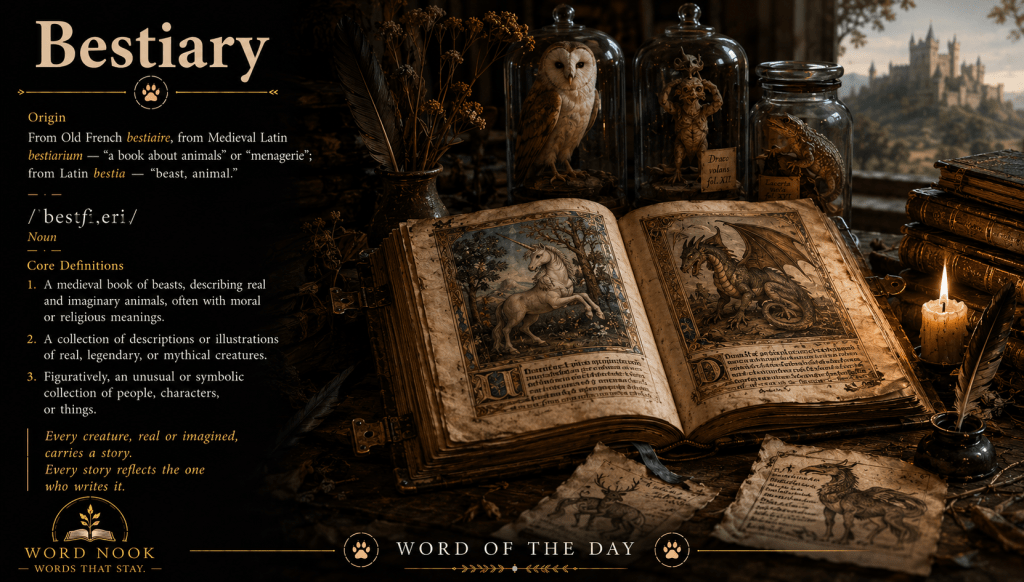
Bestiary
IPA Pronunciation: /ˈbɛs.ti.er.i/ (also /ˈbiːs.ti.er.i/)
Part of Speech: Noun
Origin
Bestiary belongs to the vocabularies of medieval literature, mythology, symbolism, and the natural world. It refers to a collection or book describing animals—both real and imaginary—whose behaviors are interpreted as moral, spiritual, or allegorical lessons.
Unlike a zoological guide, a bestiary is less concerned with biological accuracy than with what animals mean.
It suggests a world in which every creature carries a story, a symbol, or a truth.
A bestiary is nature read as metaphor.
Etymology
From Medieval Latin: bestiarium — book of beasts
From Latin: bestia — beast, animal
The word entered English in the 18th century to describe the richly illustrated medieval manuscripts that flourished between the 12th and 14th centuries.
Core Definitions
A Medieval Book of Animals
An illustrated collection describing animals, often accompanied by allegorical or religious interpretations.
“The monastery preserved an illuminated bestiary.”
A Collection of Real or Imaginary Creatures
Any work cataloguing animals, monsters, or fantastic beings.
“The fantasy novel reads like a modern bestiary.”
A Symbolic Catalogue
Figuratively, a gathering of personalities or forces represented through animal imagery.
“The play offers a bestiary of human ambition.”
Explanation & Nuance
Bestiary differs from encyclopedia or field guide.
It implies:
- Symbolic interpretation
- Wonder over classification
- Moral imagination
- The coexistence of fact and myth
It may be:
- Literary — medieval manuscripts
- Artistic — illustrated collections
- Mythological — dragons, unicorns, griffins
- Poetic — symbolic portraits of life
A bestiary is not merely about animals.
It is about what people have long seen in animals.
Historical Dimension
Medieval bestiaries commonly included:
- Lions
- Eagles
- Owls
- Foxes
- Elephants
- Beavers
- Unicorns
- Phoenixes
- Dragons
- Basilisks
Each entry combined:
- Natural description
- Legend
- Religious symbolism
- Moral instruction
Accuracy was secondary to meaning.
Poetic & Literary Use
Bestiary is an exceptionally literary word.
A poet may use it literally:
“The monk illuminated a bestiary with gold and lapis.”
or metaphorically:
“His memories became a private bestiary of impossible creatures.”
It often appears in writing about:
- Imagination
- Myth
- Dreams
- Nature
- Symbolism
- Identity
- Folklore
- Wonder
- Memory
- Transformation
Unlike zoology, bestiary invites enchantment.
It sees creatures not simply as organisms, but as embodiments of ideas.
Bestiary in Literature
Bestiaries have profoundly influenced English literature.
Their legacy can be seen in:
- The Faerie Queene
- Paradise Lost
- Alice’s Adventures in Wonderland
- The Chronicles of Narnia
Modern fantasy, children’s literature, and speculative fiction continue to draw upon the bestiary tradition, blending real animals with mythical beings to explore moral and imaginative landscapes.
Experiential Dimension
A bestiary can evoke:
- Wonder — every creature tells a story
- Curiosity — the boundary between myth and reality
- Delight — richly imagined worlds
- Reflection — symbolic readings of nature
- Nostalgia — echoes of medieval imagination
It often feels like opening a door into a world where nothing is merely what it appears to be.
Symbolic Dimensions
- Lion — courage and kingship
- Fox — cunning
- Owl — wisdom
- Phoenix — rebirth
- Unicorn — purity
- Dragon — power and chaos
Bestiary symbolizes imagination, symbolic thinking, humanity’s dialogue with nature, and the enduring search for meaning through living forms.
Synonyms & Near-Relations
- Menagerie — collection of living animals
- Compendium — organized collection of knowledge
- Codex — manuscript volume
- Mythology — body of traditional stories
- Field Guide — scientific guide to organisms
(Only bestiary fully combines animals, allegory, medieval tradition, and symbolic interpretation.)
Conceptual Relations
- Animal — defining subject
- Myth — frequent companion
- Symbol — central principle
- Manuscript — traditional form
- Wonder — emotional atmosphere
Cultural & Intellectual Resonance
Literature
Bestiaries shaped medieval and Renaissance symbolism, influencing centuries of English poetry and storytelling.
Art
Illuminated bestiaries are celebrated for their intricate illustrations, where observation and imagination coexist.
Philosophy
They reflect an older vision of the world in which nature was understood not only scientifically but morally and spiritually.
Modern Culture
Contemporary fantasy literature, games, and films often revive the bestiary tradition through encyclopedias of imaginary creatures and symbolic fauna.
Takeaway
Bestiary names the book in which beasts become meanings—
the lion that teaches courage,
the phoenix that embodies renewal,
the unicorn that represents purity,
the dragon that gives form to fear.
It reminds us that people have long looked to animals
not only to understand nature,
but to understand themselves,
finding in feather,
fur,
scale,
and claw
reflections of the human imagination.
In poetry, a bestiary is a cabinet of living symbols—
a procession of creatures,
real and imagined,
through which the world becomes
not merely observed,
but interpreted.
A bestiary is nature read as metaphor.
 Word of the Day - The English Nook
Leave a comment