
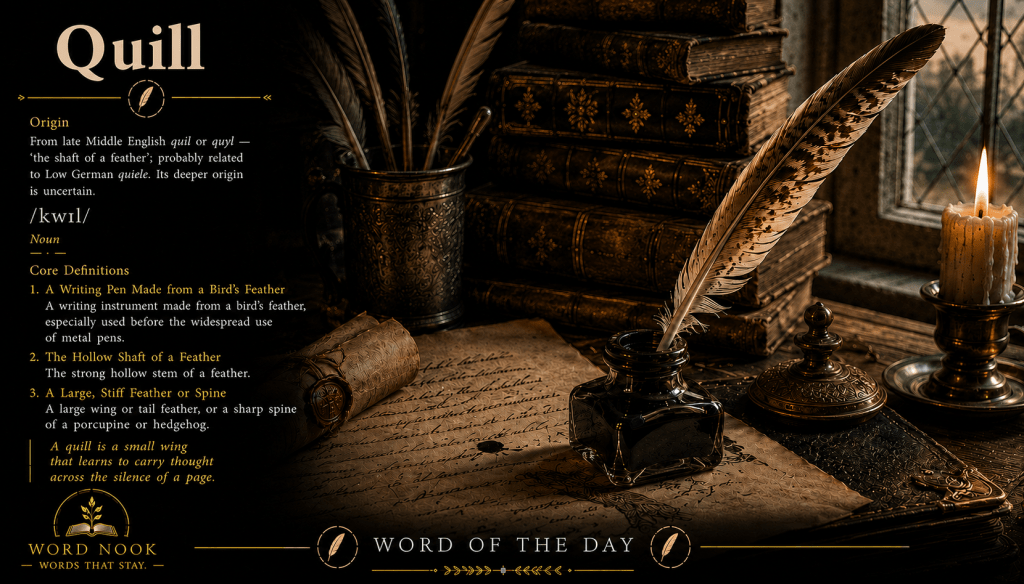
Quill
IPA Pronunciation: /kwɪl/
Part of Speech: Noun (and Verb, rare)
Origin
Quill belongs to the vocabularies of writing, birds, craftsmanship, and literary tradition. It originally referred to the hollow feather shaft of a bird, and by extension to a feather fashioned into a writing pen.
For centuries, quills were among the principal writing instruments through which poems, letters, laws, philosophies, and histories were written.
It suggests the intimate union of nature and language: a feather transformed into a vessel for thought.
A quill is a feather that learned to write.
Etymology
From Middle English: quil
From Old Dutch: quil — reed, feather shaft
Originally denoting the hollow shaft of a feather, the word naturally came to signify the writing instrument made from it.
The association between feathers and writing became so enduring that quill remains one of the most evocative symbols of authorship.
Core Definitions
A Feather Used as a Pen
The sharpened feather of a large bird, traditionally a goose, swan, or turkey, used for writing with ink.
“The scribe dipped his quill into the inkwell.”
The Hollow Shaft of a Feather
The central tubular structure supporting the feather.
“The porcupine’s quills differ from bird quills.”
(In zoology, quill may also refer to the stiff spine of a porcupine or hedgehog, though this is a distinct biological sense.)
Explanation & Nuance
Quill differs from pen.
It implies:
- Historical writing
- Handcrafted artistry
- Literary tradition
- A slower, deliberate act of composition
It may be:
- Historical — writing instrument
- Literary — emblem of authorship
- Artistic — calligraphy and illumination
- Poetic — the transformation of nature into expression
A quill does more than write.
It reminds us that words once required patience.
Historical Dimension
For centuries, quills were used by:
- Monks
- Scribes
- Poets
- Scientists
- Philosophers
- Statesmen
Many of history’s greatest works were first written with quills, including manuscripts, royal charters, scientific discoveries, and literary masterpieces.
The quill remained the dominant writing instrument in Europe until the 19th century, when steel nibs gradually replaced it.
Poetic & Literary Use
Quill is one of the most literary words in English.
A poet may use it literally:
“The quill scratched softly across the parchment.”
or metaphorically:
“Time itself held the quill.”
It often appears in writing about:
- Poetry
- Storytelling
- Scholarship
- Memory
- Creation
- History
- Silence
- Craftsmanship
- Inspiration
- Language
Unlike pen, quill immediately evokes an older world of candlelight, parchment, and careful composition.
Quill in Poetry
The quill has become an enduring emblem of the writer.
Poets use it to symbolize:
- Creative imagination
- The act of authorship
- The permanence of language
- The transmission of wisdom
- The delicate power of words
Its symbolism is beautifully paradoxical.
A feather—created for flight—
becomes the instrument through which ideas travel farther than wings ever could.
Experiential Dimension
A quill can evoke:
- Reverence — connection to literary history
- Patience — slow, intentional writing
- Elegance — graceful calligraphy
- Wonder — beauty emerging from simple materials
- Nostalgia — the tactile world of manuscripts
It often feels like writing in conversation with centuries.
Symbolic Dimensions
- Goose Feather — inspiration
- Ink-Stained Quill — devotion to craft
- Parchment — preservation
- Writing Desk — contemplation
- Wing Becoming Pen — imagination transformed into language
Quill symbolizes creativity, memory, scholarship, craftsmanship, and the enduring power of the written word.
Synonyms & Near-Relations
- Pen — modern writing instrument
- Reed Pen — earlier writing tool
- Stylus — ancient writing instrument
- Parchment — writing surface
- Ink — medium of inscription
(Only quill fully combines natural beauty, historical authorship, literary tradition, and handcrafted writing.)
Conceptual Relations
- Writing — defining purpose
- Feather — natural origin
- Ink — essential companion
- Manuscript — traditional result
- Imagination — enduring symbolic meaning
Cultural & Intellectual Resonance
Literature
The quill has become one of literature’s universal symbols, representing authorship, poetic inspiration, and the transmission of ideas across generations.
History
From medieval monasteries to Renaissance studies, the quill shaped the written record of Western civilization.
Art
Illuminated manuscripts and calligraphic traditions depended upon the precision and flexibility of finely cut quills.
Philosophy
The quill reminds us that ideas require both inspiration and craft—that imagination takes lasting form only through patient expression.
Takeaway
Quill names the feather that became a pen—
the wing turned toward words,
the hollow shaft
filled not with flight,
but with ink.
It reminds us that language often grows from the natural world,
that great books begin with simple tools,
and that some of humanity’s most enduring thoughts
were first carried
not by machines,
but by the quiet movement
of a feather across a page.
In poetry, a quill is imagination given form—
the feather resting beside an inkwell,
the soft scratch upon parchment,
the humble instrument
through which memory,
art,
and civilization
found their voice.
A quill is a feather that learned to write.
 Word Nook
Leave a comment