

Ember
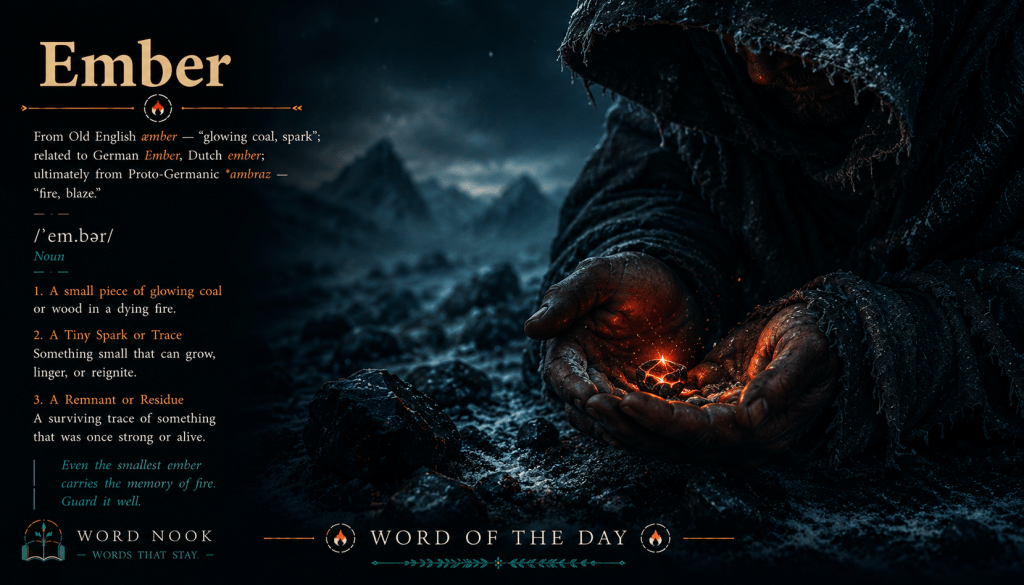
IPA Pronunciation: /ˈɛm.bər/
Part of Speech: Noun
Origin
Ember belongs to the vocabularies of fire, warmth, endurance, and quiet persistence. It refers to a small glowing fragment of burning wood or coal that remains after the flames have diminished.
It suggests life after intensity: heat that survives when brilliance has passed.
An ember is fire remembering itself.
Etymology
From Old English: æmerge or æmyrge — hot ashes, glowing cinders
Related to ancient Germanic words referring to burning remnants.
The word has existed in English for well over a thousand years, preserving its association with lingering heat and quiet fire.
Core Definitions
A Glowing Piece of Burning Material
A small fragment of wood or coal that continues to glow without large flames.
“The embers glowed long after the fire had faded.”
A Lingering Trace of Passion or Energy
Something that survives after greater intensity has passed.
“The last embers of hope remained.”
Explanation & Nuance
Ember differs from flame.
It implies:
- Residual warmth
- Quiet persistence
- Potential for renewal
- Fire beneath apparent stillness
It may be:
- Physical — glowing wood or charcoal
- Emotional — enduring love or hope
- Psychological — unresolved longing
- Poetic — memory that continues to live
An ember is not the end of a fire.
It is what remains capable of becoming flame again.
Natural Dimension
Embers occur in:
- Campfires
- Fireplaces
- Forest fires
- Wood stoves
- Bonfires
They provide:
- Lingering warmth
- Light after flames
- The possibility of rekindling
- Slow transformation into ash
A single ember, under the right conditions, can reignite an entire fire.
Poetic & Literary Use
Ember is one of the great poetic words in English.
Its physical properties naturally become metaphors for human experience.
A poet may use it literally:
“The embers glowed beneath a blanket of ash.”
or metaphorically:
“An ember of forgiveness still remained.”
It often appears in writing about:
- Memory
- Love
- Hope
- Grief
- Resilience
- Aging
- Longing
- Renewal
- Time
- Survival
Unlike fire, ember emphasizes what endures after intensity has passed.
It is the poetry of persistence.
Ember in Poetry
Ember is exceptionally common in poetry.
Poets use it to symbolize:
- Hope that survives despair
- Love after separation
- Memory that refuses to fade
- Quiet resilience
- The possibility of renewal
- Inner life concealed beneath calmness
Its greatest poetic strength lies in its paradox.
An ember appears small.
Yet it still contains fire.
Experiential Dimension
An ember can evoke:
- Comfort — warmth at day’s end
- Nostalgia — fading evenings and remembered moments
- Hope — life continuing quietly
- Patience — slow, enduring transformation
- Melancholy — beauty in what remains
It often feels like witnessing something that refuses to disappear completely.
Symbolic Dimensions
- Glowing Coal — enduring strength
- Ash-Covered Ember — hidden vitality
- Campfire at Night — companionship and reflection
- Rekindled Fire — renewal
- Last Spark — persistence against extinction
Ember symbolizes resilience, memory, hope, continuity, and the quiet endurance of life’s deepest energies.
Synonyms & Near-Relations
- Cinder — partially burned fragment
- Coal — fuel that may glow as an ember
- Spark — brief ignition
- Flame — visible burning fire
- Ash — what remains after combustion
(Only ember fully combines lingering warmth, hidden vitality, quiet endurance, and the possibility of rekindling.)
Conceptual Relations
- Fire — source of the ember
- Warmth — enduring quality
- Ash — surrounding remnant
- Renewal — latent possibility
- Memory — dominant poetic association
Cultural & Intellectual Resonance
Poetry
Embers often symbolize enduring love, memory, resilience, and the quiet persistence of the human spirit.
Literature
The image frequently marks transitions between endings and beginnings, suggesting that apparent conclusions may still contain the seeds of renewal.
Psychology
An ember offers a compelling metaphor for emotions that remain alive beneath the surface long after outward expression has faded.
Philosophy
The ember reflects the idea that strength need not always blaze visibly; some of the most enduring forms of life continue in silence, awaiting the moment when they may burn brightly once more.
Takeaway
Ember names the fire that remains—
the quiet glow
beneath the ash,
the warmth that outlives the flame,
the small light
that refuses to surrender to darkness.
It reminds us that endings are not always extinguishment,
that persistence may appear gentle rather than dramatic,
and that some of life’s deepest powers
are carried forward
not in blazing moments,
but in steady,
hidden warmth.
In poetry, an ember is hope after the fire—
the red glow in the hearth,
the last warmth of a fading campfire,
the enduring spark
through which memory,
love,
and resilience
continue to shine.
Even the smallest ember can remind us that warmth has not entirely gone.

 Word Nook
Leave a comment