

Talisman
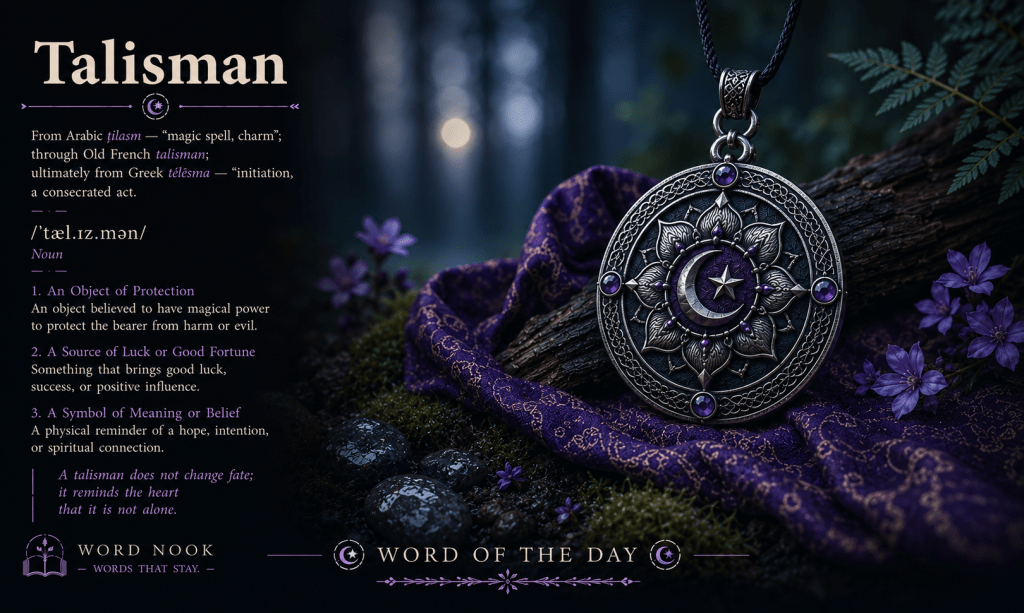
IPA Pronunciation: /ˈtæl.ɪz.mən/
Part of Speech: Noun
Origin
Talisman belongs to the vocabularies of protection, fortune, symbolism, and belief. It refers to an object believed to possess special powers, especially the ability to bring good luck, protection, strength, or guidance to its bearer.
Whether or not one believes in its supernatural efficacy, a talisman represents the human desire to carry hope in tangible form.
A talisman is hope carried in the hand.
Etymology
From French: talisman
Via Arabic: ṭilasm (طلسم) — magical image, charm
Ultimately from Greek: telesma (τέλεσμα) — religious rite, consecration, completion
Its long linguistic journey mirrors its cultural one, passing through ancient Mediterranean and Middle Eastern traditions before becoming part of English in the 17th century.
Core Definitions
An Object Believed to Possess Protective or Magical Power
An item carried or kept to attract good fortune or ward off harm.
“She wore the small stone as a talisman.”
A Symbolic Source of Confidence or Meaning
An object valued for its emotional, personal, or symbolic significance.
“The compass became his talisman during every expedition.”
Explanation & Nuance
Talisman differs from amulet or charm.
It implies:
- Protection and empowerment
- Personal significance
- Enduring companionship
- Symbolic rather than merely decorative value
It may be:
- Spiritual — sacred objects and symbols
- Cultural — traditional protective artifacts
- Personal — keepsakes imbued with meaning
- Poetic — memories or ideals carried through life
Unlike a simple ornament, a talisman is carried because it represents something greater than itself.
Natural & Human Dimension
Talismans have been fashioned from:
- Stone
- Wood
- Bone
- Metal
- Shell
- Glass
- Seeds
- Feathers
They are found across cultures, often accompanying:
- Travelers
- Soldiers
- Pilgrims
- Children
- Explorers
- Loved ones
Their power often lies as much in belief as in the object itself.
Poetic & Literary Use
Talisman is an exceptionally poetic word.
A poet may use it literally:
“She carried the weathered coin like a talisman.”
or metaphorically:
“Hope became the talisman that outlasted fear.”
It often appears in writing about:
- Memory
- Love
- Protection
- Journeys
- Identity
- Faith
- Loss
- Inheritance
- Courage
- Destiny
Unlike good-luck charm, talisman carries greater dignity, mystery, and emotional depth.
It suggests an object that accompanies a life.
Talisman in Poetry
The word has become a favorite in modern and traditional poetry because it joins the physical and the symbolic.
Poets use talismans to represent:
- Enduring love
- Inherited wisdom
- Personal resilience
- Sacred memory
- The unseen forces that sustain human beings
Often the talisman itself is ordinary.
Its meaning is extraordinary.
Experiential Dimension
A talisman can evoke:
- Comfort — something familiar carried close
- Hope — confidence during uncertainty
- Protection — emotional or spiritual reassurance
- Continuity — connection across time
- Belonging — remembrance of people or places
It often feels like carrying a fragment of home into unfamiliar territory.
Symbolic Dimensions
- Worn Stone — enduring memory
- Compass — guidance
- Feather — freedom and blessing
- Ring — fidelity and continuity
- Ancient Coin — inherited fortune
Talisman symbolizes hope, remembrance, protection, identity, and the quiet strength drawn from meaningful symbols.
Synonyms & Near-Relations
- Amulet — protective object
- Charm — object believed to bring luck
- Keepsake — treasured remembrance
- Relic — object of historical or spiritual significance
- Token — physical symbol of meaning
(Only talisman fully combines protection, personal symbolism, enduring companionship, and the sense of carrying unseen strength.)
Conceptual Relations
- Protection — traditional purpose
- Memory — common personal significance
- Faith — source of meaning
- Journey — frequent context
- Hope — enduring emotional association
Cultural & Intellectual Resonance
Poetry
Talismans often symbolize memory, courage, love, and the invisible sources of resilience that accompany us through life.
Anthropology
Nearly every culture has created talismans, reflecting the universal human impulse to embody hope and protection in physical objects.
Literature
Characters frequently carry talismans that represent identity, destiny, or enduring bonds.
Philosophy
The talisman raises a subtle question: Do objects possess power in themselves, or do they become powerful because of the meanings we invest in them?
Takeaway
Talisman names the object that carries more than its material form—
the stone kept in a pocket,
the ring worn through decades,
the small token
that gathers memory,
hope,
and courage.
It reminds us that meaning often resides in ordinary things,
that symbols can steady us when certainty cannot,
and that what we carry
sometimes shapes how we continue.
In poetry, a talisman is hope made tangible—
the weathered keepsake held through difficult years,
the quiet companion on long journeys,
the humble object
through which memory,
faith,
and resilience
remain close to the heart.
Sometimes the smallest things are the ones that help us carry the greatest hopes.
 Word Nook
Leave a comment