

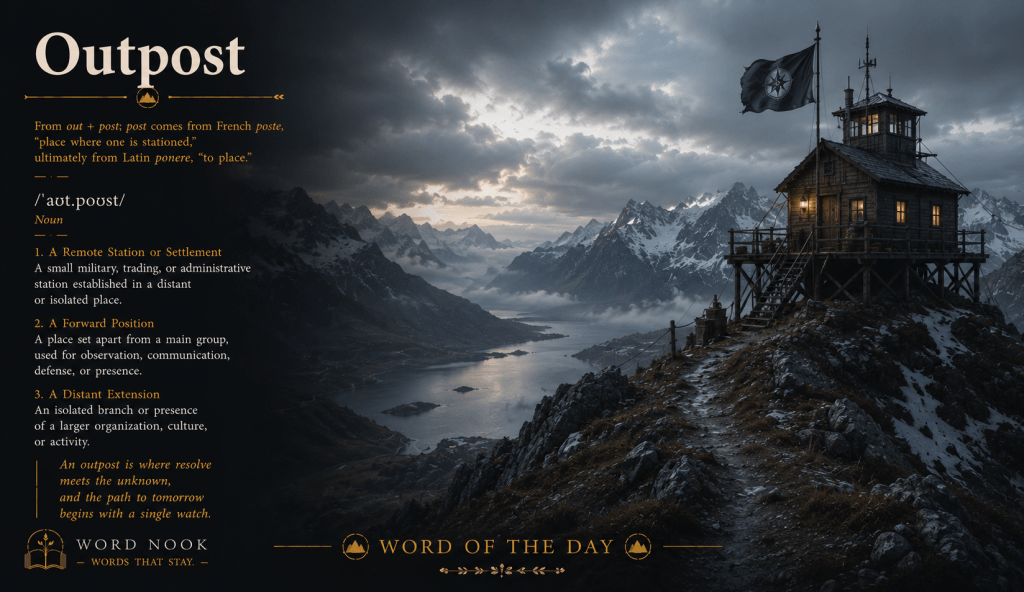
Outpost
IPA Pronunciation: /ˈaʊt.poʊst/ (US), /ˈaʊt.pəʊst/ (UK)
Part of Speech: Noun
Origin
Outpost belongs to the vocabularies of frontiers, exploration, vigilance, and isolation. It refers to a station or settlement established beyond the main body of a community, army, or civilization, often serving as a point of observation, protection, communication, or expansion.
It suggests existence at the edge: a place where the familiar ends and the unknown begins.
An outpost is civilization keeping watch.
Etymology
From English:
out — beyond, outside
post — a fixed station or assigned position
The word emerged in military usage during the 17th century, describing positions established ahead of the main force. It later broadened to include remote settlements, research stations, trading posts, and isolated communities.
Core Definitions
A Remote Station or Settlement
A small establishment located far from a central community.
“The expedition reached the mountain outpost before nightfall.”
A Frontier Position
A place maintained for observation, defense, communication, or exploration.
“The soldiers guarded the northern outpost.”
A Distant Extension of an Organization or Culture
A remote branch or representative presence.
“The university established an outpost for field research.”
Explanation & Nuance
Outpost differs from village or colony.
It implies:
- Distance from the center
- Purposeful occupation
- Exposure to uncertainty
- Connection despite isolation
It may be:
- Military — defensive positions
- Scientific — polar research stations
- Commercial — trading posts
- Poetic — places at the edge of knowledge, memory, or identity
An outpost exists because someone has chosen to remain where few others do.
Natural Dimension
Outposts often appear in:
- Mountains
- Deserts
- Polar regions
- Forests
- Remote islands
- Frontier landscapes
They become places where:
- Civilization meets wilderness
- Observation replaces certainty
- Survival requires adaptation
The horizon always feels close.
Poetic & Literary Use
Outpost is a richly poetic word.
A poet may use it literally:
“The last outpost overlooked the frozen valley.”
or metaphorically:
“Hope became the final outpost against despair.”
It often appears in writing about:
- Exploration
- Loneliness
- Discovery
- Courage
- Borders
- Memory
- Resistance
- Exile
- The unknown
- Human perseverance
Unlike settlement, outpost carries a sense of precariousness and purpose.
It is a place that watches.
Outpost in Poetry
Though less common than words like harbor or frontier, outpost has become increasingly prominent in modern poetry, particularly in works exploring psychological, political, and existential themes.
Poets use it to represent:
- The edge of civilization
- The limits of endurance
- The last refuge of hope
- The boundary between order and chaos
- The solitary observer
It naturally lends itself to landscapes of distance and introspection.
Experiential Dimension
An outpost can evoke:
- Solitude — distance from the familiar
- Alertness — constant awareness
- Resilience — enduring difficult conditions
- Wonder — living close to the unknown
- Responsibility — safeguarding what lies behind
It often feels like standing where maps begin to fade.
Symbolic Dimensions
- Remote Cabin — endurance
- Watchtower — vigilance
- Mountain Station — perspective
- Edge of the Map — exploration
- Last Light — perseverance against darkness
Outpost symbolizes courage, vigilance, curiosity, and humanity’s willingness to inhabit the boundaries of the known world.
Synonyms & Near-Relations
- Frontier — borderland between known and unknown
- Station — fixed place of activity
- Stronghold — fortified position
- Settlement — inhabited community
- Waypoint — stopping place on a journey
(Only outpost fully combines remoteness, purpose, vigilance, and the sense of standing at the world’s edge.)
Conceptual Relations
- Frontier — defining setting
- Exploration — common purpose
- Isolation — lived condition
- Observation — essential function
- Endurance — necessary quality
Cultural & Intellectual Resonance
Poetry
Outposts often symbolize the far edges of consciousness, civilization, and hope.
History
Outposts have played crucial roles in exploration, trade, scientific discovery, and frontier expansion.
Literature
They frequently serve as settings where characters confront solitude, uncertainty, and transformation.
Philosophy
The outpost reflects the human impulse to extend beyond the familiar—to establish meaning not only at the center of life, but also at its margins.
Takeaway
Outpost names the place that stands beyond the center—
the lonely station,
the distant settlement,
the watchful presence
where the known world meets the unknown.
It reminds us that discovery begins at the edges,
that courage often lives far from comfort,
and that some of humanity’s most meaningful work
is carried out
not in crowded capitals,
but in quiet places
overlooking vast horizons.
In poetry, an outpost is the last light before wilderness—
the solitary cabin beneath northern stars,
the weather station on a windswept ridge,
the steadfast presence
that keeps watch
where certainty
gives way
to possibility.
The edge of the map is often where humanity learns the most.

 Word Nook
Leave a comment