

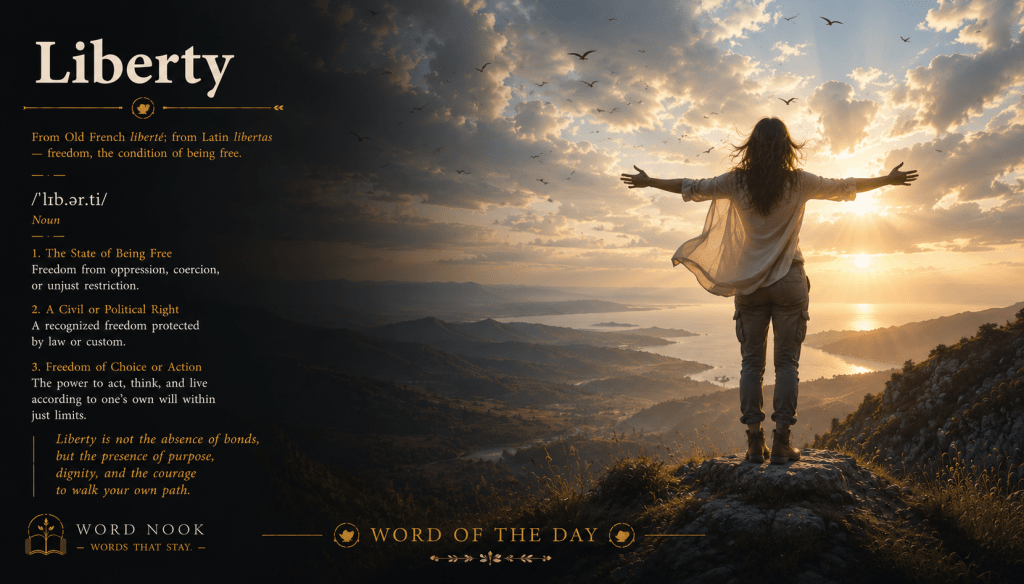
Liberty
IPA Pronunciation: /ˈlɪb.ər.ti/ (UK & US)
Part of Speech: Noun
Origin
Liberty belongs to the vocabularies of freedom, autonomy, dignity, and human rights. It refers to the condition of being free from unnecessary restraint, oppression, or domination, and to the power to act, think, and live according to one’s own will within just limits.
It suggests more than the absence of chains. It is the presence of self-determination.
Liberty is freedom given room to endure.
Etymology
From Old French: liberté
From Latin: libertas — freedom, the condition of being free
From liber — free
The word has been central to English political, legal, philosophical, and literary language since the Middle Ages, carrying ideas of personal independence, civil rights, and moral agency.
Core Definitions
The State of Being Free
Freedom from oppression, coercion, or unjust restriction.
“They fought for liberty.”
A Civil or Political Right
A recognized freedom protected by law or custom.
“Freedom of speech is a fundamental liberty.”
Freedom of Choice or Action
The ability to act according to one’s own judgment.
“She took the liberty of answering the letter.”
Explanation & Nuance
Liberty differs from freedom.
While the words often overlap, liberty tends to emphasize:
- Rights protected by law
- Political and civic freedom
- Freedom from tyranny or arbitrary power
- The ability to govern oneself responsibly
Freedom is broader and can describe almost any absence of constraint.
Liberty often carries ethical, legal, and philosophical weight.
It may be:
- Political — civil liberties and democracy
- Personal — independence and self-direction
- Moral — responsibility for one’s choices
- Poetic — the human spirit refusing confinement
Liberty is freedom recognized and safeguarded.
Liberty in Poetry
Liberty is one of the great poetic words of English literature.
For centuries, poets have invoked it as:
- A bird released into the sky
- An open horizon
- The sea beyond the harbor
- The wind beyond prison walls
- The unconquered human spirit
It appears in poetry about:
- Revolution
- Justice
- Human dignity
- Hope
- Resistance
- Exile
- Identity
- The aspiration to live authentically
Unlike freedom, liberty often carries a noble, almost ceremonial resonance, making it especially powerful in verse.
Experiential Dimension
Liberty can evoke:
- Relief — release from oppression
- Hope — possibility and self-determination
- Responsibility — the burden of choosing well
- Joy — unrestricted movement and expression
- Dignity — recognition of inherent human worth
It often feels like breathing deeply after confinement.
Symbolic Dimensions
- Open Sky — limitless possibility
- Broken Chains — liberation from oppression
- Flying Bird — independent spirit
- Open Gate — opportunity and renewal
- Rising Dawn — political and personal awakening
Liberty symbolizes autonomy, dignity, justice, and the enduring human desire to live without domination.
Synonyms & Near-Relations
- Freedom — broad absence of constraint
- Independence — self-governance
- Autonomy — self-direction
- Emancipation — release from bondage
- Self-determination — authority over one’s own future
(Only liberty fully combines legal protection, moral agency, civic rights, and the enduring ideal of freedom under justice.)
Conceptual Relations
- Freedom — closest related concept
- Justice — liberty depends upon fair laws
- Responsibility — necessary companion of liberty
- Rights — legal expression of liberty
- Democracy — political system closely associated with liberty
Cultural & Intellectual Resonance
Poetry
Liberty has long symbolized hope, dignity, courage, and the unconquerable spirit.
Political Philosophy
From thinkers such as John Locke, John Stuart Mill, and Isaiah Berlin, liberty has been explored as one of the foundational principles of a just society.
History
The pursuit of liberty has inspired revolutions, constitutional movements, and struggles for civil rights across the world.
Philosophy
Liberty raises enduring questions: What does it mean to be truly free? How can individual liberty coexist with the liberty of others? Where should freedom end and responsibility begin?
Takeaway
Liberty names the condition in which a person belongs to no master but conscience and law—
the open gate,
the unbound path,
the right to choose one’s own direction.
It reminds us that freedom is most enduring when it is protected,
that dignity requires more than the absence of chains,
and that the highest forms of liberty
allow both the individual
and the community
to flourish.
In poetry, liberty is the wind beyond the prison wall—
the bird crossing an open sky,
the voice that cannot be silenced,
the enduring promise
that every human being
is born
not merely to exist,
but to live
in freedom.
Freedom begins with possibility. Liberty ensures it can endure.

 Word Nook
Leave a comment