

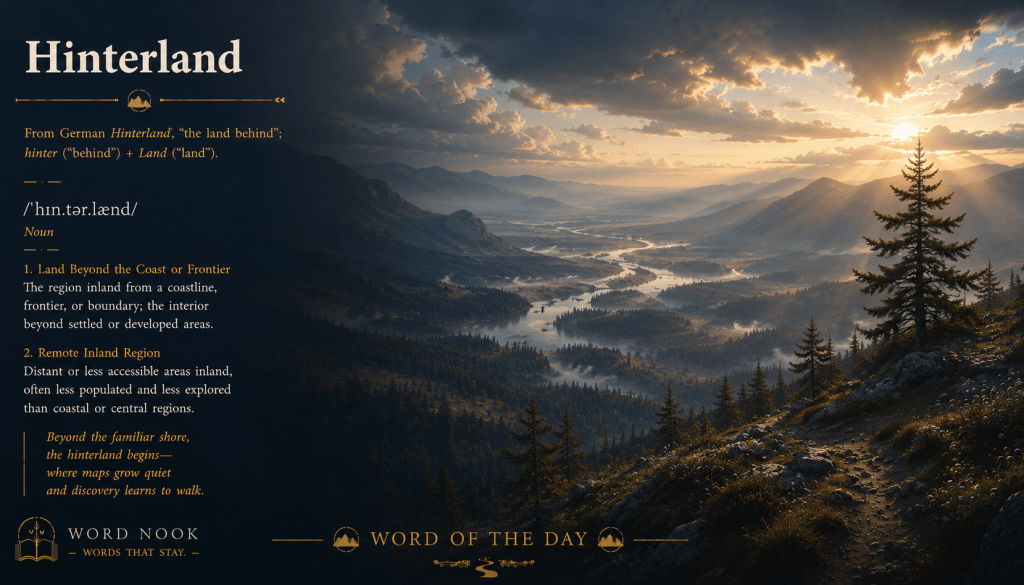
Hinterland
IPA Pronunciation: /ˈhɪn.tə.lænd/ (UK), /ˈhɪn.tɚ.lænd/ (US)
Part of Speech: Noun
Origin
Hinterland belongs to the vocabularies of geography, distance, frontiers, and hidden interiors. It refers to the land lying inland from a coast, city, river, or other settled area, especially the region that supports or is connected to it.
Beyond its geographical meaning, the word has come to suggest the unexplored, the remote, and the inward—places that exist beyond the familiar edge.
A hinterland is the unseen country behind the familiar.
Etymology
From German:
hinter — behind, beyond
Land — land
Literally: “the land behind.”
It entered English in the late 19th century through geography and economics, referring to the inland regions connected to ports and commercial centers. Its metaphorical richness soon expanded far beyond that technical use.
Core Definitions
The Inland Region Beyond a Coast or Settlement
The territory lying behind and connected to a coastal area, port, or urban center.
“The port depended on its fertile hinterland.”
A Remote or Less-Developed Interior
An area distant from major centers of population or activity.
“They traveled deep into the hinterland.”
A Hidden Reserve of Experience or Character
Figuratively, the unseen depth or background of a person, culture, or idea.
“The novel reveals the emotional hinterland of its characters.”
Explanation & Nuance
Hinterland differs from wilderness or countryside.
It implies:
- Relationship to a central place
- Distance without complete isolation
- Hidden depth
- The overlooked interior
It may be:
- Geographical — inland territories
- Economic — regions supporting a port or city
- Psychological — inner emotional landscapes
- Poetic — realms beyond immediate perception
A hinterland is not simply “far away.”
It is what exists behind what first appears.
Natural Dimension
Hinterlands may include:
- Forests
- Mountains
- Plains
- River valleys
- Grasslands
- Remote villages
They often provide:
- Natural resources
- Agricultural land
- Wild habitats
- Connections between human settlements and deeper landscapes
They are the quiet interiors that sustain the visible edges.
Poetic & Literary Use
Hinterland is an exceptionally poetic word.
Its literal and metaphorical meanings naturally overlap.
A poet may use it literally:
“Mist gathered over the forested hinterland.”
or metaphorically:
“Grief has its own hinterland, where memory keeps walking.”
It often appears in writing about:
- Memory
- Identity
- Childhood
- Interior life
- Exploration
- Isolation
- The unknown
- Landscape
- Silence
- The unconscious
Unlike wilderness, hinterland suggests connection rather than separation.
It is the hidden country that belongs to something larger.
Hinterland in Poetry
The word has become increasingly common in modern poetry because it conveys both geography and psychology.
Poets use it to describe:
- The unseen regions of the mind
- Emotional depth
- Forgotten histories
- Quiet landscapes beyond civilization
- The hidden lives beneath outward appearances
Its greatest strength is its dual meaning.
A hinterland may be a forest behind a city.
It may also be the unspoken life behind a person.
Experiential Dimension
A hinterland can evoke:
- Curiosity — what lies beyond the familiar
- Solitude — distance from the center
- Wonder — landscapes little touched
- Reflection — inward journeys
- Mystery — territories still undiscovered
It often feels like standing at the boundary between the known and the unknown.
Symbolic Dimensions
- Distant Hills — unexplored possibilities
- Forest Interior — hidden knowledge
- Country Beyond the Coast — unseen support
- Unmapped Land — imagination and discovery
- Inner Landscape — emotional depth
Hinterland symbolizes hidden potential, interiority, mystery, and the vastness that exists beyond immediate awareness.
Synonyms & Near-Relations
- Interior — inland region
- Backcountry — remote rural land
- Heartland — central region
- Frontier — edge of settlement
- Wilderness — uncultivated landscape
(Only hinterland fully combines inland geography, hidden support, psychological depth, and the idea of “the land beyond.”)
Conceptual Relations
- Interior — defining spatial quality
- Journey — movement toward the unknown
- Depth — metaphorical resonance
- Edge — what the hinterland lies beyond
- Mystery — emotional atmosphere
Cultural & Intellectual Resonance
Poetry
Hinterlands often symbolize memory, the unconscious, and the unexplored dimensions of both landscapes and lives.
Geography
The concept remains important in understanding how cities, ports, and civilizations depend upon their surrounding regions.
Psychology
The word has become a metaphor for the hidden aspects of personality and experience that lie beyond outward identity.
Philosophy
The hinterland reflects the idea that every visible thing is supported by something less visible—that beneath every center lies an overlooked interior.
Takeaway
Hinterland names the land beyond the edge—
the quiet interior
behind the coast,
the city,
the known world.
It reminds us that what is central is rarely self-sufficient,
that every visible place depends upon a deeper one,
and that every person carries landscapes
that remain largely unexplored.
In poetry, a hinterland is the country beyond appearances—
the forests behind the harbor,
the hills beyond the last road,
the hidden interior
where memory,
identity,
and mystery
continue long after
the map seems to end.
A hinterland is the unseen country behind the familiar.

 Word Nook
Leave a comment