

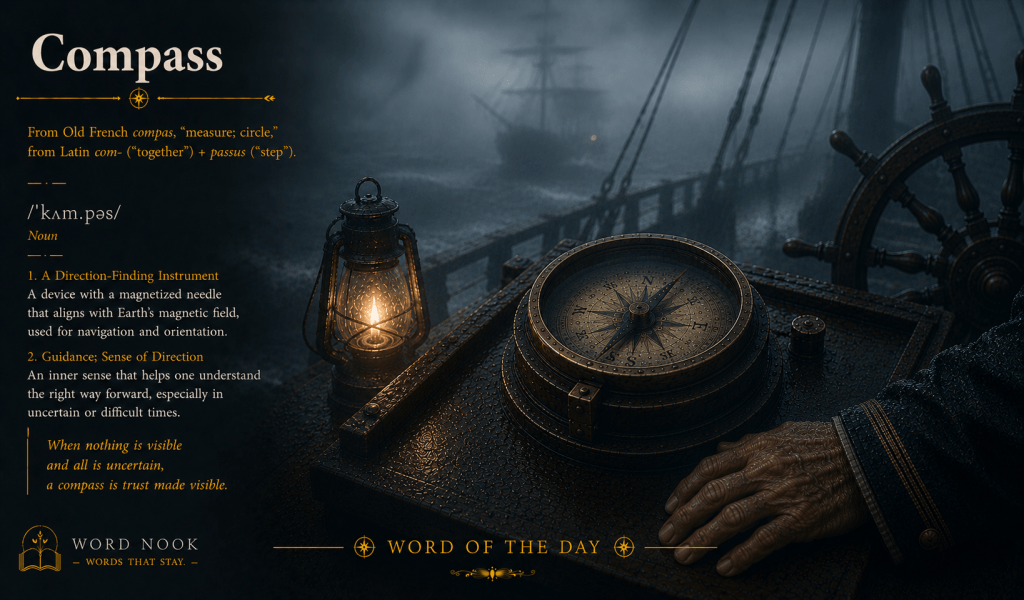
Compass
IPA Pronunciation: /ˈkʌm.pəs/
Part of Speech: Noun (and Verb, less commonly)
Origin
Compass belongs to the vocabularies of direction, navigation, orientation, and guidance. It refers to an instrument that indicates direction—traditionally by means of a magnetized needle pointing toward magnetic north.
Over time, it has become one of English’s most enduring metaphors for finding one’s way through uncertainty.
A compass is direction made portable.
Etymology
From Old French: compas — measure, circle, extent
From Latin: compassare — to step together, measure out
Originally associated with measuring and enclosing space, the word gradually became attached to navigational instruments that help travelers determine direction.
The idea of finding orientation remains central to all its meanings.
Core Definitions
Navigational Instrument
A device that indicates direction relative to magnetic north.
“The explorer checked her compass before entering the forest.”
Source of Guidance
A principle, value, belief, or person that helps determine decisions and actions.
“Integrity served as his moral compass.”
Range or Scope (Older Usage)
The limits or extent of something.
“Beyond the compass of human understanding.”
Explanation & Nuance
Compass differs from map.
It implies:
- Orientation rather than destination
- Direction rather than detail
- Guidance amid uncertainty
- Continuous reference rather than fixed instruction
It may be:
- Physical — navigational instrument
- Moral — ethical framework
- Emotional — source of inner guidance
- Poetic — symbol of purpose and direction
A map shows the terrain.
A compass helps you face the right way.
Natural Dimension
Historically, compasses enabled:
- Ocean voyages
- Exploration
- Trade routes
- Mountain travel
- Navigation through unfamiliar landscapes
They became essential wherever landmarks disappeared:
- At sea
- In deserts
- In forests
- During storms
- Under cloud-covered skies
A compass is most valuable when certainty is absent.
Poetic & Literary Use
Compass is deeply poetic because it transforms direction into meaning.
A poet may use it literally:
“The compass needle trembled in his hand.”
or metaphorically:
“Hope became the compass that guided her.”
It often appears in writing about:
- Journeys
- Purpose
- Identity
- Exploration
- Decision-making
- Faith
- Self-discovery
- Adventure
- Guidance
- Uncertainty
Unlike guide, compass suggests autonomy.
It helps one navigate rather than leading directly.
Compass in Poetry
Compass is frequently used in poetry.
Poets use it to symbolize:
- Inner direction
- Moral certainty
- Purpose amid confusion
- Spiritual guidance
- The search for meaning
The image is especially powerful because a compass does not remove uncertainty.
It helps one move through it.
Experiential Dimension
A compass can evoke:
- Confidence — knowing one’s direction
- Security — orientation in unfamiliar places
- Curiosity — readiness to explore
- Trust — reliance on a stable reference point
- Hope — belief that a path can be found
It often feels like carrying certainty through uncertainty.
Symbolic Dimensions
- North Point — truth or guiding principle
- Compass Needle — constant orientation
- Open Wilderness — uncertainty and possibility
- Traveler’s Compass — self-reliance and exploration
- Magnetic Pull — attraction toward purpose
Compass symbolizes guidance, integrity, purpose, orientation, and the search for a meaningful path.
Synonyms & Near-Relations
- Guide — source of direction
- Beacon — signal that helps navigation
- Anchor — source of stability rather than direction
- Map — representation of terrain
- North Star — traditional navigational reference
(Only compass fully combines direction, autonomy, navigation, and enduring symbolic guidance.)
Conceptual Relations
- Direction — defining function
- Journey — common context
- Purpose — metaphorical destination
- Orientation — central quality
- North — traditional point of reference
Cultural & Intellectual Resonance
Poetry
Compasses often symbolize inner truth, moral guidance, and purposeful movement through life.
Exploration History
The compass transformed navigation and expanded humanity’s ability to travel and discover.
Literature
Characters frequently rely on symbolic or literal compasses during journeys of transformation.
Philosophy
The compass raises questions about what should guide human choices when certainty is impossible.
Takeaway
Compass names the instrument that does not tell you where you will arrive —
only which way you are facing.
It reminds us that guidance is not the same as certainty,
that direction matters even when destinations remain distant,
and that progress often begins
with simple orientation.
In poetry, a compass is the quiet needle pointing through doubt —
the traveler’s companion beneath clouded skies,
the unseen alignment toward north,
the enduring symbol
of purpose,
guidance,
and the human desire
to find the way forward.
The right direction is often more valuable than a detailed map.
 Word Nook
Leave a comment