
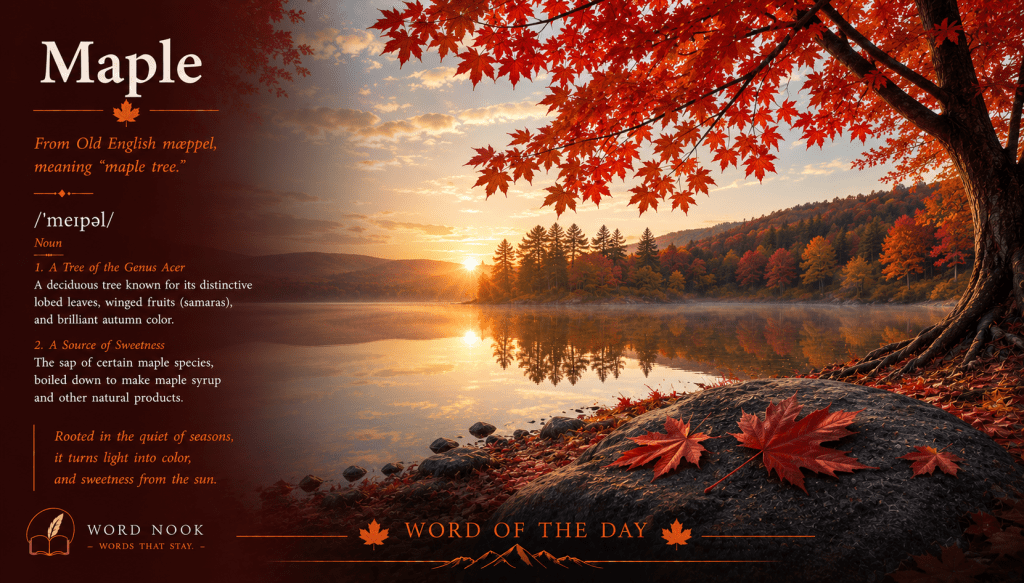
Maple
IPA Pronunciation: /ˈmeɪ.pəl/
Part of Speech: Noun
Origin
Maple belongs to the vocabularies of forests, seasons, color, and enduring growth. It refers to any tree of the genus Acer, renowned for its distinctive leaves, winged seeds, and spectacular autumn foliage.
It suggests beauty through transformation: a tree that becomes most radiant as the growing season ends.
A maple is change made radiant.
Etymology
From Old English: mapulder or mapel-trēow — maple tree
The word has existed in English for over a thousand years, making it one of the language’s oldest tree names.
Despite changes in spelling, its association with woodland beauty and the changing seasons has remained remarkably constant.
Core Definitions
A Tree of the Genus Acer
A deciduous tree known for lobed leaves, paired winged seeds (samaras), and often brilliant autumn colors.
“A maple stood at the edge of the meadow.”
A Source of Maple Syrup and Maple Wood
Certain species are valued for sap, timber, and ornamental planting.
Explanation & Nuance
Maple differs from oak or pine.
It implies:
- Seasonal transformation
- Distinctive leaf shapes
- Autumn brilliance
- Graceful woodland presence
It may be:
- Botanical — a deciduous hardwood tree
- Ecological — habitat and food source
- Poetic — emblem of change and beauty
- Symbolic — maturity, balance, and renewal
A maple is often admired not for permanence, but for its annual transformation.
Natural Dimension
Maples are common in:
- Temperate forests
- Woodlands
- Parks
- River valleys
- Urban landscapes
They contribute:
- Shade
- Habitat for wildlife
- Brilliant autumn foliage
- Winged seeds dispersed by wind
Many species display vivid shades of gold, orange, and crimson each autumn.
Poetic & Literary Use
Maple is deeply poetic because it embodies seasonal change without loss of identity.
A poet may use it literally:
“A scarlet maple blazed against the hillside.”
or metaphorically:
“Her thoughts turned like a maple in October.”
It often appears in writing about:
- Autumn
- Time
- Aging
- Beauty
- Transformation
- Memory
- Cycles of life
- Home
- Landscape
- Resilience
Unlike oak, which often symbolizes steadfastness, maple frequently symbolizes graceful change.
Maple in Poetry
Maple is a highly poetic tree in English literature.
Poets often use it to evoke:
- Autumn’s brilliance
- The beauty of impermanence
- Maturity and reflection
- The turning of seasons
- The coexistence of vitality and decline
Because its most celebrated display occurs before winter, the maple has become a powerful image of radiance in transition.
Experiential Dimension
A maple can evoke:
- Wonder — brilliant seasonal color
- Nostalgia — autumn landscapes and memories
- Peace — shaded avenues and woodland paths
- Reflection — awareness of passing time
- Joy — the vividness of seasonal change
It often feels like nature demonstrating that endings can be beautiful.
Symbolic Dimensions
- Scarlet Leaves — beauty in transition
- Falling Maple Leaf — impermanence and change
- Winged Seeds — continuity and renewal
- Autumn Canopy — maturity and reflection
- Deep Roots — endurance beneath transformation
Maple symbolizes transformation, seasonal wisdom, renewal, and the capacity to remain rooted while changing.
Synonyms & Near-Relations
- Tree — broader category
- Oak — symbol of strength and endurance
- Birch — associated with renewal and beginnings
- Ash — graceful deciduous tree
- Sycamore — another broad-leaved woodland tree
(Only maple fully combines seasonal brilliance, graceful transformation, and iconic autumn imagery.)
Conceptual Relations
- Autumn — season most associated with maple
- Leaf — defining visual feature
- Transformation — central symbolic meaning
- Forest — natural habitat
- Cycle — recurring pattern of change and renewal
Cultural & Intellectual Resonance
Poetry
Maples often symbolize maturity, memory, and the dignity of change.
Art
Their autumn colors have inspired painters, photographers, and landscape artists for centuries.
Ecology
Maples are important components of temperate forest ecosystems.
Philosophy
The maple reflects the idea that change need not diminish beauty—that transformation itself can become a form of flourishing.
Takeaway
Maple names the tree that burns brightest before winter —
the canopy of gold,
amber,
and crimson,
the rooted life that turns passing seasons into spectacle.
It reminds us that change need not diminish beauty,
that maturity can possess its own radiance,
and that some of nature’s most beautiful moments
occur in transition.
In poetry, a maple is autumn made visible —
the scarlet tree on a hillside,
the leaves drifting through cool air,
the living emblem
of transformation,
memory,
and grace.
Some of life’s brightest moments arrive not despite change, but because of it. 🍁
 Word of the Day - The English Nook
Leave a comment