
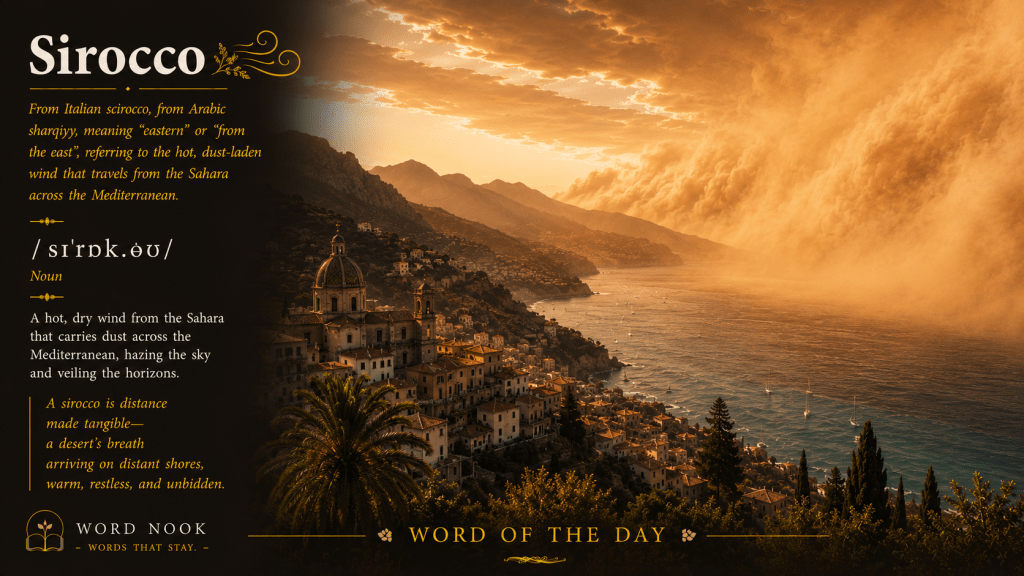
Sirocco
IPA Pronunciation: /sɪˈrɒk.oʊ/ (UK), /səˈrɑː.koʊ/ (US)
Part of Speech: Noun
Origin
Sirocco belongs to the vocabularies of wind, deserts, distance, and atmospheric transformation. It refers to a hot, dry wind originating in the Sahara and moving northward across the Mediterranean, often carrying dust, heat, and haze.
It suggests a force that arrives from far away: weather carrying the character of another landscape.
A sirocco is distance made tangible in the air.
Etymology
From Italian: scirocco
From Arabic: sharq (شرق) — east
The name originally referred to an easterly wind. As the term traveled through Mediterranean languages, it became associated specifically with the hot desert winds crossing from North Africa into southern Europe.
Core Definitions
A Hot Desert Wind
A warm or hot wind blowing from the Sahara toward the Mediterranean region.
“A sirocco swept dust across the coast.”
A Dry, Oppressive Atmospheric Current
By extension, any wind carrying intense heat and dryness.
Explanation & Nuance
Sirocco differs from gale or breeze.
It implies:
- Heat rather than force alone
- Long-distance movement
- Desert origins
- Atmospheric transformation of entire regions
It may be:
- Meteorological — Saharan wind systems
- Geographical — Mediterranean climates
- Poetic — longing, restlessness, foreign influence
- Symbolic — forces arriving from beyond the horizon
A sirocco carries another landscape within itself.
Natural Dimension
Siroccos can bring:
- Heat waves
- Dust-laden skies
- Reduced visibility
- Dry conditions
- Sudden atmospheric shifts
They connect:
- Deserts and coastlines
- Africa and Europe
- Distant regions through moving air
The wind itself becomes a messenger of geography.
Poetic & Literary Use
Sirocco is deeply poetic because it turns wind into a traveler.
A poet may use it literally:
“The sirocco stained the sky with dust.”
or metaphorically:
“A sirocco of memory crossed the years.”
It often appears in writing about:
- Distance
- Travel
- Longing
- Foreignness
- Deserts
- Heat
- Transformation
- Restlessness
- Migration
- Invisible connections between places
Unlike wind, sirocco possesses identity and origin.
It arrives with a history.
Experiential Dimension
A sirocco can evoke:
- Oppression — heavy heat and dryness
- Wonder — awareness of distant landscapes
- Restlessness — air that seems unable to settle
- Foreignness — contact with faraway places
- Anticipation — changing weather and atmosphere
It often feels as though another world has briefly entered your own.
Symbolic Dimensions
- Desert Dust — memory carried across distance
- Hot Wind — passion, intensity, unease
- Hazy Horizon — uncertainty and transition
- Mediterranean Crossing — connection between worlds
- Moving Air Mass — unseen influences shaping experience
Sirocco symbolizes distance, transformation, longing, and the movement of faraway forces into everyday life.
Synonyms & Near-Relations
- Desert Wind — broader category
- Khamsin — hot, dry North African wind
- Harmattan — dust-laden West African wind
- Gale — strong wind, though not necessarily hot
- Breeze — gentler atmospheric movement
(Only sirocco fully combines Saharan origin, heat, dust, and the poetic sense of a distant landscape arriving on the wind.)
Conceptual Relations
- Desert — birthplace of the sirocco
- Heat — defining characteristic
- Distance — carried across regions
- Atmosphere — medium of movement
- Migration — metaphorical parallel to its journey
Cultural & Intellectual Resonance
Poetry
Siroccos often symbolize longing, displacement, passion, and distant influence.
Mediterranean History
For centuries, people have associated the sirocco with dramatic shifts in weather, mood, and daily life.
Geography
The sirocco reveals how landscapes remain connected through atmospheric circulation.
Philosophy
The wind reflects the idea that distant events and places can shape our immediate experience in unseen ways.
Takeaway
Sirocco names the wind that arrives from elsewhere —
the desert crossing the sea
without moving an inch.
It reminds us that distance is never absolute,
that places remain connected through invisible currents,
and that sometimes the world changes
not because we travel,
but because something far away
comes to us.
In poetry, sirocco is the breath of another horizon —
the warm dust-laden air from beyond the sea,
the restless wind carrying traces of distant deserts,
the unseen traveler
that turns atmosphere
into memory,
movement,
and longing.
A sirocco is distance made tangible in the air.

 Word Nook
Leave a comment