
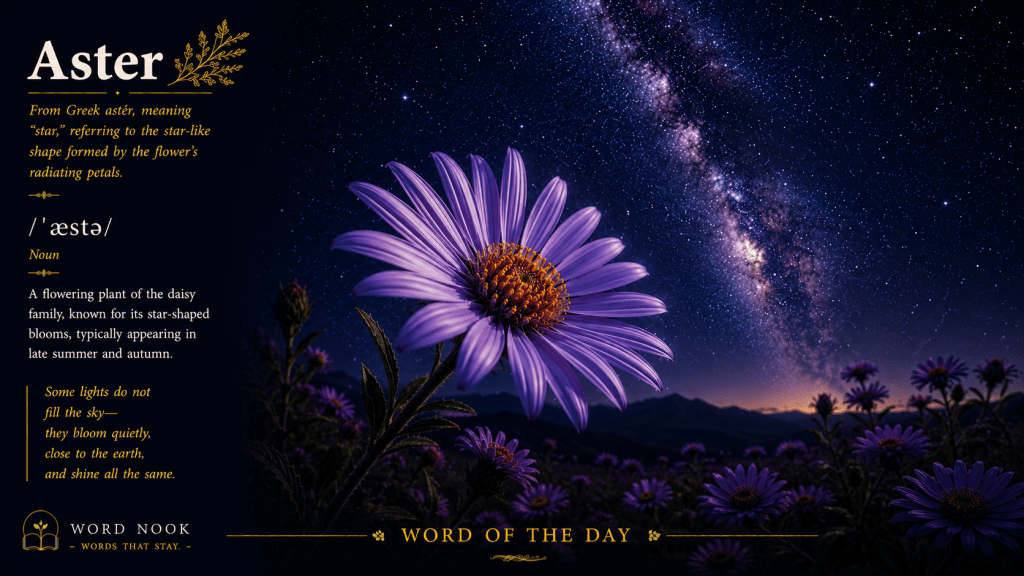
Aster
IPA Pronunciation: /ˈæs.tɚ/
Part of Speech: Noun
Origin
Aster belongs to the vocabularies of flowers, stars, seasons, and quiet beauty. It refers to a flowering plant of the daisy family, known for its star-shaped blossoms, often appearing in late summer and autumn landscapes.
It suggests small radiance: a living point of light growing close to the earth.
An aster is a star that chose to bloom.
Etymology
From Ancient Greek: astḗr (ἀστήρ) — star
The name comes from the flower’s radial shape, resembling a star.
The same root appears in words connected to astronomy, such as asteroid and astral.
Core Definitions
A Star-Shaped Flower
A flowering plant of the Asteraceae family, often with purple, blue, pink, or white petals surrounding a yellow center.
“Wild asters brightened the meadow.”
A Symbol of Delicate Beauty
In poetry and symbolism, aster often represents patience, remembrance, and quiet grace.
Explanation & Nuance
Aster differs from rose or lily.
It implies:
- Small-scale beauty
- Star-like form
- Seasonal transition
- Wild or natural elegance
It may be:
- Botanical — garden and wildflower species
- Seasonal — associated with autumn blooms
- Poetic — earthly stars, memory, gentle light
- Symbolic — patience, love, remembrance
An aster does not dominate a landscape.
It illuminates it.
Natural Dimension
Asters appear in:
- Meadows
- Woodland edges
- Prairies
- Garden borders
- Autumn fields
They create:
- Clusters of color
- Food sources for pollinators
- Late-season beauty
- Continuity as other flowers fade
They often bloom when summer begins surrendering to autumn.
Poetic & Literary Use
Aster is deeply poetic because it connects earth and sky.
A poet may use it literally:
“Purple asters trembled beside the path.”
or metaphorically:
“An aster of memory bloomed in the forgotten garden.”
It often appears in writing about:
- Stars
- Seasons
- Autumn
- Memory
- Small joys
- Fragile beauty
- Nature’s cycles
- Quiet hope
- Farewell and remembrance
Unlike sunflower, aster feels intimate rather than grand.
It is a small light rather than a blazing one.
Experiential Dimension
An aster can evoke:
- Gentleness — delicate petals and small scale
- Nostalgia — late-season landscapes
- Hope — blooming near the end of a cycle
- Peace — quiet meadow beauty
- Wonder — resemblance to distant stars
It often feels like discovering something beautiful rather than being confronted by it.
Symbolic Dimensions
- Star Shape — connection between earth and cosmos
- Autumn Bloom — beauty during transition
- Purple Flower — reflection and dignity
- Meadow Cluster — community and belonging
- Late Flowering — endurance and patience
Aster symbolizes quiet radiance, remembrance, transition, and beauty that persists as seasons change.
Synonyms & Near-Relations
- Daisy — related flower family
- Wildflower — broader category
- Bloom — general flower
- Starwort — another plant name connected to aster-like flowers
- Blossom — poetic term for flowering
(Only aster fully combines star imagery, seasonal blooming, delicate beauty, and symbolic depth.)
Conceptual Relations
- Star — defining visual inspiration
- Autumn — common blooming season
- Meadow — natural setting
- Memory — symbolic association
- Light — emotional quality
Cultural & Intellectual Resonance
Poetry
Asters often symbolize remembrance, tenderness, and the beauty of passing seasons.
Botany
The aster family is one of the largest flowering plant groups on Earth.
Symbolism
Asters have often been associated with patience, love, and wisdom.
Philosophy
The aster reflects the idea that small forms can contain vast meaning — a tiny flower carrying the image of a star.
Takeaway
Aster names the flower that mirrors the heavens —
a small star
rooted in soil.
It reminds us that beauty does not need scale,
that endings can still carry color,
and that quiet things
can hold extraordinary brightness.
In poetry, aster is the earth’s small constellation —
the purple bloom in fading fields,
the star-shaped flower beneath autumn skies,
the gentle reminder
that even as seasons change,
something continues
to open.
Some stars bloom close to the earth.
 Word Nook
Leave a comment