
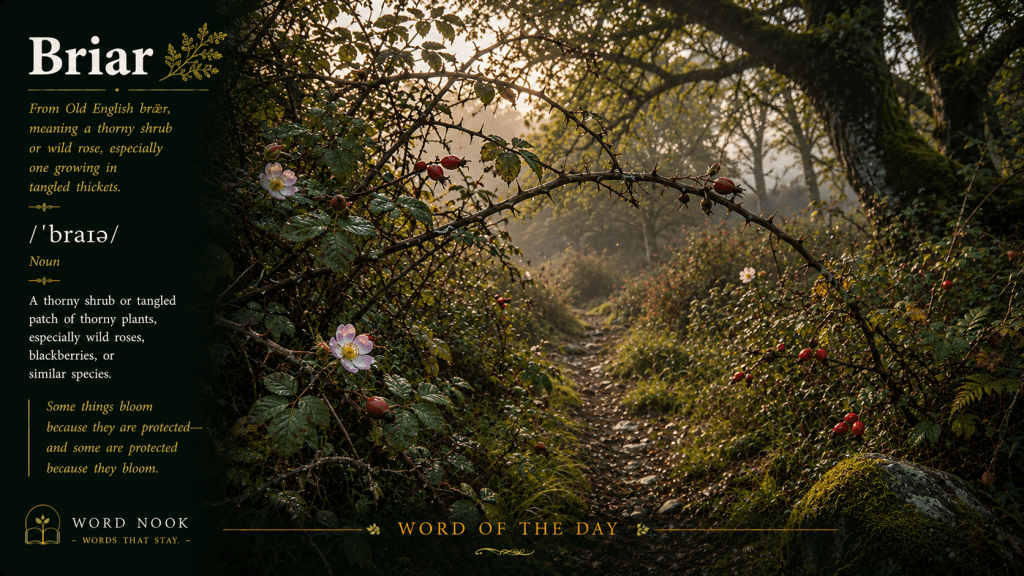
Briar
(also spelled brier)
IPA Pronunciation: /ˈbraɪ.ər/
Part of Speech: Noun
Origin
Briar belongs to the vocabularies of thorns, wild growth, entanglement, and resilience. It refers to a thorny shrub or a dense tangle of prickly stems, especially wild roses, blackberries, or similar plants.
It suggests beauty and difficulty existing together: growth that protects itself through sharpness.
A briar is wildness armed with thorns.
Etymology
From Old English: brǣr — thorny bush, bramble.
The word has deep roots in English landscape vocabulary and has long been associated with hedgerows, uncultivated places, and thorn-covered growth.
Core Definitions
A Thorny Shrub or Bramble
A prickly plant or dense growth of thorn-bearing stems.
“The path disappeared into a briar patch.”
A Tangle of Thorny Vegetation
An area densely overgrown with brambles or similar plants.
Explanation & Nuance
Briar differs from bush or shrub.
It implies:
- Thorns and resistance
- Wild, unmanaged growth
- Entanglement
- Protective harshness
It may be:
- Botanical — wild rose briars, blackberry briars
- Landscape-related — hedgerows, thickets, abandoned fields
- Poetic — obstacles, defenses, hidden beauty
- Symbolic — resilience, suffering, and protection
A briar is rarely inviting, yet often conceals life within it.
Natural Dimension
Briars appear in:
- Forest edges
- Hedgerows
- Overgrown fields
- Roadside thickets
- Abandoned clearings
They create:
- Shelter for birds and animals
- Natural barriers
- Dense vegetation
- Seasonal flowers and berries
Many creatures find shelter within briars because what deters danger also creates refuge.
Poetic & Literary Use
Briar is deeply poetic because it unites beauty and difficulty.
A poet may use it literally:
“Morning dew glittered on the briars.”
or metaphorically:
“She carried her heart through a briar of old regrets.”
It often appears in writing about:
- Love and pain
- Protection
- Wildness
- Obstacles
- Memory
- Transformation
- Fairy tales
- Resilience
- Hidden beauty
- Untamed landscapes
Unlike thorn, briar suggests an entire living system rather than a single sharp point.
It is both barrier and habitat.
Experiential Dimension
A briar can evoke:
- Caution — awareness of thorns
- Wonder — flowers blooming among sharp stems
- Frustration — entanglement and obstruction
- Respect — strength expressed through vulnerability
- Nostalgia — hedgerows, countryside paths, and childhood exploration
It often feels like beauty refusing easy access.
Symbolic Dimensions
Thorns
Pain, protection, sacrifice, and survival.
Wild Roses
Beauty intertwined with difficulty.
Briar Patch
Complexity, resistance, and entanglement.
Hidden Nest
Life protected within difficulty.
Overgrown Path
Forgotten journeys, memories, and neglected possibilities.
Briar symbolizes resilience, guarded beauty, hardship, and the paradox that what protects us may also wound.
Synonyms & Near-Relations
- Bramble — thorny shrub, especially blackberry
- Thicket — dense growth of shrubs and small trees
- Hedge — boundary of shrubs or bushes
- Thornbush — thorn-bearing shrub
- Undergrowth — dense low vegetation
(Only briar fully combines thorniness, wild beauty, entanglement, and literary resonance.)
Conceptual Relations
- Thorn — defining characteristic of many briars
- Protection — ecological and symbolic function
- Wildness — growth beyond cultivation
- Entanglement — physical and metaphorical quality
- Resilience — thriving despite harsh conditions
Cultural & Intellectual Resonance
Poetry
Briars often symbolize difficult love, memory, endurance, and beauty protected by pain.
Folklore & Fairy Tales
Briars often guard places of transformation. In stories such as Sleeping Beauty, the thorn hedge protects what must remain hidden until the proper moment arrives.
Landscape Tradition
Briars are iconic elements of hedgerows and uncultivated countryside.
Philosophy
The briar reflects the truth that vulnerability often develops defenses, and that what appears hostile may shelter something precious.
Takeaway
Briar names the thorny growth that guards itself —
the tangled living barrier
where flowers,
berries,
and sharpness coexist.
It reminds us that beauty is not always gentle,
that protection can take difficult forms,
and that some of life’s richest places
require patience to enter.
In poetry, briar is the wild hedge at the edge of the path —
the rose among thorns,
the bramble catching at sleeves,
the resilient growth
through which beauty
and difficulty
remain inseparably entwined.
The sharpest thorns often grow closest to what is worth protecting.

 Word Nook
Leave a comment