
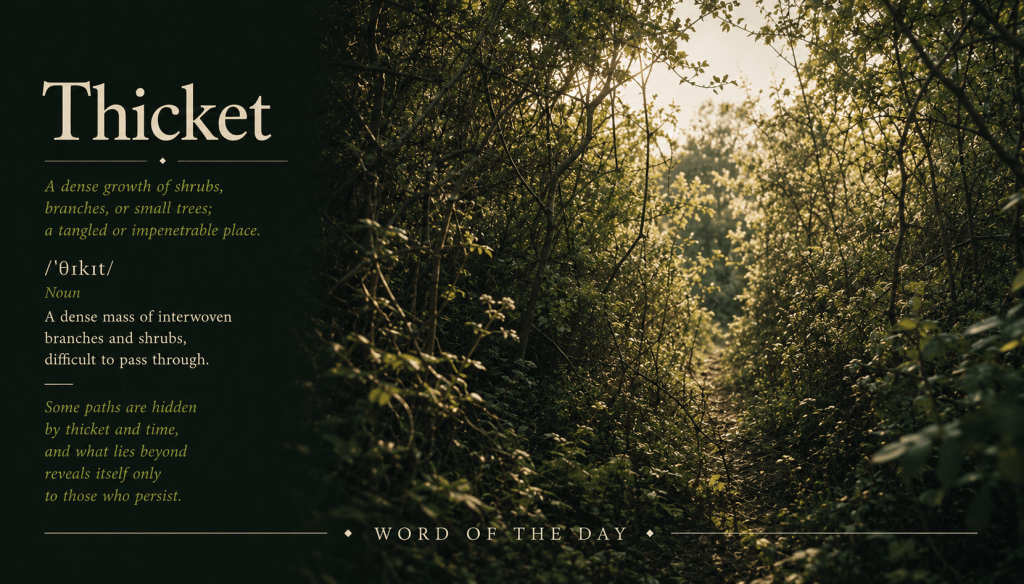
Thicket
IPA Pronunciation: /ˈθɪk.ɪt/
Part of Speech: Noun
Origin
Thicket belongs to the vocabularies of wilderness, density, concealment, and difficult passage. It refers to a dense growth of shrubs, bushes, or small trees growing close together — a place where movement slows and vision narrows.
It suggests nature in its crowded form: life pressed tightly enough to become barrier as well as shelter.
A thicket is growth made difficult to pass through.
Etymology
From Old English: þiccet — dense place, from þicce meaning thick
The word preserves the sense of crowded vegetation and obstructed space.
Core Definitions
Dense Growth of Shrubs or Trees
A tightly packed area of bushes or small trees.
“They disappeared into the thicket.”
Figurative Complexity
A tangled or confusing situation.
“He found himself in a thicket of arguments.”
Explanation & Nuance
Thicket differs from forest or grove.
It implies:
Density rather than openness
Obstruction rather than easy passage
Concealment rather than visibility
Wildness rather than arrangement
It may be:
Natural — brambles, underbrush, young woodland
Emotional — confusion, tangled thought
Narrative — difficulty, danger, hidden paths
Poetic — the mind or memory becoming overgrown
A thicket is where movement must become deliberate.
Natural Dimension
Thickets appear in:
Blackberry brambles
Young forests thick with saplings
Hedgerows overgrown with vines
Riverbanks crowded with reeds and brush
They create:
Shelter
Shadow
Protection
Entanglement
A thicket can hide both refuge and threat.
Poetic & Literary Use
Thicket is deeply poetic because it turns density into atmosphere.
A poet may use it literally:
“The deer vanished into the pine thicket.”
Or metaphorically:
“She wandered through a thicket of old grief.”
It often appears in writing about:
Memory
Confusion
Childhood woods
Desire
Fear
Secrets
Transformation
Hidden paths
Folklore
The unconscious mind
Unlike woods, thicket feels closer and more tangled.
It is not landscape observed — it is landscape entered.
Experiential Dimension
A thicket can evoke:
Mystery — what cannot be clearly seen
Difficulty — progress slowed by resistance
Protection — hiddenness from the world
Anxiety — fear of what lies within
Discovery — the possibility of something concealed
It often feels like being surrounded by what resists clarity.
Symbolic Dimensions
Brambles — pain tied to passage
Maze — confusion without clear route
Nest — shelter inside density
Shadowed Path — movement through uncertainty
Vines — growth becoming entanglement
Thicket symbolizes complexity, concealment, and the labor of finding a way through.
Synonyms & Near-Relations
Brush — dense low vegetation
Copse — small group of trees (less dense)
Grove — open cluster of trees
Undergrowth — vegetation beneath trees
Maze — figurative complexity
Only thicket fully combines natural density, obstruction, and symbolic entanglement.
Conceptual Relations
Wilderness — untamed growth
Confusion — mental thicket
Protection — hidden space within density
Threshold — crossing into uncertainty
Persistence — movement despite obstruction
Cultural & Intellectual Resonance
Poetry
Thickets often represent memory, danger, and the hidden self.
Folklore
Heroes pass through thickets before transformation or revelation.
Psychology
The mind’s unresolved thoughts are often imagined as tangled growth.
Philosophy
Thicket reflects how truth is often reached through complication, not direct paths.
Takeaway
Thicket names the place where growth becomes resistance —
where life gathers so densely
that passage itself becomes meaningful.
It reminds us that not all paths are clear,
that shelter and difficulty often share the same ground,
and that what is hidden
must sometimes be entered slowly.
In poetry, thicket is the mind overgrown —
the bramble of memory,
the shadowed place
where one gets lost
before finding
what could not be reached
by open roads.
Some places cannot be crossed quickly. They must be entered like a thicket.
 Word of the Day - The English Nook
Leave a comment