
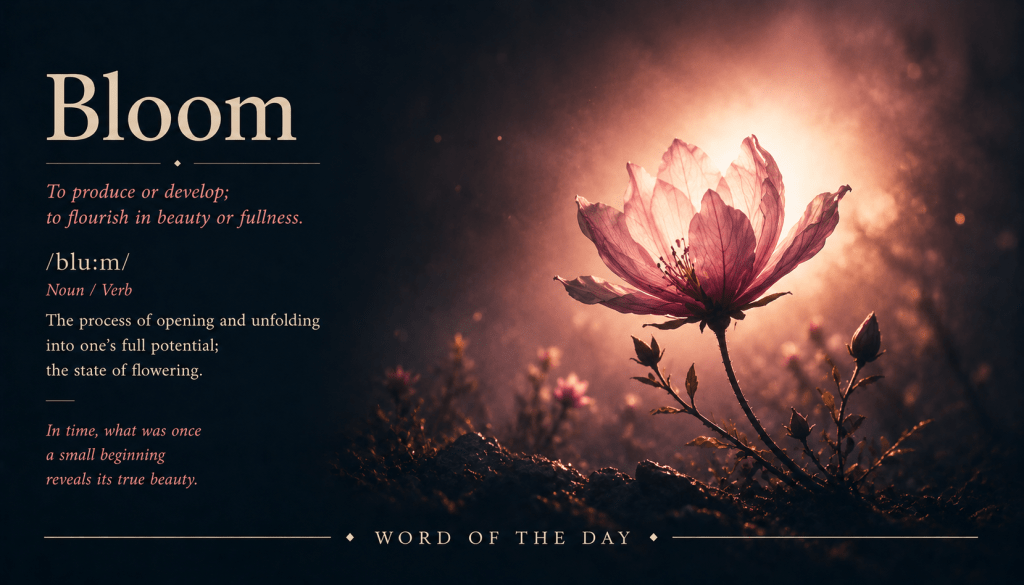
Bloom
IPA Pronunciation: /bluːm/
Part of Speech: Noun & Verb
Origin
Bloom belongs to the vocabularies of growth, flowering, ripeness, and emergence. It refers to the opening of a flower into full life — and, more broadly, to any moment of unfolding into visible fullness, beauty, or maturity.
It suggests becoming through expansion: what was held inward turning outward into form.
A bloom is arrival through opening.
Etymology
From Old Norse / Old English related forms: blómi / blōma — flower, mass of flowers, flourishing
The word carries both the literal flower and the larger sense of flourishing life.
Core Definitions
Flowering
The blossom of a plant; the visible flower itself.
“The roses were in bloom.”
To Flower or Open
To produce blossoms or come into full beauty or maturity.
“The garden bloomed in spring.”
Fullness of Health or Beauty
A glow of vitality, freshness, or ripeness.
“She had the bloom of youth.”
Explanation & Nuance
Bloom differs from growth.
It implies:
Visibility rather than preparation
Fullness rather than beginning
Beauty joined to completion
A moment of revealed potential
It may be:
Natural — flowers, orchards, spring fields
Emotional — confidence, love, joy unfolding
Creative — talent reaching expression
Poetic — becoming fully present in one’s own form
Bloom belongs to emergence after hidden preparation.
Natural Dimension
Bloom appears in:
Flowers opening in spring
Fruit trees flowering before harvest
Algae spreading across water
Light spreading across morning fields
It reflects:
Ripeness
Seasonal return
Transformation
The visible sign of inner life
Bloom is what growth looks like when it can no longer stay hidden.
Poetic & Literary Use
Bloom is deeply poetic because it joins beauty with time.
A poet may use it literally:
“The lilacs bloomed beside the stone wall.”
Or metaphorically:
“Her silence bloomed into song.”
It often appears in writing about:
Spring
Love
Youth
Memory
Desire
Awakening
Grief turning to tenderness
Identity becoming visible
Unlike flower, bloom emphasizes the act of opening.
It is beauty in motion.
Experiential Dimension
Bloom can evoke:
Hope — the return of life
Joy — visible flourishing
Tenderness — fragility within beauty
Ripeness — readiness after waiting
Transience — beauty that cannot remain forever
It often feels like both beginning and nearing.
Symbolic Dimensions
Flower — visible life unfolding
Spring — return after dormancy
Garden — cultivated becoming
Morning Light — opening into clarity
Blush — emotional blooming made visible
Bloom symbolizes fulfillment, emergence, and the temporary brilliance of becoming.
Synonyms & Near-Relations
Blossom — flower or flowering (closely related)
Flourish — thrive fully
Unfold — gradual opening
Ripen — move toward readiness
Awaken — come into active life
Only bloom fully combines flowering, beauty, timing, and emotional unfolding.
Conceptual Relations
Growth — what precedes bloom
Beauty — visible flourishing
Time — necessary for unfolding
Season — rhythm of return
Ephemerality — bloom does not last forever
Cultural & Intellectual Resonance
Poetry
Bloom often represents youth, love, awakening, and the fragile beauty of time.
Art
Flowers in bloom symbolize both life and mortality.
Philosophy
Bloom reflects the paradox that fullness is often closest to fading.
Psychology
Personal blooming suggests self-realization and emotional emergence.
Takeaway
Bloom names the moment when hidden life becomes visible —
when what has been forming quietly
opens into the world.
It reminds us that beauty requires season,
that becoming often happens slowly,
and that the most radiant moments
are often the most temporary.
In poetry, bloom is the visible breath of time —
the flower after winter,
the voice after silence,
the self
arriving at last
in its own unfolding light.
Bloom is growth becoming visible.
 Word of the Day - The English Nook
Leave a comment