
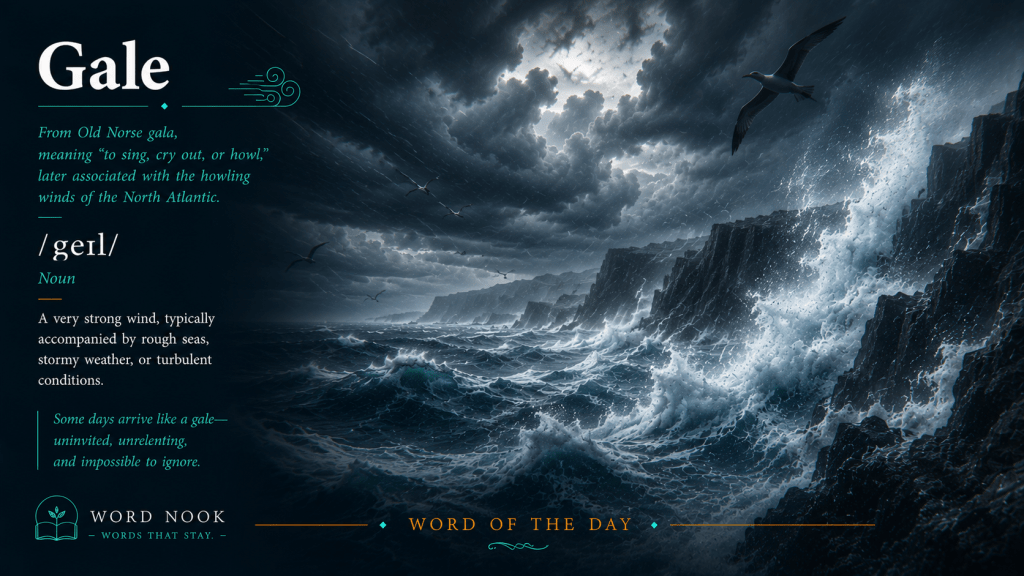
Gale
IPA Pronunciation: /ɡeɪl/
Part of Speech: Noun
Origin
Gale belongs to the vocabularies of wind, force, turbulence, and elemental power. It refers to a very strong wind, especially one capable of bending trees, driving waves, and altering landscapes.
It suggests motion intensified beyond the ordinary: air transformed into a visible force.
A gale is wind made undeniable.
Etymology
The exact origin is uncertain, but gale entered English in the medieval period as a term for a strong wind or storm wind.
The word has retained its association with powerful atmospheric movement for centuries.
Core Definitions
A Strong Wind
A powerful, sustained wind, often associated with storms or rough seas.
“A gale swept across the coast.”
Figurative Force or Outburst
An intense surge of emotion, laughter, or activity.
“A gale of laughter filled the room.”
Explanation & Nuance
Gale differs from breeze or gust.
It implies:
Sustained force rather than brief movement
Power rather than gentleness
Atmospheric upheaval
Energy capable of altering surroundings
It may be:
Meteorological — coastal storms, open-ocean winds
Emotional — overwhelming feeling or reaction
Poetic — forces of change, upheaval, or liberation
Symbolic — nature’s indifference and vitality
A gale is not merely air in motion.
It is weather asserting itself.
Natural Dimension
Gales appear in:
Stormy coastlines
Open oceans
Mountain passes
Winter fronts
Tempestuous weather systems
They create:
Roaring sound
Bending trees
Driving rain
Rough seas
Shifting clouds
Unlike a breeze, a gale announces its presence.
Poetic & Literary Use
Gale is deeply poetic because it transforms the invisible into something physical and dramatic.
A poet may use it literally:
“A gale rattled the windows through the night.”
Or metaphorically:
“A gale of grief swept through him.”
It often appears in writing about:
Storms
Change
Freedom
Conflict
Nature’s power
Emotional upheaval
Travel by sea
Resistance
Renewal after destruction
The sublime
Unlike wind, gale carries intensity and consequence.
It is movement that leaves traces.
Experiential Dimension
A gale can evoke:
Awe — confrontation with elemental power
Fear — loss of control before natural force
Excitement — raw energy and motion
Liberation — breaking of stillness and stagnation
Vulnerability — awareness of human smallness
It often feels like the world refusing to remain still.
Symbolic Dimensions
Storm Wind — transformation and upheaval
Bending Trees — resilience under pressure
White-Capped Waves — unleashed energy
Open Sea — exposure to forces beyond control
Cleared Sky After Gale — renewal following turmoil
Gale symbolizes disruption, vitality, change, and the overwhelming energies that periodically reshape life.
Synonyms & Near-Relations
Wind — general atmospheric movement
Gust — brief strong burst of wind
Storm — broader weather event
Tempest — violent storm, often literary
Squall — sudden sharp increase in wind
Only gale fully combines sustained wind, elemental force, and poetic grandeur.
Conceptual Relations
Air — medium through which gales move
Storm — frequent companion of gales
Power — defining characteristic
Change — consequence of strong wind
Exposure — human condition during a gale
Cultural & Intellectual Resonance
Poetry
Gales often symbolize upheaval, freedom, fate, and nature’s untamed power.
Maritime Literature
Sailors have long feared and respected gales as forces capable of altering journeys and destinies.
Romanticism
Gales embody the sublime: beauty mixed with danger and overwhelming scale.
Philosophy
The gale reflects forces beyond human control that nonetheless shape human lives.
Takeaway
Gale names the moment when wind becomes force —
when the invisible
takes on weight,
sound,
and consequence.
It reminds us that change is not always gradual,
that power can arrive without warning,
and that some transformations
sweep through the world
with elemental certainty.
In poetry, gale is the voice of unsettled weather —
the wind bending pines along the coast,
the roar across dark water,
the great rushing force
that tears away the stagnant
and leaves the landscape
changed.
A gale is what happens when the wind decides it will no longer be ignored.
 Word Nook
Leave a comment