
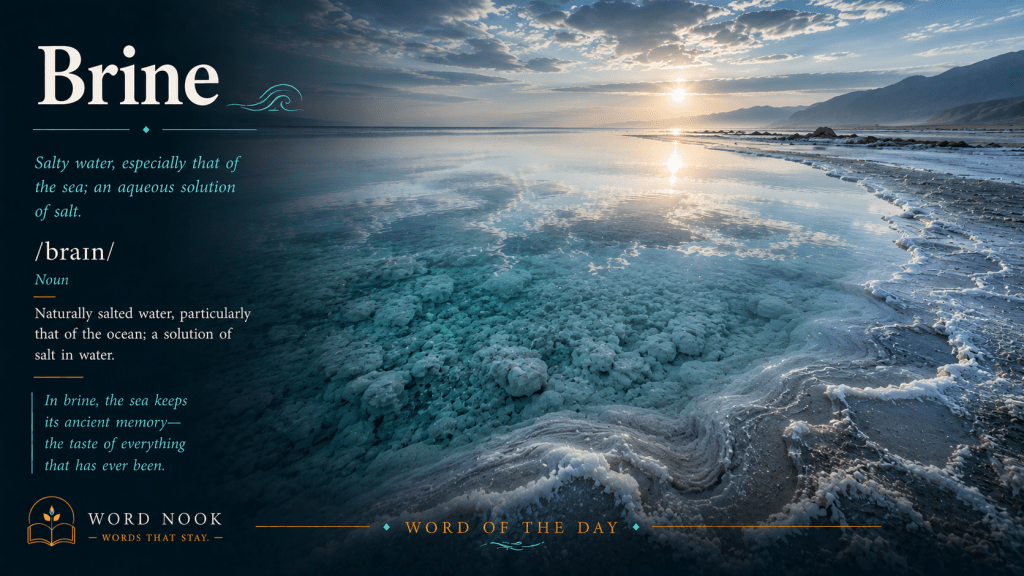
Brine
IPA Pronunciation: /braɪn/
Part of Speech: Noun & Verb
Origin
Brine belongs to the vocabularies of salt, preservation, sea-water, and mineral intensity. It refers to strongly salty water — especially seawater or water saturated with salt for preserving food.
It suggests concentration through dissolution: water transformed by what it carries invisibly within it.
Brine is water altered by endurance.
Etymology
From Old English: brīn — salt water, sea, brine
The word has long been associated with oceans, curing, and the preservative power of salt.
Core Definitions
Salt Water
Water containing a high concentration of salt.
“The fish were stored in brine.”
Preserving Solution
Salted liquid used to cure or preserve food.
(Verb) To Soak in Salt Water
“To brine meat before cooking.”
Explanation & Nuance
Brine differs from seawater or salt alone.
It implies:
Concentration rather than dilution
Preservation through saturation
Mineral harshness mixed with necessity
Transformation through immersion
It may be:
Natural — ocean water, salt marsh pools
Culinary — curing and preserving food
Emotional — tears, bitterness, endurance
Poetic — the sea as both life-giving and corrosive
Brine is never neutral water.
Natural Dimension
Brine appears in:
Oceans and tidal pools
Salt marshes
Evaporating coastal flats
Preserved foods submerged in saltwater
It creates:
Preservation
Corrosion
Density
Harsh vitality
Brine sustains some forms of life while eroding others.
Poetic & Literary Use
Brine is deeply poetic because it joins preservation with harshness.
A poet may use it literally:
“Brine darkened the harbor stones.”
Or metaphorically:
“His voice carried the brine of old grief.”
It often appears in writing about:
The sea
Voyages
Memory
Survival
Salt tears
Weathered endurance
Decay and preservation together
Fishermen and coasts
Long passage through time
Hard-won resilience
Unlike water, brine feels elemental and weathered.
It carries the taste of distance.
Experiential Dimension
Brine can evoke:
Harshness — salt stinging skin or wounds
Vitality — oceanic life and mineral force
Nostalgia — coastal air and harbors
Preservation — survival through difficult conditions
Melancholy — tears and sea-weathered memory
It often feels like something ancient remaining in the world.
Symbolic Dimensions
Salt Water — endurance and purification
Sea Spray — contact with elemental vastness
Curing Brine — preservation through difficulty
Tear Salt — grief embodied physically
Tidal Flats — mineral landscapes between land and sea
Brine symbolizes endurance, memory, preservation, and the harsh conditions through which life continues.
Synonyms & Near-Relations
Seawater — ocean water generally
Saltwater — water containing salt
Salinity — degree of salt concentration
Pickling Liquid — culinary preserving solution
Tears — emotionally symbolic salt water
Only brine fully combines salt concentration, preservation, harshness, and oceanic resonance.
Conceptual Relations
Salt — defining substance of brine
Preservation — central practical function
Sea — natural home of brine
Endurance — survival through saturation
Corrosion — the wearing force of salt over time
Cultural & Intellectual Resonance
Poetry
Brine often symbolizes voyages, grief, endurance, and elemental reality.
Maritime Tradition
Brine evokes sailors, storms, harbors, and ocean life.
Cuisine
Brining preserves and transforms food through controlled saturation.
Philosophy
Brine reflects how difficult conditions may preserve as much as they erode.
Takeaway
Brine names water transformed by salt —
the sea concentrated into taste,
preservation,
and sting.
It reminds us that endurance often leaves traces,
that survival may require immersion in harshness,
and that what preserves life
can also mark it deeply.
In poetry, brine is the taste of the ancient sea —
the salt on harbor wind,
the sting within tears,
the mineral memory
left behind
by time,
weather,
and long passage through the world.
Brine is what water becomes after surviving the sea for too long.

 Word Nook
Leave a comment