
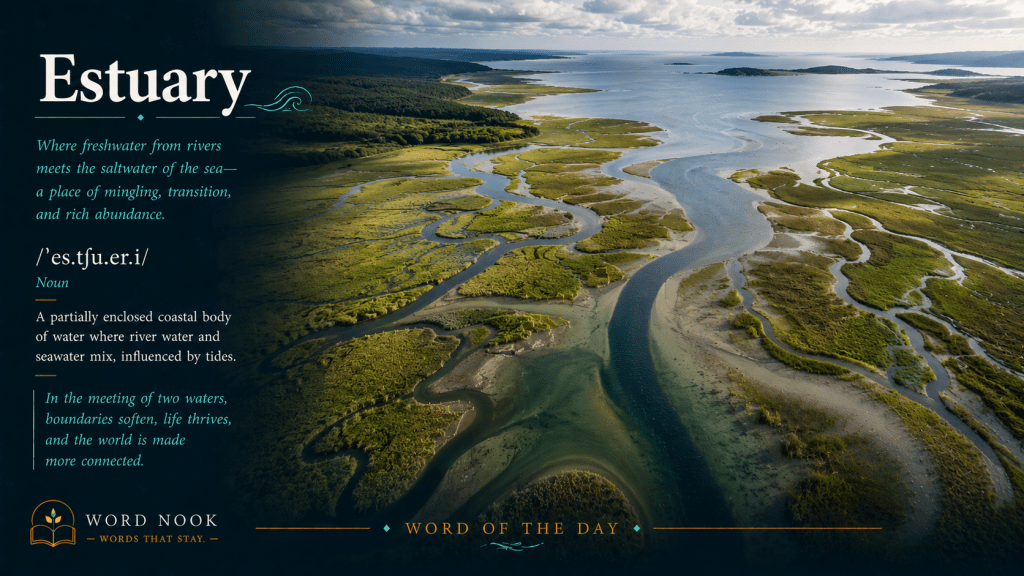
Estuary
IPA Pronunciation: /ˈɛs.tʃuˌɛr.i/
Part of Speech: Noun
Origin
Estuary belongs to the vocabularies of confluence, transition, brackish water, and ecological meeting points. It refers to the tidal mouth of a river where freshwater and seawater mix.
It suggests union without complete merging: a place where different currents meet, alter one another, and create a distinct world between categories.
An estuary is a threshold where waters learn each other.
Etymology
From Latin: aestuarium — tidal marsh, inlet
Related to aestus meaning tide, surge, boiling movement
The word has always carried associations of tidal motion and transitional waters.
Core Definitions
Tidal River Mouth
The partly enclosed coastal body of water where river water mixes with the sea.
“The birds gathered along the estuary.”
Ecological Transition Zone
A biologically rich region shaped by the meeting of fresh and salt water.
Explanation & Nuance
Estuary differs from delta or bay.
It implies:
Mixture rather than separation
Transition rather than fixed identity
Tidal influence moving inward from the sea
Constant negotiation between currents
It may be:
Geographical — river mouths and coastal wetlands
Ecological — habitats rich in biodiversity
Emotional — spaces of ambiguity and becoming
Poetic — places between origins and destinations
An estuary belongs equally to river and ocean, yet fully to neither.
Natural Dimension
Estuaries appear in:
River mouths opening into the sea
Salt marshes and tidal flats
Mangrove ecosystems
Migratory bird habitats
Coastal wetlands shaped by tides
They create:
Nutrient richness
Biological diversity
Changing salinity
Continuous movement between fresh and salt water
Estuaries are among the most productive ecosystems on Earth.
Poetic & Literary Use
Estuary is deeply poetic because it transforms meeting into landscape.
A poet may use it literally:
“Mist drifted across the estuary at dawn.”
Or metaphorically:
“Memory became an estuary where grief and joy mingled.”
It often appears in writing about:
Thresholds
Identity
Migration
Transformation
Blending
Tides
Belonging and displacement
Origins meeting endings
Ambiguity
Emotional convergence
Unlike river or ocean, estuary emphasizes relation.
It is a geography of coexistence.
Experiential Dimension
An estuary can evoke:
Calm — slow tidal movement
Ambiguity — waters neither fully fresh nor salt
Fertility — life flourishing through mixture
Melancholy — endings dissolving into beginnings
Wonder — ecosystems shaped by transition
It often feels like standing where categories loosen.
Symbolic Dimensions
River Mouth — passage from inward land to open sea
Brackish Water — blended identity
Tide Entering River — outside forces reaching inward
Marsh Grass — resilience within instability
Migratory Birds — movement between worlds
Estuary symbolizes transition, coexistence, and the fertile complexity created when different worlds meet.
Synonyms & Near-Relations
Delta — sediment-rich river branching at the sea
Bay — broad coastal inlet
Lagoon — shallow separated coastal water
Inlet — narrow coastal opening
Confluence — meeting of rivers or forces
Only estuary fully combines tidal mixing, ecological richness, and transitional identity.
Conceptual Relations
Threshold — defining nature of estuaries
Confluence — meeting of waters and systems
Tide — oceanic influence reaching inland
Transformation — identities altered through mixture
Interdependence — life emerging through interaction
Cultural & Intellectual Resonance
Poetry
Estuaries often symbolize blended identities, emotional transition, and reconciliation.
Ecology
Estuaries sustain fisheries, migratory species, and coastal ecosystems.
Geography
They reveal the dynamic relationship between inland and oceanic systems.
Philosophy
The estuary reflects the idea that meaning often emerges in intermediate states rather than absolutes.
Takeaway
Estuary names the place where waters meet without fully surrendering themselves —
where river and sea
enter into continual exchange.
It reminds us that transition can be fertile,
that identity may deepen through mixture,
and that some of the richest forms of life
emerge between categories
rather than inside them.
In poetry, estuary is the meeting-place of currents —
the tidal mouth beneath mist,
the brackish world between land and ocean,
the living threshold
where separate journeys
become part
of the same moving water.
An estuary is where separate waters learn how to belong to the same tide.
 Word Nook
Leave a comment