
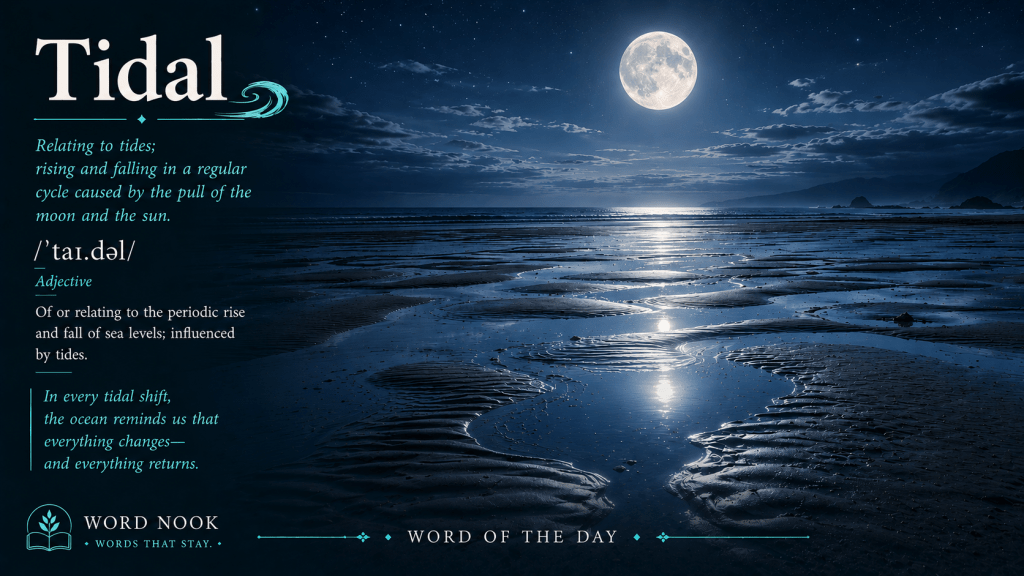
Tidal
IPA Pronunciation: /ˈtaɪ.dəl/
Part of Speech: Adjective
Origin
Tidal belongs to the vocabularies of oceans, cycles, gravitational movement, and overwhelming force. It describes anything related to tides — the rhythmic rising and falling of water shaped primarily by the moon’s gravitational pull.
It suggests motion governed by larger forces: recurring change beyond individual control.
Tidal means moved by something vast and cyclical.
Etymology
From tide + the adjectival suffix -al
Tide comes from Old English: tīd — time, season, period
Originally associated with recurring intervals of time, the word later became closely tied to the cyclical movement of the sea.
Core Definitions
Relating to Tides
Connected to the regular rise and fall of ocean water.
“Tidal currents shaped the coastline.”
Moving in Powerful Cycles
Characterized by overwhelming rhythmic force.
“She felt a tidal wave of emotion.”
Explanation & Nuance
Tidal differs from oceanic or watery.
It implies:
Rhythmic recurrence
Movement governed by external cosmic forces
Large-scale flow beyond human control
Alternation between advance and retreat
It may be:
Natural — tidal rivers, tidal flats, tidal currents
Emotional — overwhelming recurring feeling
Social — sweeping collective movements
Poetic — cycles of return, loss, or transformation
Tidal movement is never entirely still.
Natural Dimension
Tidal phenomena appear in:
Coastlines changing with the sea
Estuaries filling and emptying
Moon-governed ocean rhythms
Wet sand revealed and concealed daily
They create:
Cycles
Erosion
Renewal
Changing boundaries between land and water
The tidal world is always in transition.
Poetic & Literary Use
Tidal is deeply poetic because it joins intimacy with cosmic scale.
A poet may use it literally:
“Tidal water flooded the dark marsh.”
Or metaphorically:
“A tidal grief moved through the house.”
It often appears in writing about:
Emotion
Memory
Return
Longing
The moon
Transformation
Overwhelming force
Cycles of history
Love and loss
The unconscious mind
Unlike wave, tidal suggests inevitability and recurrence.
It is movement obeying something larger than itself.
Experiential Dimension
Tidal can evoke:
Overwhelm — force difficult to resist
Rhythm — recurring emotional or natural cycles
Submission — yielding to larger powers
Awe — awareness of cosmic influence
Instability — shifting boundaries and conditions
It often feels like standing inside a pattern older than human intention.
Symbolic Dimensions
Moon — distant force shaping life
Rising Tide — arrival of emotion or change
Retreating Water — loss or withdrawal
Shoreline — threshold constantly rewritten
Tidal Pull — attraction impossible to fully escape
Tidal symbolizes cyclical power, inevitability, and the deep rhythms governing both nature and inner life.
Synonyms & Near-Relations
Oceanic — related to the sea broadly
Cyclical — recurring in patterns
Rhythmic — moving with repeated flow
Surging — forcefully advancing
Undulating — wave-like movement
Only tidal fully combines cyclical recurrence, oceanic force, and gravitational inevitability.
Conceptual Relations
Cycle — defining structure of tides
Moon — cosmic influence behind tidal motion
Return — tides always come again
Threshold — changing boundary between sea and land
Power — movement beyond human control
Cultural & Intellectual Resonance
Poetry
Tidal imagery often represents overwhelming feeling, recurring memory, and emotional inevitability.
Science
Tides reveal gravitational relationships between Earth, moon, and sun.
Psychology
Tidal metaphors describe emotions that return in waves and cycles.
Philosophy
Tidal movement reflects how life is governed by rhythms larger than individual will.
Takeaway
Tidal names the movement shaped by distant forces —
the rising and falling
that returns again and again.
It reminds us that much of life moves cyclically,
that boundaries are rarely fixed,
and that some powers
act upon us continuously
whether we notice them or not.
In poetry, tidal is the rhythm beneath the shore —
the moon pulling at dark water,
the recurring surge of memory,
the vast returning motion
through which loss,
desire,
and time
continue to move.
Tidal is what happens when movement begins obeying the moon instead of us.

 Word Nook
Leave a comment