
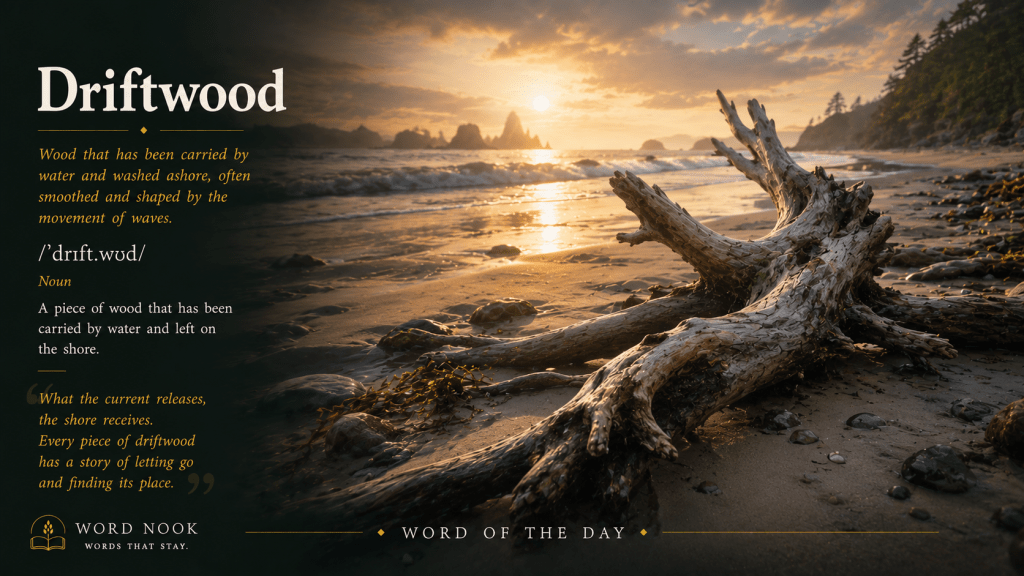
Driftwood
IPA Pronunciation: /ˈdrɪftˌwʊd/
Part of Speech: Noun
Origin
Driftwood belongs to the vocabularies of the sea, weathering, displacement, and survival after movement. It refers to wood carried by rivers, tides, or oceans and eventually cast ashore, shaped by long exposure to water, salt, and time.
It suggests endurance through wandering: something once rooted, now transformed by passage.
Driftwood is memory shaped by currents.
Etymology
Compound of drift + wood
Drift comes from Old Norse and Germanic roots associated with being driven or carried along by movement beyond one’s control.
The word preserves the idea of wood no longer anchored to its original place.
Core Definitions
Wood Carried by Water
Branches, trunks, or fragments transported by rivers or the sea and washed ashore.
“Driftwood lined the empty beach.”
Symbol of Weathered Survival
In literary use, driftwood often represents displacement, endurance, or lives altered by time and movement.
Explanation & Nuance
Driftwood differs from timber or branch.
It implies:
Separation from origin
Transformation through exposure
Movement without fixed destination
Beauty created by weathering
It may be:
Natural — bleached wood on shorelines
Emotional — lives shaped by wandering or loss
Poetic — remnants carried through time
Symbolic — survival after uprooting
Driftwood carries the history of motion within its surface.
Natural Dimension
Driftwood appears in:
Ocean beaches after storms
Riverbanks after flooding
Tidal estuaries
Rocky coasts shaped by waves
It creates:
Textures smoothed by erosion
Pale weathered surfaces
Signs of long travel
Temporary shoreline structures
Unlike living trees, driftwood no longer grows — it arrives.
Poetic & Literary Use
Driftwood is deeply poetic because it transforms displacement into form.
A poet may use it literally:
“Driftwood rested along the winter shore.”
Or metaphorically:
“They moved through the city like driftwood after the storm.”
It often appears in writing about:
Exile
Memory
Shipwreck
Survival
Time
The sea
Wandering
Loss of roots
Transformation
Aftermath
Unlike wreckage, driftwood feels softened rather than destroyed.
It is ruin made gentle by time.
Experiential Dimension
Driftwood can evoke:
Melancholy — separation from origin
Peace — stillness after long movement
Resilience — endurance through weathering
Loneliness — solitary remains cast ashore
Beauty — forms shaped unintentionally by nature
It often feels like the sea returning something altered.
Symbolic Dimensions
Bleached Wood — time exposed visibly
Shoreline — threshold between journey and rest
Ocean Current — forces shaping destiny
Broken Branch — severed origin
Smoothed Surface — suffering transformed through passage
Driftwood symbolizes survival, displacement, transformation, and the strange beauty left by long endurance.
Synonyms & Near-Relations
Flotsam — floating debris from wreckage
Timber — processed or structural wood
Branch — living extension of a tree
Wreckage — damaged remains after destruction
Relic — surviving remnant of the past
Only driftwood fully combines wandering, weathering, oceanic movement, and softened survival.
Conceptual Relations
Current — force carrying driftwood
Shore — place of temporary arrival
Weathering — transformation through exposure
Memory — traces of unknown journeys
Rootlessness — separation from origin
Cultural & Intellectual Resonance
Poetry
Driftwood often symbolizes exile, endurance, and lives reshaped by circumstance.
Art & Design
Its weathered textures evoke natural minimalism and time-worn beauty.
Ecology
Driftwood supports shoreline ecosystems and coastal habitats.
Philosophy
Driftwood reflects the idea that identity can survive transformation and dislocation.
Takeaway
Driftwood names what remains after long passage through uncertain waters —
wood once rooted,
now carried,
weathered,
and reshaped by the world.
It reminds us that displacement can alter without erasing,
that endurance leaves visible marks,
and that some forms of beauty
emerge only after wandering.
In poetry, driftwood is the sea’s returned memory —
the pale branch upon the shore,
the remnant smoothed by tide and salt,
the quiet survivor
of distances
too long
to fully know.
Driftwood is what survives after the sea finishes rewriting it.
 Word Nook
Leave a comment