

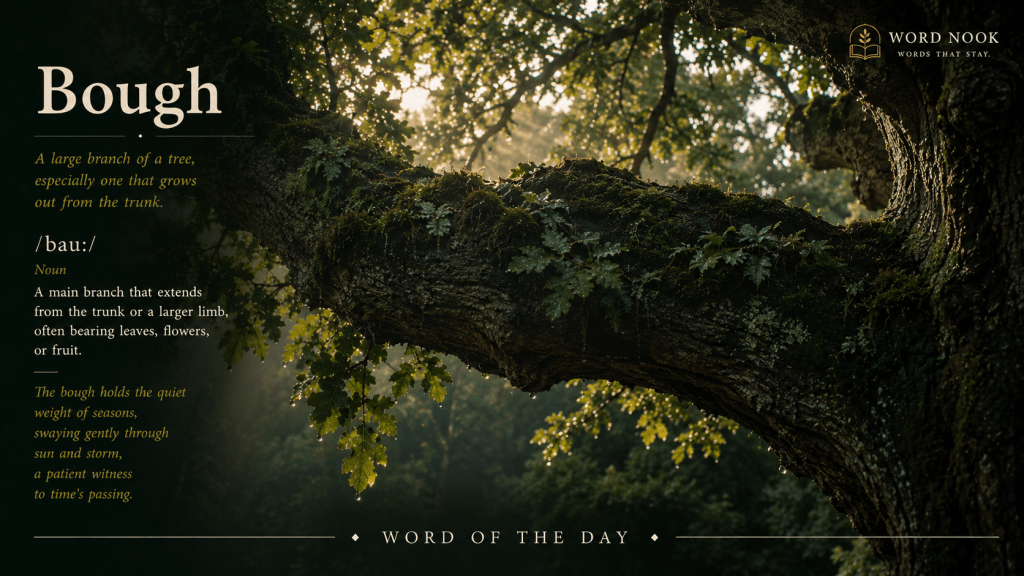
Bough
IPA Pronunciation: /baʊ/
Part of Speech: Noun
Origin
Bough belongs to the vocabularies of trees, shelter, weight, and living structure. It refers to a large branch of a tree — especially one that spreads outward with strength and age.
It suggests support shaped by growth: an extension of the tree that both reaches outward and bears weight.
A bough is strength made organic.
Etymology
From Old English: bōg / bōh — shoulder, arm, branch
The word is related to bodily imagery, preserving the sense of a tree’s limbs extending like arms into space.
Core Definitions
Large Tree Branch
A major branch growing from the trunk of a tree.
“The snow bent the pine boughs.”
Poetic Symbol of Natural Structure
In literary use, bough often represents shelter, endurance, burden, or living extension.
Explanation & Nuance
Bough differs from branch.
It implies:
Larger scale and age
Organic strength rather than mere division
Weight-bearing extension
A more poetic or elevated tone
It may be:
Natural — oak boughs, willow boughs, cedar limbs
Emotional — support, burden, endurance
Symbolic — life extending outward through time
Poetic — sheltering structures of memory or lineage
A bough feels ancient compared to a branch.
Natural Dimension
Boughs appear in:
Old oak trees spreading wide
Pines heavy with snow
Willows hanging over rivers
Orchards bending with fruit
They create:
Shade
Shelter
Canopy
Visible structure within the tree
Boughs hold nests, leaves, fruit, and weather.
Poetic & Literary Use
Bough is deeply poetic because it transforms trees into living architecture.
A poet may use it literally:
“The moon rested between dark boughs.”
Or metaphorically:
“He carried grief like a wintered bough.”
It often appears in writing about:
Forests
Autumn
Snow
Age
Strength
Shelter
Inheritance
Time
Memory
Nature’s endurance
Unlike branch, bough carries emotional and visual weight.
It feels slower, older, and more rooted.
Experiential Dimension
A bough can evoke:
Protection — shade and overhead shelter
Strength — visible endurance through seasons
Melancholy — bare winter limbs
Peace — trees arching overhead
Continuity — growth extending across years
It often feels like the arm of the landscape itself.
Symbolic Dimensions
Tree Limb — living extension
Fruit-Laden Bough — abundance and burden together
Winter Bough — endurance stripped bare
Arching Branches — shelter and passage
Nest on a Bough — fragile life supported by strength
Bough symbolizes endurance, support, and the reaching structure of living time.
Synonyms & Near-Relations
Branch — general tree division
Limb — bodily metaphor for branch
Canopy — collective overhead structure
Trunk — central support of the tree
Frond — softer leaf-like extension
Only bough fully combines age, strength, organic extension, and poetic gravity.
Conceptual Relations
Tree — source and foundation
Growth — process shaping the bough
Shelter — what boughs create
Weight — what they bear
Time — visible in their thickness and reach
Cultural & Intellectual Resonance
Poetry
Boughs often symbolize endurance, lineage, and sheltering strength.
Religion & Myth
Sacred trees and boughs frequently represent life, continuity, and blessing.
Art
Tree boughs frame landscapes and create emotional atmosphere.
Philosophy
The bough reflects how growth expands outward while remaining rooted.
Takeaway
Bough names the great living arm of the tree —
the structure that reaches outward
while remaining bound to its source.
It reminds us that strength can grow slowly,
that support often appears in quiet forms,
and that what endures through seasons
becomes part of the landscape itself.
In poetry, bough is the architecture of living time —
the snow-bearing pine limb,
the shadow over the path,
the ancient reaching form
that holds weight,
weather,
and memory
without breaking.
A bough is strength that has learned how to shelter.

 Word Nook
Leave a comment