

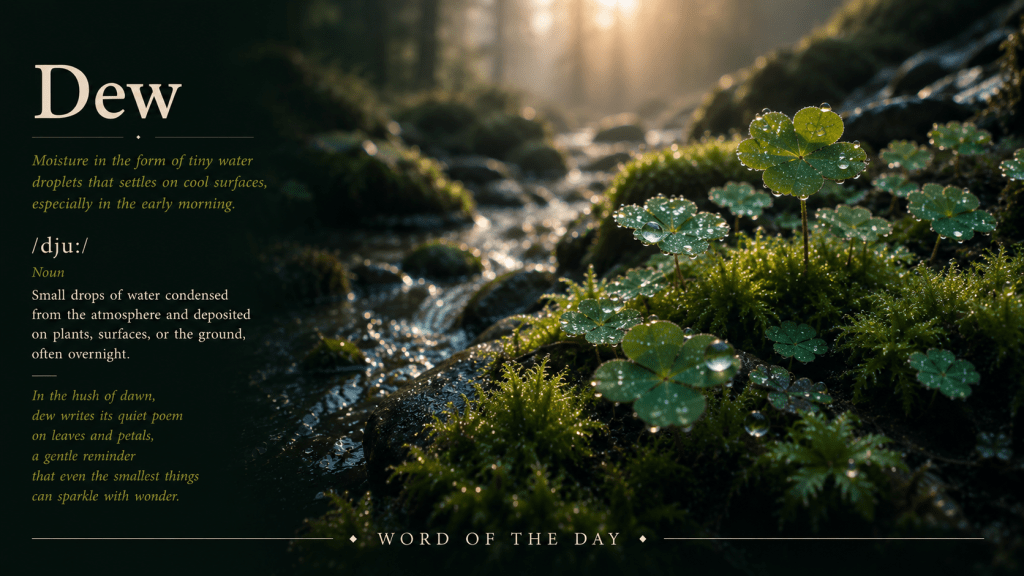
Dew
IPA Pronunciation: /duː/
Part of Speech: Noun
Origin
Dew belongs to the vocabularies of morning, transience, delicacy, and renewal. It refers to tiny drops of water that gather on surfaces during the night, appearing at dawn on grass, leaves, petals, and stone.
It suggests moisture arriving silently: a form of presence so gentle it seems almost breathed into existence.
Dew is water at the threshold of disappearance.
Etymology
From Old English: dēaw — dew, moisture
The word has remained remarkably unchanged, carrying ancient associations of dawn, freshness, and fragile natural beauty.
Core Definitions
Condensed Moisture
Tiny drops of water formed overnight on cool surfaces.
“The meadow glittered with dew.”
Symbol of Freshness or Transience
In literary use, dew often represents purity, brief beauty, or the fleeting nature of life.
Explanation & Nuance
Dew differs from rain or mist.
It implies:
Stillness rather than motion
Gentleness rather than force
Appearance through quiet accumulation
Fragility tied to time and temperature
It may be:
Natural — morning grass, flower petals, spiderwebs
Emotional — tenderness, vulnerability, renewal
Poetic — beauty existing only briefly before vanishing
Spiritual — quiet blessing or grace
Dew belongs to moments before the world fully wakes.
Natural Dimension
Dew appears in:
Grass at sunrise
Rose petals at dawn
Spiderwebs catching light
Cold windows in early morning
Fields before the heat of day
It creates:
Soft brilliance
Freshness
Coolness
Temporary luminosity
Unlike rain, dew does not fall — it gathers.
Poetic & Literary Use
Dew is deeply poetic because it joins beauty with impermanence.
A poet may use it literally:
“Dew shimmered across the meadow.”
Or metaphorically:
“Joy rested on the moment like dew.”
It often appears in writing about:
Morning
Youth
Innocence
Spring
Memory
Ephemeral beauty
Silence
Renewal
Love
Mortality
Unlike rain, dew feels intimate.
It is water quiet enough to be almost secret.
Experiential Dimension
Dew can evoke:
Freshness — the world beginning again
Fragility — beauty vulnerable to sunlight
Peace — stillness before activity
Tenderness — softness without force
Melancholy — awareness of brief existence
It often feels like the earth breathing softly before day begins.
Symbolic Dimensions
Morning Grass — renewal and beginning
Droplet — small perfection of form
Spiderweb — fragility illuminated
Sunrise — transition from stillness to movement
Evaporation — beauty passing quickly
Dew symbolizes impermanence, quiet renewal, and the delicate brilliance of temporary things.
Synonyms & Near-Relations
Mist — suspended moisture in air
Frost — frozen counterpart to dew
Condensation — scientific formation of moisture
Drizzle — light falling rain
Glisten — visual effect often created by dew
Only dew fully combines stillness, delicacy, dawn, and fleeting natural beauty.
Conceptual Relations
Morning — natural home of dew
Transience — its defining condition
Renewal — freshness after night
Light — what reveals dew’s brilliance
Fragility — beauty dependent on brief conditions
Cultural & Intellectual Resonance
Poetry
Dew often represents innocence, fleeting beauty, and morning renewal.
Religion & Spiritual Writing
Dew can symbolize grace arriving quietly and gently.
Japanese & Romantic Aesthetics
It reflects awareness of impermanence and delicate passing beauty.
Science
Dew forms through cooling and condensation rather than precipitation.
Takeaway
Dew names the quiet moisture that appears before morning fully arrives —
the fragile brightness
left upon the world
by night.
It reminds us that some beauty forms silently,
that the most delicate things
may exist only briefly,
and that renewal often comes
without announcement.
In poetry, dew is the smallest form of dawn —
the shining drop on grass,
the cool breath before sunlight,
the temporary jewel
the world wears
for only a few moments
before letting go.
Dew is the world wearing morning for a few quiet moments.


 Word Nook
Leave a comment