

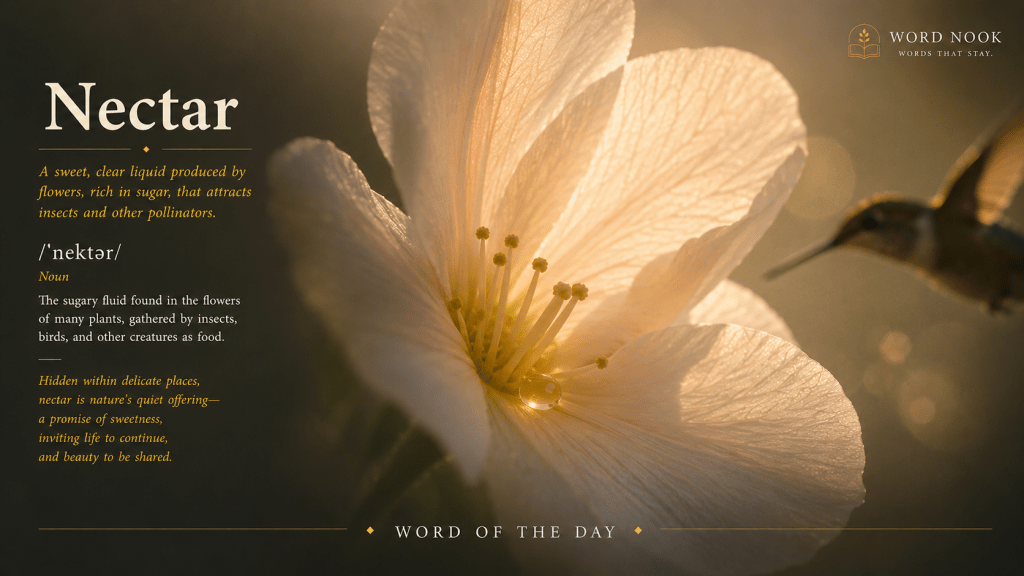
Nectar
IPA Pronunciation: /ˈnɛk.tər/
Part of Speech: Noun
Origin
Nectar belongs to the vocabularies of sweetness, nourishment, desire, and divine vitality. It refers to the sweet liquid produced by flowers to attract pollinators — and, more broadly, to any substance imagined as exquisitely pleasurable, life-giving, or almost sacred.
It suggests sweetness concentrated into essence: something small in quantity but immense in attraction.
Nectar is sweetness offered at the center of life.
Etymology
From Greek: nektar — the drink of the gods
In Greek mythology, nectar granted vitality or immortality to the gods, giving the word an enduring association with divine sweetness and sustaining pleasure.
Core Definitions
Sweet Floral Liquid
A sugary fluid produced by flowers and gathered by pollinating insects.
“Bees moved from blossom to blossom collecting nectar.”
Exquisite or Life-Giving Sweetness
Something intensely pleasurable or nourishing.
“The fruit tasted like nectar.”
Mythic Divine Drink
In classical mythology, the sustaining drink of the gods.
Explanation & Nuance
Nectar differs from honey or sweetness alone.
It implies:
Essence rather than abundance
Natural attraction
Vital nourishment tied to beauty
Pleasure linked with life and continuation
It may be:
Botanical — floral nectar feeding bees and birds
Sensory — rich sweetness in fruit or drink
Emotional — moments of rare delight
Poetic — concentrated beauty or sustaining joy
Nectar exists at the meeting point of beauty and survival.
Natural Dimension
Nectar appears in:
Flower blossoms
Hummingbird feeding
Bee pollination
Orchards in bloom
Gardens alive with insects
It creates:
Attraction
Exchange
Fertility
Ecological continuity
Flowers offer nectar not freely, but relationally.
Poetic & Literary Use
Nectar is deeply poetic because it transforms sweetness into symbolic essence.
A poet may use it literally:
“The jasmine held nectar after rain.”
Or metaphorically:
“Her voice carried the nectar of remembered summers.”
It often appears in writing about:
Love
Spring
Desire
Beauty
Fruitfulness
Pleasure
Myth
Abundance
Youth
Sacred vitality
Unlike sugar or honey, nectar feels more delicate and transcendent.
It is sweetness before transformation.
Experiential Dimension
Nectar can evoke:
Delight — concentrated pleasure
Longing — attraction toward beauty
Vitality — nourishment through sweetness
Tenderness — intimacy with living things
Abundance — the world offering richness
It often feels like discovering something both fragile and sustaining.
Symbolic Dimensions
Flower Center — hidden source of sweetness
Bee — desire guided toward nourishment
Golden Liquid — concentrated vitality
Mythic Cup — divine sustenance
Fruit Juice — ripeness overflowing into sweetness
Nectar symbolizes life’s hidden sweetness, the exchange between beauty and survival, and nourishment that feels almost sacred.
Synonyms & Near-Relations
Honey — transformed floral sweetness
Ambrosia — food of the gods in mythology
Sap — nourishing plant fluid
Sweetness — general pleasurable flavor
Elixir — life-giving substance
Only nectar fully combines floral sweetness, attraction, vitality, and mythic resonance.
Conceptual Relations
Beauty — source of attraction
Pollination — exchange sustaining life
Desire — movement toward sweetness
Vitality — nourishment and continuation
Transience — flowers and nectar are temporary offerings
Cultural & Intellectual Resonance
Poetry
Nectar often represents beauty, sensuality, and fleeting abundance.
Mythology
Nectar symbolized divine vitality and immortality.
Ecology
Nectar sustains pollinators and entire ecosystems.
Philosophy
Nectar reflects how attraction and survival are intertwined in nature.
Takeaway
Nectar names the sweetness hidden within living things —
the small offering
that draws life toward life.
It reminds us that beauty is often relational,
that nourishment can arrive through attraction,
and that the world sustains itself
through countless delicate exchanges.
In poetry, nectar is the secret sweetness at the heart of bloom —
the golden drop inside the flower,
the invitation carried by fragrance,
the brief rich essence
for which bees,
birds,
and human longing
continue to search.
Nectar is sweetness the world offers quietly to keep life moving toward itself.
 Word Nook
Leave a comment