

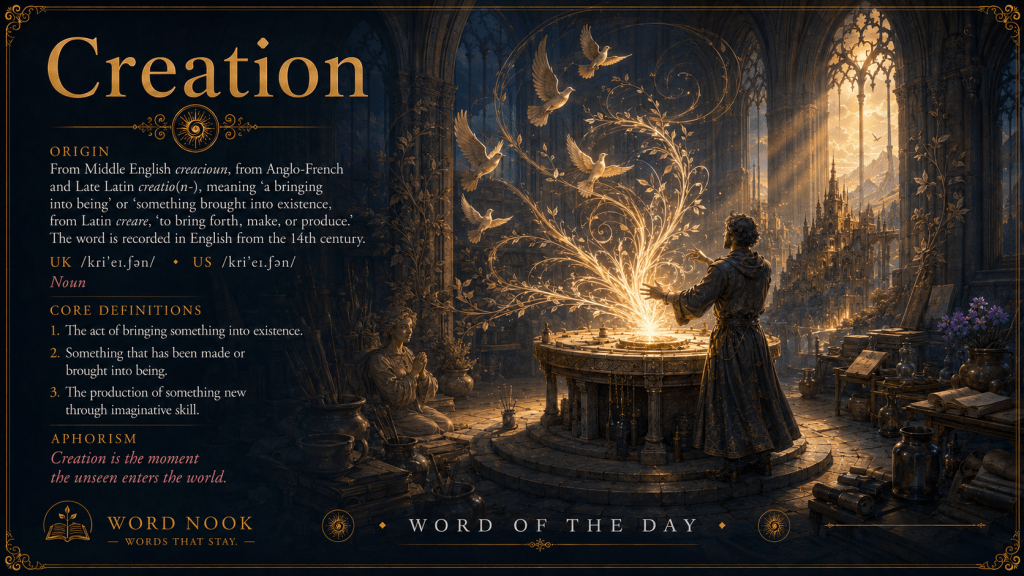
Creation
IPA Pronunciation: /kriˈeɪ.ʃən/
Part of Speech: Noun
Origin
Creation belongs to the vocabularies of making, imagination, origins, and transformation. It refers to the act of bringing something into existence, whether a work of art, an invention, an idea, a living thing, or an entire imagined world.
The word may describe both the process and its result.
A poem is created.
A machine is created.
A character is created.
A society creates laws, customs, and institutions.
Creation begins with absence and ends with something capable of entering the world.
That transition gives the word its power.
Creation is the moment the possible acquires consequences.
Etymology
From Middle English: creacioun
From Old French: creation
From Latin: creatio — a creating, producing, or bringing forth
From creare — to make, produce, bring forth, or cause to grow
The word entered English during the Middle Ages.
Its earliest uses were strongly connected with theology, especially the Creation of the world by God.
Over time, the word expanded to include human making: literature, art, invention, design, institutions, and any act through which something new is given form.
Core Definitions
The Act of Bringing Something into Existence
The process of making, producing, or originating something new.
“The creation of the new library took several years.”
Something That Has Been Created
A work, object, idea, or other result of creative activity.
“The sculpture was one of her finest creations.”
The Origin of the Universe or Life
In religious and philosophical contexts, the bringing into existence of the world or living beings.
“The poem retells the story of Creation.”
Explanation & Nuance
Creation implies:
- Bringing forth
- Transformation
- Imagination becoming form
- A beginning with consequences
It may be:
- Artistic — a poem, painting, story, or composition
- Practical — an invention, system, or design
- Intellectual — a theory or concept
- Social — an institution, law, or tradition
- Religious — the origin of the world
- Literary — the relationship between maker and made
Unlike discovery, creation brings something new into existence rather than finding what was already there.
Unlike invention, it is not limited to practical or technical innovation.
Unlike imagination, it requires movement beyond the inner world.
Imagination may conceive.
Creation gives the conception a body.
Creative & Philosophical Dimension
Creation often appears to begin with inspiration, but inspiration alone is rarely enough.
The act may require:
- Experiment
- Failure
- Revision
- Discipline
- Risk
- Patience
- Destruction and rebuilding
To create is therefore not simply to have an idea.
It is to choose among possibilities until one of them becomes real enough to resist further imagination.
Once created, a thing may also escape the intentions of its maker.
A book may acquire meanings its author never planned. An invention may be used in unexpected ways. An institution may survive long after its founders and evolve beyond their original purpose.
Creation produces more than an object.
It produces consequences.
Poetic & Literary Use
Creation is a foundational literary word.
A writer may use it directly:
“The novel occupied ten years of creation.”
or metaphorically:
“Morning was the daily creation of the world.”
It often appears in writing about:
- Art
- Birth
- Invention
- Imagination
- Nature
- Identity
- Responsibility
- Power
- Destruction
- Renewal
Literature itself is an act of creation.
A writer arranges marks upon a page and produces voices, houses, landscapes, histories, and lives that never physically existed.
The reader then completes the act by imagining them.
Creation therefore becomes a meeting between maker and witness.
Creation in Literature
Few works examine creation more intensely than Mary Shelley’s Frankenstein.
Victor Frankenstein succeeds in doing what had seemed impossible: he gives life to something assembled by his own hands.
Yet the novel immediately asks a deeper question.
What happens after creation?
Victor desires the achievement but recoils from the being his achievement has produced. The act that promised glory becomes inseparable from responsibility, abandonment, suffering, and consequence.
Shelley transforms creation from a triumph into a moral relationship.
To make something is not necessarily to control it.
Nor does the creator’s responsibility automatically end when the work begins to live beyond them.
Experiential Dimension
Creation can evoke:
- Wonder — seeing something exist for the first time
- Pride — recognising one’s effort made visible
- Vulnerability — releasing something personal into the world
- Frustration — struggling to make reality match imagination
- Responsibility — accepting what the created thing may cause
- Renewal — beginning again after absence or destruction
It often feels like crossing a threshold after which the world contains something it did not contain before.
Symbolic Dimensions
- Blank Page — possibility before form
- Spark — the first moment of invention
- Hands at Work — imagination becoming material
- Unfinished Figure — creation still changing
- Open Door — entrance into existence
- New Flame — life or thought newly begun
Creation symbolizes possibility, invention, birth, transformation, and the responsibility that begins when imagination enters reality.
Synonyms & Near-Relations
- Making — bringing something into form
- Invention — creation of a new device, method, or idea
- Production — process of making something
- Genesis — origin or beginning
- Formation — process of taking shape
- Conception — formation of an idea
- Work — something produced through effort
(Only creation fully combines origin, imaginative possibility, physical or intellectual making, and the emergence of something that did not previously exist.)
Conceptual Relations
- Imagination — where possibility begins
- Form — what creation gives it
- Work — process of becoming
- Birth — natural analogue
- Responsibility — consequence of making
- Destruction — opposing and sometimes necessary force
Takeaway
Creation names the moment absence loses its hold—
the blank page marked,
the idea given form,
the thing imagined
allowed to enter
the world.
It reminds us that making requires more than desire,
that every finished work
begins among possibilities,
and that what we create
may eventually become
larger than our intentions.
In literature, creation is possibility becoming consequential—
the character given breath,
the invention switched on,
the world opened,
and the creator standing before
something that did not exist before
and can no longer
be treated
as though it does not.
Creation is the moment the possible acquires consequences.

 Word Nook
Leave a comment