

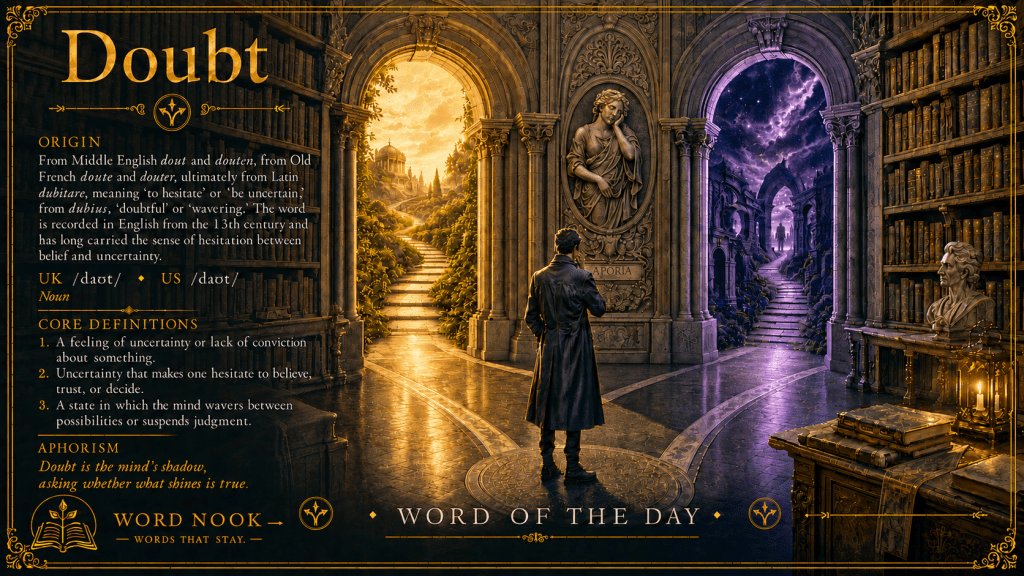
Doubt
IPA Pronunciation: /daʊt/
Part of Speech: Noun
Origin
Doubt belongs to the vocabularies of uncertainty, questioning, skepticism, and judgment. It refers to the state of being unsure whether something is true, right, possible, or trustworthy.
Doubt may arise from lack of evidence, conflicting information, fear of error, or the recognition that appearances can mislead.
It is not always weakness.
At its best, doubt interrupts certainty long enough for thought to become more careful. At its worst, it can become paralysis: the inability to trust any conclusion, even after sufficient reason has been found.
It suggests the mind refusing to close the question too soon.
Doubt is the space certainty leaves open for truth to enter.
Etymology
From Middle English: doute
From Old French: douter — to fear, hesitate, or doubt
From Latin: dubitare — to waver, hesitate, or be uncertain
The Latin root is connected with duo — two.
The history of the word therefore carries the image of a mind divided between alternatives.
To doubt is to stand between possibilities without yet knowing which deserves belief.
The silent b in modern English reflects the word’s later spelling under Latin influence.
Core Definitions
A State of Uncertainty
A feeling of not being sure about something.
“There was still some doubt about the accuracy of the report.”
Lack of Confidence or Trust
Uncertainty about a person, claim, decision, or outcome.
“His explanation left her with serious doubts.”
A Question or Reservation
A specific concern that prevents complete acceptance.
“She raised several doubts about the proposal.”
Explanation & Nuance
Doubt implies:
- Uncertainty
- Competing possibilities
- Suspended judgment
- A need for further reason or evidence
It may be:
- Intellectual — questioning whether a claim is true
- Personal — uncertainty about one’s ability or decision
- Moral — hesitation over what is right
- Religious — uncertainty concerning belief
- Literary — a force destabilising perception or trust
Unlike ignorance, doubt recognises that a question exists.
Unlike disbelief, it does not necessarily reject.
Unlike fear, it concerns uncertainty rather than danger alone.
Unlike skepticism, which may be a deliberate method or general attitude, doubt is often a particular state of hesitation.
Doubt does not always say no.
Often, it simply refuses to say yes too quickly.
Intellectual & Philosophical Dimension
Doubt has played a central role in philosophy because certainty is difficult to test without first questioning it.
A thoughtful doubt may ask:
- What evidence supports this?
- Could there be another explanation?
- Am I mistaking familiarity for truth?
- What would change my mind?
- Am I certain—or merely comfortable?
In this sense, doubt can protect the mind from credulity.
Philosophers such as René Descartes used systematic doubt as a method, temporarily questioning accepted beliefs in search of a firmer foundation for knowledge.
Yet endless doubt creates its own problem.
If every conclusion is reopened indefinitely, inquiry loses the ability to become judgment.
Wisdom therefore requires knowing not only when to question, but when the questioning has done enough.
Poetic & Literary Use
Doubt is a powerful literary word because uncertainty creates tension.
A writer may use it directly:
“For the first time, doubt entered his voice.”
or metaphorically:
“Doubt moved through the room like a draft beneath the door.”
It often appears in writing about:
- Trust
- Faith
- Love
- Identity
- Memory
- Guilt
- Ambition
- Perception
- Choice
- Truth
Doubt can transform the meaning of everything around it.
A remembered conversation becomes ambiguous.
A trusted friend appears unfamiliar.
A confident decision begins to fracture.
A certainty once taken for granted suddenly requires proof.
Nothing external may have changed.
But the mind’s relationship with it has.
Doubt in Literature
Literature often uses doubt to place both character and reader inside uncertainty.
A narrator may be unreliable. A prophecy may have several meanings. Evidence may point in conflicting directions. A character may no longer know whether instinct should be trusted.
In the works of Aldous Huxley, doubt often becomes a form of resistance. A society may appear stable, rational, and efficient until someone begins asking what that stability has required people to surrender.
This is one of doubt’s most important functions.
It interrupts the world that everyone else has agreed not to question.
Sometimes that interruption reveals error.
Sometimes it reveals only how difficult certainty truly is.
Experiential Dimension
Doubt can evoke:
- Unease — losing confidence in what seemed certain
- Curiosity — wanting stronger evidence
- Humility — admitting the possibility of error
- Anxiety — being unable to settle a question
- Freedom — escaping an unquestioned belief
- Paralysis — questioning until action becomes impossible
It often feels like a floor that remains solid but no longer feels entirely trustworthy.
Symbolic Dimensions
- Forked Path — competing possibilities
- Half-Open Door — uncertainty not yet resolved
- Flickering Lamp — unstable confidence
- Cracked Mirror — perception divided
- Unbalanced Scales — judgment still forming
- Mist — truth present but not yet clear
Doubt symbolizes uncertainty, inquiry, intellectual humility, and the fragile boundary between careful questioning and corrosive hesitation.
Synonyms & Near-Relations
- Uncertainty — absence of complete confidence
- Hesitation — pause before action or belief
- Skepticism — deliberate questioning of claims
- Suspicion — doubt directed toward possible deception
- Misgiving — uneasy concern about a choice or situation
- Reservation — reason for withholding full acceptance
- Indecision — inability to choose between alternatives
(Only doubt fully combines uncertainty, suspended belief, questioning, and the possibility of either deeper understanding or paralysis.)
Conceptual Relations
- Certainty — defining opposite
- Question — natural expression
- Evidence — possible resolution
- Trust — what doubt unsettles
- Judgment — what must eventually follow
- Truth — what careful doubt seeks
Takeaway
Doubt names the question that refuses to close too early—
the pause before belief,
the second look,
the certainty asked
to show
its foundations.
It reminds us that questioning can protect us
from easy error,
that humility begins
with the possibility
of being wrong,
and that wisdom lies
not in doubting forever,
but in knowing
what deserves another look.
In literature, doubt is the first crack in a finished world—
the trusted voice altered,
the familiar rule examined,
the question whispered
where everyone else
has agreed
to remain certain.
Doubt is the space certainty leaves open for truth to enter.


 Word Nook
Leave a comment