

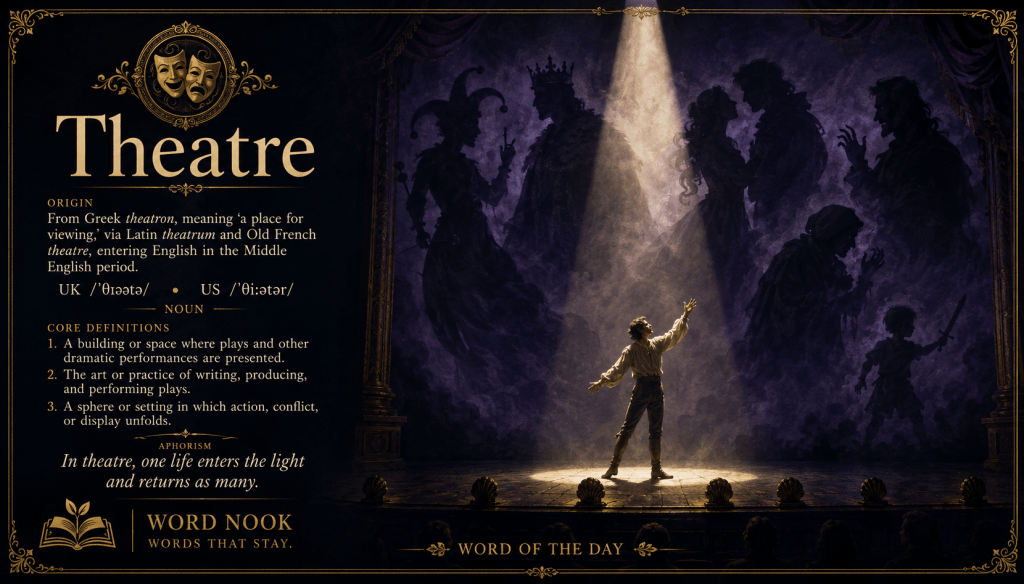
Theatre
IPA Pronunciation: /ˈθɪə.tə(r)/ (UK), /ˈθiː.ə.t̬ɚ/ (US)
Part of Speech: Noun
Origin
Theatre belongs to the vocabularies of performance, storytelling, illusion, and shared experience. It refers both to the art of presenting drama before an audience and to the building or space in which that performance occurs.
Unlike a novel, theatre does not remain fixed upon the page. It depends upon living bodies, spoken language, movement, light, silence, and the attention of those gathered to watch.
Every performance is temporary.
The same play may be repeated for centuries, yet no two evenings will be completely alike.
Theatre suggests a story becoming real only long enough to be witnessed.
Theatre is imagination made mortal for an evening.
Etymology
From Middle English: theatre
From Old French: theatre
From Latin: theatrum
From Greek: théatron — a place for viewing
From theâsthai — to behold or look at
The original meaning centred upon the audience rather than the stage: a theatre was the place from which people watched.
The British spelling is theatre, while theater is standard in American English. Both forms refer to the same art and performance space.
Core Definitions
The Art of Dramatic Performance
The presentation of stories through actors, dialogue, movement, and staging before an audience.
“She devoted her life to the theatre.”
A Building or Space for Performance
A place designed for plays, concerts, or other staged events.
“The theatre filled before the curtain rose.”
The Dramatic Profession or Community
The people, institutions, and traditions connected with theatrical work.
“He had worked in the theatre for thirty years.”
An Operating Room
In British English, a room in a hospital where surgery is performed.
“The patient was taken into theatre.”
Explanation & Nuance
Theatre implies:
- Live performance
- Shared attention
- Transformation through illusion
- A moment that cannot be repeated exactly
It may be:
- Dramatic — plays performed before an audience
- Architectural — the performance venue
- Professional — the theatrical world
- Political — public action shaped for effect
- Medical — an operating room in British usage
Unlike film, theatre unfolds in the same physical space as its audience.
Unlike literature, it requires interpretation through voice, body, and movement.
Unlike ordinary performance, theatre usually creates an imagined world governed by character, conflict, and dramatic form.
A play may exist on paper.
Theatre begins when the page acquires breath.
Historical Dimension
Theatre has appeared in many cultures through ritual, storytelling, dance, music, and public ceremony.
In ancient Greece, drama became a major civic and religious form. Tragedies and comedies were performed before large audiences, examining questions of fate, justice, power, family, and human weakness.
Later traditions included:
- Roman performance
- Medieval mystery plays
- Renaissance public theatres
- Court masques
- Opera
- Melodrama
- Modern experimental performance
Theatre has served as entertainment, worship, political criticism, education, and collective reflection.
A stage can hold a kingdom, a battlefield, a forest, or a private room without becoming any of them permanently.
Its power lies in asking an audience to believe together.
Literary Dimension
Theatre transforms writing into action.
A playwright must consider not only what characters say, but:
- Who hears them
- What remains unspoken
- Where bodies stand
- When silence begins
- What the audience knows
- What the characters misunderstand
In the works of William Shakespeare, a nearly empty stage becomes Rome, Denmark, Verona, a storm-torn island, or an enchanted forest through language and performance.
The audience does not merely receive the illusion.
It helps create it.
Theatre therefore depends upon a special form of imagination: many strangers agreeing, for a few hours, to see more than what is physically present.
Poetic & Literary Use
A writer may use theatre literally:
“The old theatre glowed above the crowded street.”
or metaphorically:
“The courtroom became a theatre of wounded pride.”
It often appears in writing about:
- Identity
- Performance
- Society
- Illusion
- Ambition
- Politics
- Memory
- Conflict
- Spectacle
- Transformation
The word may suggest sincerity or pretence.
Life can resemble theatre when people adopt roles, conceal motives, or shape their actions for an audience.
Yet theatricality is not always falsehood.
Sometimes a performed gesture reveals a truth that ordinary behaviour keeps hidden.
Experiential Dimension
Theatre can evoke:
- Anticipation — waiting for the curtain to rise
- Wonder — watching an empty space become another world
- Tension — sharing silence with performers and strangers
- Recognition — seeing one’s own life reflected onstage
- Loss — knowing the performance disappears as it occurs
It often feels like entering an agreement with illusion and leaving with something unexpectedly true.
Symbolic Dimensions
- Curtain — passage between reality and performance
- Mask — identity transformed or concealed
- Empty Stage — possibility
- Spotlight — concentrated attention
- Applause — shared recognition
- Final Bow — the return from illusion
Theatre symbolizes transformation, collective imagination, human performance, and the brief creation of a world that exists only while people agree to believe in it.
Synonyms & Near-Relations
- Drama — literature or performance built around conflict
- Stage — physical platform or theatrical profession
- Playhouse — building used for plays
- Performance — presentation before an audience
- Spectacle — visually impressive public display
- Acting — portrayal of a character
- Play — dramatic work written for performance
(Only theatre fully combines dramatic art, physical space, living performance, and the shared act of imaginative belief.)
Conceptual Relations
- Audience — necessary witness
- Actor — living interpreter
- Stage — place of transformation
- Illusion — creative method
- Language — principal instrument
- Presence — defining quality
Takeaway
Theatre names the story that must become alive—
the empty stage,
the waiting audience,
the written voice
given breath,
movement,
and consequence.
It reminds us that imagination
can be shared,
that a room may become
an entire world,
and that something temporary
may remain within us
long after
the curtain falls.
In literature, theatre is illusion witnessed together—
the mask lifted,
the kingdom summoned from darkness,
the actor becoming someone else,
and the audience recognising
its own life
inside a story
that will vanish
before the night is over.
Theatre is imagination made mortal for an evening.


 Word Nook
Leave a comment