
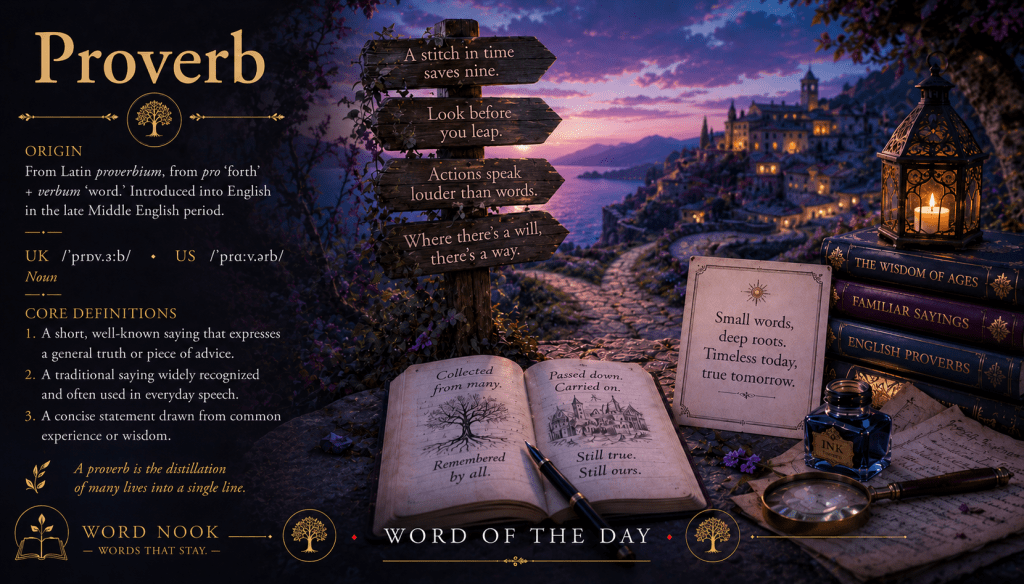
Proverb
IPA Pronunciation: /ˈprɒv.ɜːb/ (UK), /ˈprɑː.vɝːb/ (US)
Part of Speech: Noun
Origin
Proverb belongs to the vocabularies of wisdom, tradition, memory, and everyday speech. It refers to a short, widely known saying that expresses a general truth, practical lesson, or piece of inherited advice.
Unlike a maxim, which may be deliberately formulated by an individual thinker, a proverb usually belongs to a community. It travels through generations, often without a known author, becoming polished by repetition until only its most memorable form remains.
A proverb rarely explains itself at length. It trusts experience to complete the meaning.
It suggests wisdom carried collectively rather than owned individually.
A proverb is a lesson remembered long after its teacher is forgotten.
Etymology
From Middle English: proverbe
From Old French: proverbe
From Latin: proverbium — proverb or common saying
The Latin word is traditionally associated with:
- pro- — forth or publicly
- verbum — word
The word entered English during the Middle Ages and became closely connected with moral instruction, religious teaching, folklore, and practical wisdom.
Its history reflects its purpose: a proverb is a thought sent outward into common speech.
Core Definitions
A Traditional Saying
A short, familiar expression conveying a general truth or practical lesson.
“A stitch in time saves nine” is a familiar proverb.
A Concise Expression of Collective Wisdom
A saying preserved through repeated use within a culture or community.
“Her grandmother answered with an old proverb.”
Explanation & Nuance
Proverb implies:
- Traditional authority
- Collective experience
- Memorable language
- Practical or moral guidance
It may be:
- Moral — advising right conduct
- Practical — warning about consequences
- Cultural — preserving shared values
- Literary — adding inherited wisdom to a narrative
- Humorous — expressing truth through wit
Unlike a maxim, a proverb usually develops through communal use rather than individual authorship.
Unlike an aphorism, it is generally traditional rather than newly composed.
Unlike an idiom, it communicates a lesson or observation rather than merely carrying a non-literal meaning.
A proverb survives because people continue to find it useful.
Its authority comes not from proof, but from recognition.
Cultural Dimension
Every culture possesses proverbs.
They arise from:
- Farming
- Weather
- Family life
- Trade
- Animals
- Work
- Food
- Conflict
- Age
- Human behavior
Because they emerge from ordinary life, proverbs often preserve images from the environments in which they developed.
A farming culture may speak through seeds and harvests. A maritime culture may speak through tides, storms, and boats. A pastoral culture may speak through flocks, wolves, and shepherds.
The lesson may be universal, but the image carries the landscape of its origin.
Poetic & Literary Use
Proverb is a familiar yet deeply literary word.
A writer may use it literally:
“The old woman answered with a proverb.”
or metaphorically:
“His silence had hardened into a proverb among the villagers.”
Proverbs often appear in writing about:
- Wisdom
- Community
- Age
- Experience
- Family
- Tradition
- Labor
- Patience
- Consequence
- Human nature
Their language is often rhythmic, balanced, or vividly figurative.
Many rely upon:
- Contrast
- Repetition
- Rhyme
- Parallel structure
- Concrete imagery
- Cause and effect
These qualities allow them to pass easily from one voice to another.
Proverb in Literature
In literature, a proverb may reveal far more than its literal lesson.
It can show:
- A character’s upbringing
- A community’s values
- The authority of an elder
- Conflict between tradition and change
- Wisdom repeated without being understood
- Cultural identity carried through speech
Writers may use proverbs sincerely, ironically, or critically.
A character may follow one faithfully.
Another may discover that an inherited saying does not fit every circumstance.
This tension matters because proverbs simplify experience. Their brevity gives them power, but no single sentence can contain every exception.
A proverb offers guidance, not absolute law.
Experiential Dimension
A proverb can evoke:
- Recognition — hearing a familiar truth
- Comfort — receiving inherited guidance
- Reflection — reconsidering an experience
- Connection — sharing language across generations
- Caution — remembering the consequences faced by others
It often feels like advice spoken by many voices at once.
Symbolic Dimensions
- Old Path — guidance tested by time
- Shared Fire — communal memory
- Seed — wisdom carried into the future
- Weathered Stone — truth preserved through repetition
- Grandparent’s Voice — inherited experience
- Open Road — advice accompanying action
Proverb symbolizes collective wisdom, continuity, cultural memory, and the human desire to preserve experience in language simple enough to remember.
Synonyms & Near-Relations
- Maxim — deliberately formulated principle
- Aphorism — concise expression of insight
- Adage — saying accepted through long use
- Saying — familiar expression
- Precept — rule of conduct
- Dictum — authoritative statement
- Idiom — fixed expression with a non-literal meaning
(Only proverb fully combines traditional speech, collective authorship, practical wisdom, and transmission across generations.)
Conceptual Relations
- Wisdom — defining purpose
- Tradition — source of authority
- Memory — means of survival
- Community — collective speaker
- Experience — foundation
- Language — vessel
Takeaway
Proverb names the sentence a community refuses to forget—
the warning repeated,
the lesson polished,
the experience carried
from one generation
into the next.
It reminds us that wisdom does not always arrive
through books or formal teaching,
that ordinary lives leave behind
their own philosophy,
and that a few remembered words
may preserve
what countless people
learned the difficult way.
In literature, a proverb is memory speaking in chorus—
the elder beside the fire,
the worker in the field,
the traveler on the road,
each passing forward
a sentence
whose first speaker
has long disappeared.
A proverb is a lesson remembered long after its teacher is forgotten.


 Word Nook
Leave a comment