
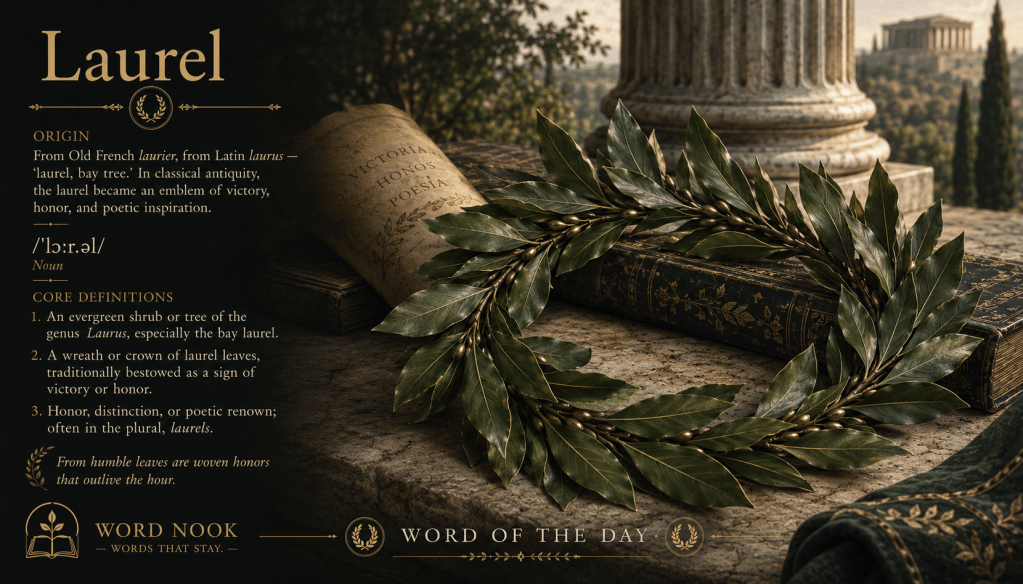
Laurel
IPA Pronunciation: /ˈlɒr.əl/ (UK), /ˈlɔːr.əl/ (US)
Part of Speech: Noun
Origin
Laurel belongs to the vocabularies of nature, victory, poetry, honor, and enduring achievement. It refers both to an evergreen tree of the genus Laurus—especially the bay laurel—and to the wreath woven from its leaves, traditionally bestowed upon poets, scholars, athletes, and heroes.
Few plants have become so completely transformed into symbols.
The laurel no longer signifies merely a tree. It signifies honor earned through excellence.
A laurel is excellence made enduring.
Etymology
From Old French: laurier
From Latin: laurus — laurel tree
The word has been part of English since the 13th century, carrying with it the classical traditions of Greece and Rome, where laurel wreaths symbolized triumph, wisdom, and poetic inspiration.
Core Definitions
The Bay Laurel Tree
An evergreen Mediterranean tree whose aromatic leaves are used in cooking and ceremonial wreaths.
“Laurel grew along the hillside.”
A Laurel Wreath
A crown woven from laurel leaves, awarded as a mark of honor or achievement.
“The victor received a laurel wreath.”
Honor or Distinction
Recognition earned through accomplishment.
“She rested on her laurels.”
Explanation & Nuance
Laurel differs from crown.
It implies:
- Achievement rather than authority
- Honor rather than power
- Intellectual or artistic excellence
- Recognition that endures
It may be:
- Botanical — evergreen tree
- Historical — ceremonial wreath
- Literary — poetic distinction
- Symbolic — enduring accomplishment
Unlike a jeweled crown, a laurel is woven from living leaves.
Its authority comes not from inheritance, but from merit.
Historical Dimension
In the ancient Greek and Roman worlds, laurel wreaths crowned:
- Poets
- Victorious athletes
- Military commanders
- Scholars
- Statesmen
The laurel became inseparably linked with poetry through Apollo, whose sacred tree was the laurel after the myth of Daphne.
From this tradition comes the title Poet Laureate, still bestowed today upon officially appointed national poets.
Poetic & Literary Use
Laurel is one of the great poetic symbols of the English language.
A poet may use it literally:
“The laurel cast its evergreen shadow.”
or metaphorically:
“She sought not gold, but laurel.”
It often appears in writing about:
- Poetry
- Glory
- Memory
- Achievement
- Immortality
- Art
- Wisdom
- Reputation
- Excellence
- Legacy
Unlike victory, laurel emphasizes what deserves to be remembered.
It celebrates achievement that outlives the moment.
Laurel in Poetry
For more than two thousand years, the laurel has symbolized:
- Poetic inspiration
- Literary greatness
- Artistic immortality
- Wisdom
- Noble achievement
Because the tree remains evergreen throughout the seasons, it naturally became a symbol of lasting fame.
To receive the laurel was not merely to win.
It was to be remembered.
Experiential Dimension
A laurel can evoke:
- Pride — recognition of achievement
- Aspiration — striving toward excellence
- Reverence — honoring tradition
- Joy — well-earned success
- Continuity — accomplishments remembered across generations
It often feels like quiet recognition rather than loud celebration.
Symbolic Dimensions
- Laurel Wreath — earned honor
- Evergreen Leaves — enduring fame
- Poet’s Brow — artistic excellence
- Sacred Tree — inspiration
- Living Crown — merit over power
Laurel symbolizes victory, wisdom, artistic achievement, lasting reputation, and the hope that worthy work may outlive its maker.
Synonyms & Near-Relations
- Wreath — circular garland
- Crown — symbol of authority
- Garland — decorative foliage
- Honor — recognition of merit
- Glory — celebrated achievement
(Only laurel fully combines evergreen life, classical tradition, poetic excellence, and enduring intellectual distinction.)
Conceptual Relations
- Victory — traditional association
- Poetry — enduring connection
- Honor — defining quality
- Evergreen — botanical foundation
- Legacy — symbolic culmination
Cultural & Intellectual Resonance
Poetry
The laurel has become the universal emblem of poetic excellence, inspiring titles such as Poet Laureate and symbolizing literature that survives the passage of time.
Classical Antiquity
Laurel wreaths represented the highest forms of civic, military, athletic, and artistic achievement in ancient Greece and Rome.
Art
Painters and sculptors have long depicted laurels as signs of genius, virtue, and immortal fame.
Philosophy
The laurel reminds us that the greatest rewards are often symbolic rather than material.
A wreath of leaves possesses little monetary value, yet it may represent a lifetime of excellence remembered for generations.
Takeaway
Laurel names the tree whose leaves became a crown—
the evergreen branch
woven into honor,
the living circle
placed upon the brow
of those whose work
outlives their years.
It reminds us that true distinction is earned,
that excellence leaves a legacy,
and that the highest honors
often grow
not from wealth or power,
but from wisdom,
courage,
and art.
In poetry, a laurel is memory made evergreen—
the wreath above the poet’s brow,
the leaves that never wholly fade,
the enduring emblem
of achievement,
inspiration,
and the quiet hope
that beautiful work
may outlive
its maker.
A laurel is excellence made enduring.

 Word Nook
Leave a comment