
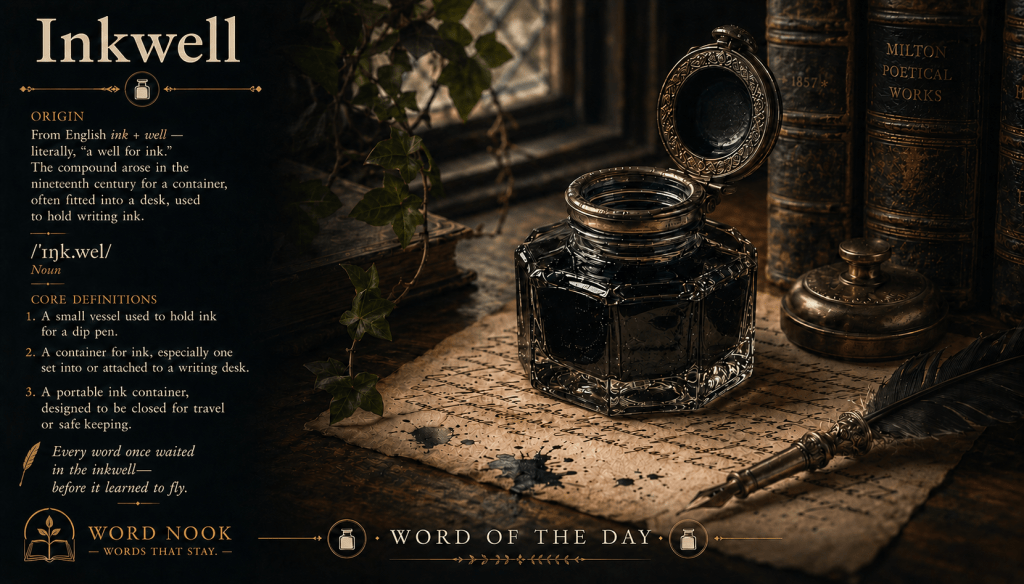
Inkwell
IPA Pronunciation: /ˈɪŋk.wɛl/
Part of Speech: Noun
Origin
Inkwell belongs to the vocabularies of writing, scholarship, craftsmanship, and literary history. It refers to a small container designed to hold ink for dipping pens or quills.
Though humble in form, the inkwell was once the quiet center of intellectual life. Around it were written poems, letters, treaties, scientific discoveries, and novels.
It suggests the quiet place where thought first prepares to become language.
An inkwell is silence waiting to become language.
Etymology
From English:
ink — the writing fluid
well — a deep container or source
Literally, “a well of ink.”
The compound appeared in English during the 17th century as portable writing became increasingly common.
Core Definitions
A Container for Ink
A small vessel holding ink for use with a quill, dip pen, or calligraphy pen.
“She dipped the quill into the inkwell.”
A Symbol of Traditional Writing
Figuratively, the material culture of handwriting, literature, and scholarship.
“The old desk still held its brass inkwell.”
Explanation & Nuance
Inkwell differs from ink bottle.
It implies:
- Daily writing
- Elegance
- Deliberate craftsmanship
- Historical literary practice
It may be:
- Practical — desk accessory
- Historical — writing equipment
- Literary — emblem of authorship
- Poetic — source of expression
Unlike a bottle, an inkwell remains open and ready.
It quietly invites the next sentence.
Historical Dimension
For centuries, inkwells stood upon the desks of:
- Poets
- Novelists
- Scholars
- Monks
- Lawyers
- Scientists
- Statesmen
Countless manuscripts, letters, constitutions, scientific discoveries, and literary masterpieces first passed through an inkwell before reaching the page.
The object became inseparable from the physical act of thoughtful composition.
Poetic & Literary Use
Inkwell is a deeply literary word.
A poet may use it literally:
“Moonlight shimmered across the forgotten inkwell.”
or metaphorically:
“Memory became the inkwell from which every poem arose.”
It often appears in writing about:
- Writing
- Creativity
- Scholarship
- Memory
- History
- Silence
- Patience
- Language
- Books
- Imagination
Unlike a pen or a keyboard, the inkwell evokes not the act of writing, but its quiet beginning.
It is where words wait before they touch the page.
Inkwell in Poetry
Although less common than quill or ink, inkwell possesses remarkable symbolic power.
Poets use it to represent:
- The source of creativity
- Hidden imagination
- The reservoir of memory
- Patient craftsmanship
- The quiet beginning of literature
Its symbolism is beautifully understated.
The inkwell itself never writes.
Yet every sentence depends upon it.
Experiential Dimension
An inkwell can evoke:
- Stillness — quiet desks and libraries
- Anticipation — the unwritten page
- Craftsmanship — deliberate composition
- Reverence — literary tradition
- Nostalgia — handwritten correspondence
It often feels like the silent pause before creation.
Symbolic Dimensions
- Brass Inkwell — enduring scholarship
- Dark Ink — untold stories
- Quill Entering Ink — inspiration meeting craft
- Writing Desk — contemplation
- Full Inkwell — creative abundance
Inkwell symbolizes creativity, preparation, memory, literary tradition, and the silent source from which language emerges.
Synonyms & Near-Relations
- Ink bottle — storage container
- Quill — traditional writing instrument
- Dip pen — pen used with an inkwell
- Parchment — writing surface
- Desk — place of composition
(Only inkwell fully combines the storage of ink, literary ritual, quiet readiness, and the symbolic origin of written expression.)
Conceptual Relations
- Ink — defining substance
- Quill — natural companion
- Writing — essential purpose
- Manuscript — ultimate result
- Silence — the atmosphere preceding creation
Cultural & Intellectual Resonance
Literature
The inkwell has become an enduring emblem of authorship, representing the patient labor behind lasting works rather than the finished text alone.
History
For centuries, the inkwell was a constant companion of writers, scholars, diplomats, and artists, quietly participating in the making of history.
Art
Still-life paintings often include an inkwell beside books, letters, and quills as symbols of learning and contemplation.
Philosophy
The inkwell reminds us that creation begins in reserve. Before words flow, there must first be a place where they are gathered, waiting to be drawn into the world.
Takeaway
Inkwell names the quiet vessel from which writing begins—
the small pool of ink
beside the empty page,
the silent companion
of every patient hand.
It reminds us that great works often arise from modest tools,
that thought requires both inspiration and preparation,
and that before language finds its voice,
it first gathers itself in silence.
In poetry, an inkwell is possibility held in liquid form—
the dark mirror beneath the quill,
the quiet source
from which poems,
letters,
histories,
and dreams
first emerge
into words.
An inkwell is silence waiting to become language.

 Word Nook
Leave a comment