
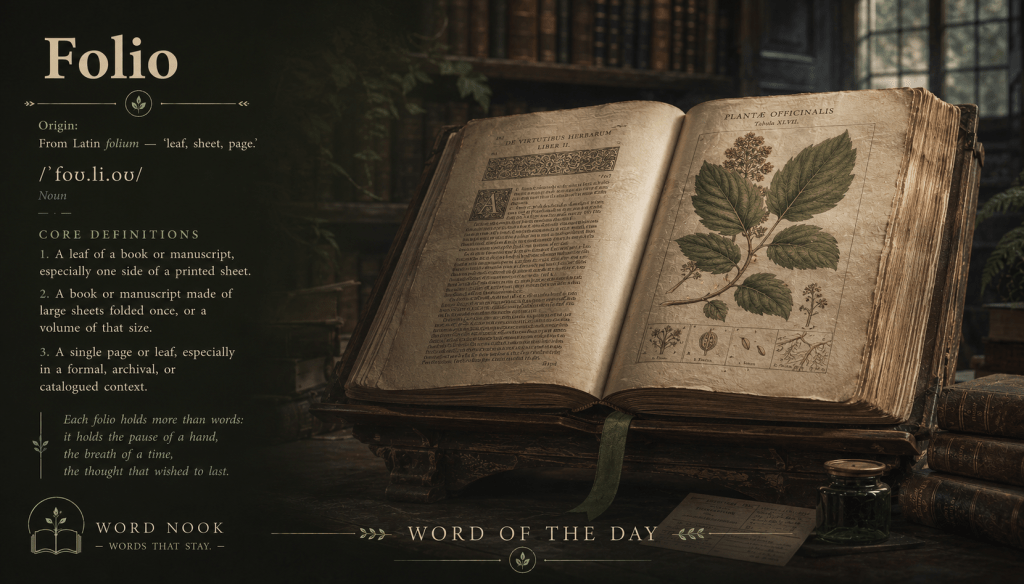
Folio
IPA Pronunciation: /ˈfoʊ.li.oʊ/ (US), /ˈfəʊ.li.əʊ/ (UK)
Part of Speech: Noun
Origin
Folio belongs to the vocabularies of books, manuscripts, scholarship, and the history of writing. It originally referred to a single leaf of paper, then to a large book made from sheets folded once, and later to the numbered pages of manuscripts and rare books.
It evokes the physical dignity of the written word—the weight of parchment, the turning of large pages, and the preservation of knowledge across centuries.
A folio is a page made monumental.
Etymology
From Latin: folium — leaf
Via Italian foglio and French feuille, the word entered English in the 15th century.
Its original meaning—leaf—preserves the ancient image of pages as the leaves of a living tree of knowledge.
Core Definitions
A Leaf of a Book or Manuscript
A single sheet consisting of two pages (front and back).
“The missing folio contained the final illustration.”
A Large Book Format
A book produced by folding each printed sheet once, creating large pages.
“The library displayed a magnificent folio edition.”
A Numbered Page or Leaf
The numbering system used in manuscripts and archival works.
“See folio 47 recto.”
Explanation & Nuance
Folio differs from page.
It implies:
- Physical craftsmanship
- Historical books
- Large-format printing
- Scholarly precision
It may be:
- Bibliographical — book format
- Archival — manuscript reference
- Artistic — portfolios of prints
- Poetic — the material presence of knowledge
A folio carries the atmosphere of libraries, monasteries, and archives rather than everyday reading.
Historical Dimension
Folio volumes became the preferred format for:
- Religious texts
- Atlases
- Scientific works
- Legal documents
- Collected literary works
Because of their size, folios conveyed permanence, authority, and prestige.
Many of history’s greatest books first appeared in folio form.
Literary Significance
Among the most celebrated examples is the First Folio, the 1623 volume that preserved thirty-six of William Shakespeare’s plays, many of which might otherwise have been lost.
Without the First Folio, works such as Macbeth, Twelfth Night, The Tempest, and Julius Caesar may never have survived in complete form.
As a result, folio has become almost synonymous with literary preservation and cultural memory.
Poetic & Literary Use
Folio is a deeply literary word.
A poet may use it literally:
“Dust settled upon the ancient folio.”
or metaphorically:
“Autumn opened another folio of the year.”
It often appears in writing about:
- Books
- Memory
- History
- Archives
- Learning
- Libraries
- Inheritance
- Writing
- Time
- Civilization
Unlike page, folio possesses ceremonial weight.
It suggests that what is written is worthy of preservation.
Folio in Poetry
Although uncommon in everyday speech, folio is cherished in literary writing because it connects language with its physical home.
Poets use it to symbolize:
- Memory preserved
- History recorded
- Knowledge accumulated
- Lives written into time
- The permanence of words
A folio is not merely paper.
It is the leaf upon which civilization remembers itself.
Experiential Dimension
A folio can evoke:
- Reverence — handling ancient books
- Curiosity — turning forgotten pages
- Wonder — surviving manuscripts
- Stillness — quiet libraries
- Continuity — voices carried across centuries
It often feels like holding history in one’s hands.
Symbolic Dimensions
- Turning Page — passage of time
- Illuminated Folio — wisdom and beauty
- Blank Folio — possibility
- Ancient Manuscript — inherited memory
- Pressed Leaf — the natural origin of writing
Folio symbolizes preservation, learning, memory, craftsmanship, and the enduring life of literature.
Synonyms & Near-Relations
- Page — individual side of a sheet
- Leaf — bibliographic term for a sheet
- Codex — bound manuscript or book
- Manuscript — handwritten text
- Volume — complete bound work
(Only folio fully combines the material history of books, large-format craftsmanship, and the enduring dignity of the written page.)
Conceptual Relations
- Book — defining object
- Manuscript — historical context
- Library — natural home
- Archive — preservation
- Memory — symbolic meaning
Cultural & Intellectual Resonance
Literature
The folio represents the survival of literary heritage and the careful transmission of texts across generations.
Book History
For printers, librarians, and scholars, folios remain symbols of craftsmanship and bibliographic importance.
Art
Large folios have long been used to present engravings, botanical illustrations, maps, and architectural drawings.
Philosophy
The folio reminds us that ideas endure because they are given lasting form—that memory requires not only thought, but preservation.
Takeaway
Folio names the leaf that carries more than ink—
the broad page of a manuscript,
the great book opened upon a lectern,
the written surface
where thought becomes inheritance.
It reminds us that knowledge has a body as well as a voice,
that words survive because someone preserved them,
and that every page
is a leaf
grown from the long tree
of human memory.
In poetry, a folio is the quiet architecture of civilization—
the parchment turned by careful hands,
the illuminated page glowing in candlelight,
the enduring leaf
upon which language
outlives its authors.
A folio is memory given the dignity of a page.

 Word Nook
Leave a comment