
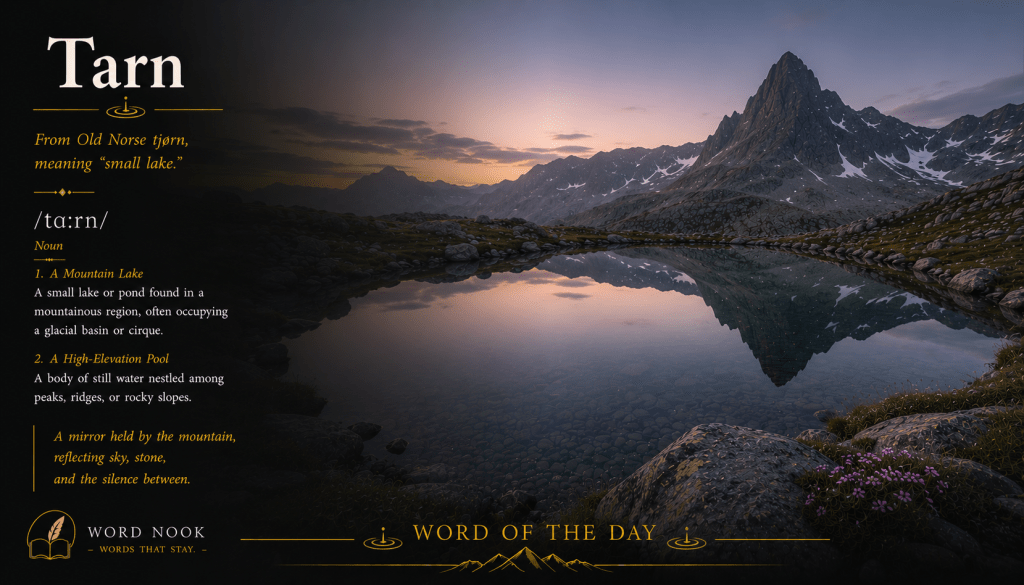
Tarn
IPA Pronunciation: /tɑːrn/
Part of Speech: Noun
Origin
Tarn belongs to the vocabularies of mountains, still water, solitude, and high landscapes. It refers to a small mountain lake, especially one formed in a glacial hollow or cirque.
It suggests stillness held at altitude: a body of water gathered among stone, sky, and silence.
A tarn is a mountain’s mirror.
Etymology
From Old Norse: tjǫrn — small lake, pond
The word entered English through northern and upland dialects, particularly in regions influenced by Norse settlement, such as the English Lake District.
Its ancient roots have always been associated with small, quiet waters.
Core Definitions
A Mountain Lake
A small lake or pond found in a mountainous region, often occupying a glacial basin.
“The hikers paused beside a windswept tarn.”
A High-Elevation Pool
A body of still water nestled among peaks, ridges, or rocky slopes.
Explanation & Nuance
Tarn differs from lake or pond.
It implies:
- Mountain setting
- Glacial origins
- Isolation
- Stillness and clarity
It may be:
- Geographical — alpine or subalpine waterbody
- Ecological — habitat in remote uplands
- Poetic — reflective stillness amid ruggedness
- Symbolic — calm enclosed by challenge
A tarn feels remote even when small.
Its character comes as much from its surroundings as from the water itself.
Natural Dimension
Tarns are commonly found in:
- Mountain ranges
- Glacial cirques
- High valleys
- Alpine landscapes
They create:
- Reflections of peaks and clouds
- Freshwater habitats
- Sources for streams
- Pockets of stillness in rugged terrain
Many tarns owe their existence to glaciers that vanished thousands of years ago.
Poetic & Literary Use
Tarn is deeply poetic because it joins water and elevation.
A poet may use it literally:
“The tarn reflected the evening sky without a ripple.”
or metaphorically:
“His mind became a tarn of quiet thought.”
It often appears in writing about:
- Mountains
- Solitude
- Reflection
- Silence
- Wilderness
- Memory
- Altitude
- Mystery
- Contemplation
- Beauty in isolation
Unlike lake, tarn carries an atmosphere of remoteness and intimacy.
It feels discovered rather than inhabited.
Experiential Dimension
A tarn can evoke:
- Peace — still water far from noise
- Awe — dramatic mountain settings
- Loneliness — beautiful isolation
- Clarity — reflective surfaces and clear air
- Contemplation — natural conditions for reflection
It often feels like a place where the landscape pauses to think.
Symbolic Dimensions
- Mirror-Like Water — self-reflection and awareness
- Glacial Basin — memory preserved by time
- Mountain Hollow — shelter amid exposure
- Still Surface — inner calm
- Remote Lake — beauty beyond ordinary reach
Tarn symbolizes contemplation, solitude, endurance, and the quiet depths hidden within rugged surroundings.
Synonyms & Near-Relations
- Lake — larger body of inland water
- Pond — smaller standing waterbody
- Pool — contained body of water
- Loch — Scottish lake
- Cirque Lake — scientific term for many tarns
(Only tarn fully combines mountain setting, glacial origin, remoteness, and poetic stillness.)
Conceptual Relations
- Mountain — defining environment
- Reflection — common visual quality
- Silence — atmosphere often associated with tarns
- Glacier — geological origin
- Solitude — emotional resonance
Cultural & Intellectual Resonance
Poetry
Tarns often symbolize introspection, isolation, and moments of profound stillness.
Landscape Writing
They are celebrated as some of the most evocative features of mountainous terrain.
Geology
Tarns preserve evidence of ancient glacial activity and landscape formation.
Philosophy
The tarn reflects the idea that stillness and depth often arise in places shaped by immense forces.
Takeaway
Tarn names the small lake held high among the mountains —
the still water
gathered in stone,
silence,
and sky.
It reminds us that serenity can exist in rugged places,
that reflection often requires distance,
and that some of the world’s most serene spaces
are born from ancient upheaval.
In poetry, a tarn is the mountain’s hidden eye —
the clear pool beneath the peaks,
the mirror cradled by rock and cloud,
the secluded water
where solitude,
clarity,
and wonder
come to rest.
A mirror held by the mountain,
reflecting sky, stone,
and the silence between.
 Word of the Day - The English Nook
Leave a comment