
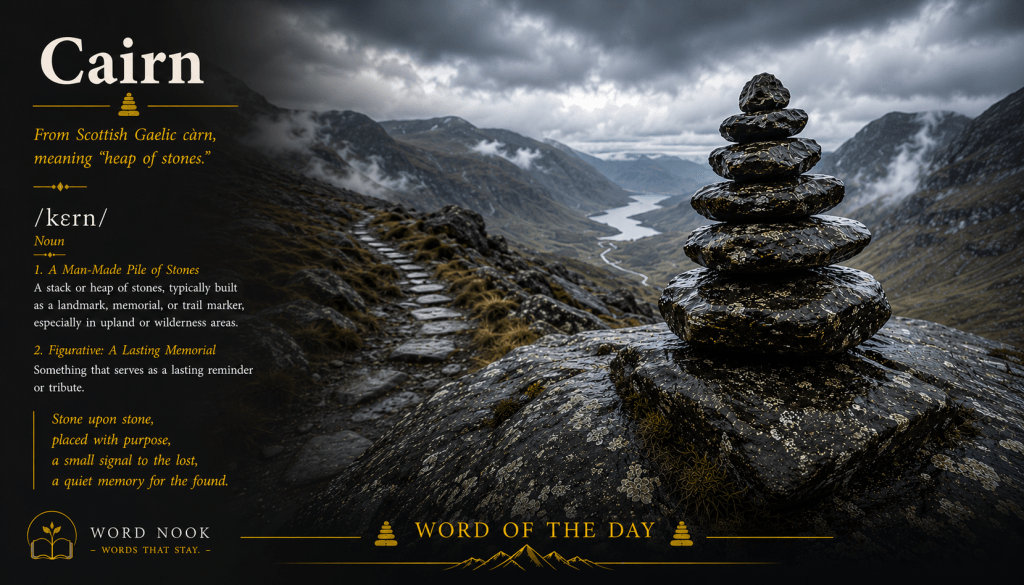
Cairn
IPA Pronunciation: /kɛərn/ (UK), /kɛrn/ (US)
Part of Speech: Noun
Origin
Cairn belongs to the vocabularies of stone, memory, navigation, and endurance. It refers to a human-made pile of stones, often built as a landmark, trail marker, memorial, or monument.
It suggests meaning created through accumulation: individual stones arranged into something that guides, remembers, or endures.
A cairn is memory built from stones.
Etymology
From Scottish Gaelic: càrn — heap of stones, rocky mound
The word entered English through the landscapes of Scotland and Ireland, where cairns have marked paths, summits, graves, and significant places for centuries.
Core Definitions
A Pile of Stones Used as a Marker
A deliberately constructed stack or mound of rocks used for navigation or commemoration.
“The hikers followed a line of cairns across the ridge.”
A Memorial of Stones
A monument created by arranging stones, often to honor a person, event, or journey.
Explanation & Nuance
Cairn differs from monument or marker.
It implies:
- Simplicity rather than grandeur
- Human intention through natural materials
- Endurance through accumulation
- Guidance and remembrance
It may be:
- Geographical — trail marker in remote terrain
- Historical — burial mound or memorial site
- Poetic — remembrance made tangible
- Symbolic — meaning assembled piece by piece
A cairn feels ancient even when newly built.
Natural Dimension
Cairns are commonly found in:
- Mountain ranges
- Moorlands
- Deserts
- Coastal paths
- Remote wilderness areas
They provide:
- Navigation
- Orientation
- Evidence of human passage
- Points of gathering or remembrance
Unlike signs, cairns seem to belong to the landscape itself.
Poetic & Literary Use
Cairn is deeply poetic because it transforms stone into memory.
A poet may use it literally:
“A lone cairn stood against the sky.”
or metaphorically:
“He built a cairn of small remembered moments.”
It often appears in writing about:
- Journeys
- Memory
- Loss
- Guidance
- Endurance
- Mountains
- Pilgrimage
- Legacy
- Commemoration
- Belonging
Unlike monument, cairn feels intimate and handmade.
It suggests care rather than display.
Experiential Dimension
A cairn can evoke:
- Reassurance — proof that others have passed this way
- Reflection — pauses during a journey
- Continuity — connection across generations
- Solitude — markers in remote places
- Respect — remembrance without extravagance
It often feels like a quiet message left by strangers.
Symbolic Dimensions
- Stacked Stones — meaning built gradually
- Trail Cairn — guidance through uncertainty
- Summit Cairn — achievement and arrival
- Memorial Cairn — remembrance that endures
- Single Added Stone — participation in a shared story
Cairn symbolizes memory, direction, continuity, and the cumulative nature of human significance.
Synonyms & Near-Relations
- Marker — object indicating direction or place
- Monument — commemorative structure
- Memorial — object of remembrance
- Mound — heap or raised formation
- Waypoint — navigational reference point
(Only cairn fully combines stone, simplicity, navigation, and remembrance.)
Conceptual Relations
- Stone — fundamental material
- Journey — common context for cairns
- Memory — central symbolic meaning
- Guidance — practical function
- Endurance — quality suggested by stone and time
Cultural & Intellectual Resonance
Poetry
Cairns often symbolize remembrance, accumulated experience, and guidance through uncertainty.
History
For millennia, cairns have marked routes, graves, sacred sites, and territorial boundaries.
Outdoor Culture
Hikers and mountaineers frequently encounter cairns as signs of safe passage.
Philosophy
The cairn reflects how meaning is often built incrementally—one act, one memory, one stone at a time.
Takeaway
Cairn names the pile of stones that means more than stone —
the marker on the ridge,
the memorial beside the path,
the sign that someone was here before.
It reminds us that meaning need not be elaborate,
that remembrance can be simple,
and that enduring meaning is often assembled gradually.
In poetry, a cairn is a conversation between people and landscape —
the stones stacked against wind and weather,
the quiet monument on a lonely summit,
the lasting gesture
through which memory,
direction,
and presence
remain.
Stone upon stone,
placed with purpose,
a small signal to the lost,
a quiet memory for the found.
 Word of the Day - The English Nook
Leave a comment