

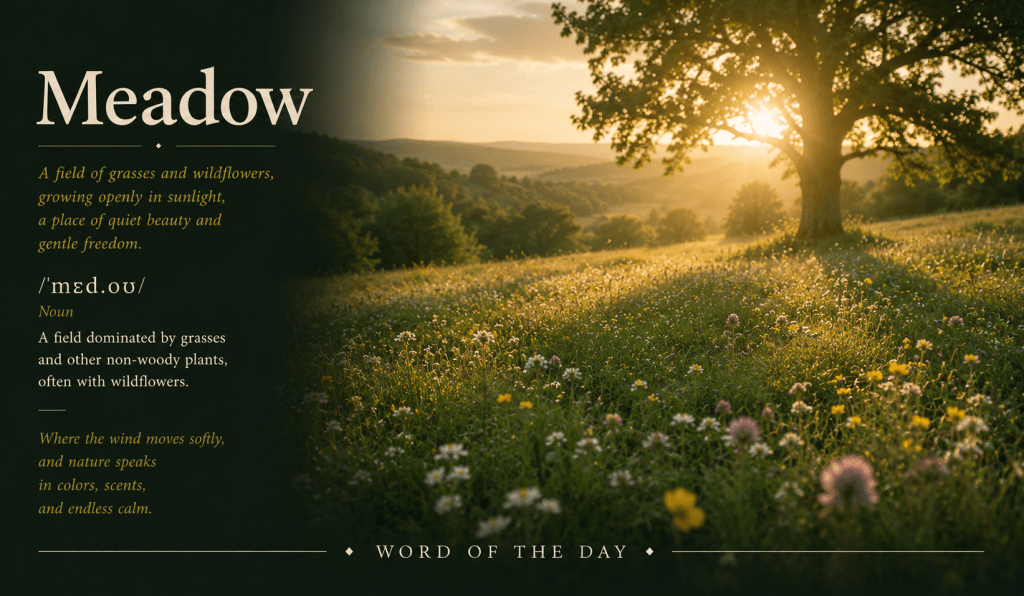
Meadow
IPA Pronunciation: /ˈmɛd.oʊ/
Part of Speech: Noun
Origin
Meadow belongs to the vocabularies of openness, grassland, stillness, and pastoral beauty. It refers to an open field covered with grass, wildflowers, or soft vegetation, often bordered by woods, rivers, or hills.
It suggests space without harshness: land left open enough for light, wind, and quiet movement.
A meadow is openness made gentle.
Etymology
From Old English: mædwe — meadow, meadowland
Related to roots associated with mowing and cultivated grassland.
The word carries both natural beauty and the human history of lived landscapes.
Core Definitions
Grassy Open Field
A stretch of open land covered with grass and often wildflowers.
“They crossed the meadow at dawn.”
Pastoral Natural Space
A calm, open landscape associated with peace, quiet, and rural beauty.
Explanation & Nuance
Meadow differs from field or plain.
It implies:
Softness rather than severity
Natural openness rather than emptiness
Calm habitation rather than wilderness
Beauty shaped by light and season
It may be:
Natural — wildflower meadows, river meadows
Agricultural — hay meadows and grazing land
Emotional — peace, nostalgia, emotional openness
Poetic — spaces of pause, memory, and quiet life
A meadow invites wandering rather than conquest.
Natural Dimension
Meadows appear in:
Valleys between forests
Mountain clearings
Riverbanks
Countryside pastures
Summer grasslands filled with flowers
They create:
Light
Movement of wind
Visibility
A sense of breathing space
Unlike forests, meadows reveal rather than conceal.
Poetic & Literary Use
Meadow is deeply poetic because it turns openness into intimacy.
A poet may use it literally:
“The meadow shimmered with late summer grass.”
Or metaphorically:
“Childhood remained like a meadow in memory.”
It often appears in writing about:
Summer
Childhood
Peace
Love
Morning
Rural life
Dreams
Stillness
Nostalgia
Passing seasons
Unlike plain, meadow feels inhabited by gentleness.
It is openness softened by life.
Experiential Dimension
A meadow can evoke:
Freedom — space without confinement
Peace — quiet movement under open sky
Nostalgia — remembered summers and fields
Tenderness — beauty without grandeur
Transience — flowers and grasses changing with season
It often feels like the world breathing slowly.
Symbolic Dimensions
Wildflowers — beauty without arrangement
Tall Grass — movement shaped by wind
Open Sky — emotional spaciousness
Path Through Grass — gentle passage through life
Summer Field — fullness before fading
Meadow symbolizes openness, calm, and the living softness of the natural world.
Synonyms & Near-Relations
Field — broader and more functional open land
Pasture — grazing land
Plain — large flat openness (less intimate)
Glade — smaller clearing among trees
Prairie — vast grassland ecosystem
Only meadow fully combines openness, softness, pastoral calm, and poetic intimacy.
Conceptual Relations
Openness — emotional and physical spaciousness
Light — defining presence of meadow landscapes
Season — visible cycles of change
Stillness — quiet movement rather than silence
Memory — pastoral spaces often recalled nostalgically
Cultural & Intellectual Resonance
Poetry
Meadows often symbolize innocence, peace, and fleeting beauty.
Painting
Pastoral landscapes use meadows to evoke harmony and serenity.
Ecology
Meadows support diverse grasses, flowers, and pollinating life.
Philosophy
The meadow reflects the idea that openness can itself be a form of shelter.
Takeaway
Meadow names the open place where softness survives —
where grass, light, and wind
share the same slow rhythm.
It reminds us that openness need not feel empty,
that beauty can exist without spectacle,
and that some landscapes
offer peace simply by allowing space to remain.
In poetry, meadow is the breathing room of the earth —
the field beneath summer light,
the quiet between forests,
the wide green pause
where the world
seems briefly
unafraid.
A meadow is openness that has learned how to feel gentle.

 Word Nook
Leave a comment