
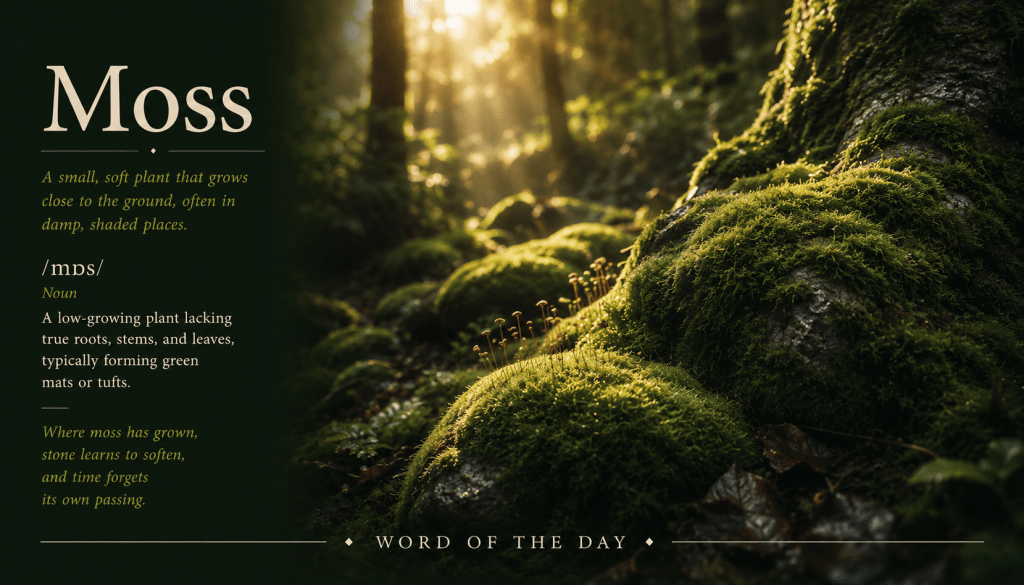
Moss
IPA Pronunciation: /mɔːs/
Part of Speech: Noun
Origin
Moss belongs to the vocabularies of softness, dampness, age, and quiet persistence. It refers to a small green plant that grows in dense, velvety clusters over stone, bark, earth, and forgotten surfaces — especially where moisture, shade, and stillness remain.
It suggests life that settles rather than rises: gentle growth that covers, softens, and endures.
Moss is time made green.
Etymology
From Old English: mos — bog, moss, marsh plant
The word carries ancient associations of wet ground, quiet growth, and soft accumulation.
Core Definitions
A Small Green Non-Flowering Plant
A low-growing plant that forms soft carpets in damp, shaded places.
“The old wall was covered in moss.”
Symbol of Age and Stillness
In literary use, moss often represents time, neglect, memory, and quiet endurance.
Explanation & Nuance
Moss differs from grass or flower.
It implies:
Soft accumulation rather than upward growth
Persistence rather than display
Age rather than freshness
Stillness rather than movement
It may be:
Botanical — woodland floors, stones, roofs, bark
Emotional — memory settling over experience
Poetic — beauty formed through time and quiet
Symbolic — gentleness covering what remains
Moss belongs to places untouched by haste.
Natural Dimension
Moss appears in:
Forest stones after rain
Tree trunks in shaded woods
Old roofs and forgotten paths
Garden walls left undisturbed
Wet earth beneath ferns
It creates:
Softness
Silence
Coolness
A sense of old continuity
Unlike flowers, moss does not bloom — it gathers.
Poetic & Literary Use
Moss is deeply poetic because it turns slowness into beauty.
A poet may use it literally:
“Moss climbed the ruined steps.”
Or metaphorically:
“Years settled over the house like moss.”
It often appears in writing about:
Memory
Ruins
Rain
Childhood
Old gardens
Time
Abandonment
Recovery
Silence
Sacred stillness
Unlike fern, moss feels closer to the ground.
It is beauty that arrives by staying.
Experiential Dimension
Moss can evoke:
Nostalgia — places left quiet for years
Peace — softness without urgency
Melancholy — beauty touched by abandonment
Continuity — life persisting without spectacle
Intimacy — closeness to earth and time
It often feels like touching the surface of patience.
Symbolic Dimensions
Stone — permanence softened by life
Rain — slow nourishment
Ruin — beauty after use
Forest Floor — humble continuity
Velvet Green — tenderness shaped by time
Moss symbolizes endurance, memory, and the gentle reclaiming power of nature.
Synonyms & Near-Relations
Fern — shaded woodland growth (taller, unfolding)
Lichen — older, rougher surface growth
Grass — brighter and more open growth
Mold — decay-associated covering
Velvet — metaphor for moss’s texture
Only moss fully combines softness, age, stillness, and quiet accumulation.
Conceptual Relations
Time — what moss visibly records
Memory — emotional moss settling inwardly
Stillness — condition of moss growth
Shade — its natural climate
Persistence — life without urgency
Cultural & Intellectual Resonance
Poetry
Moss often represents age, memory, and the beauty of neglected places.
Japanese Aesthetics
Moss is associated with stillness, impermanence, and quiet beauty.
Ecology
It reflects fragile ecosystems of moisture and shade.
Philosophy
Moss suggests that endurance may be softer than strength.
Takeaway
Moss names the slow green patience of the world —
the life that gathers quietly
where time has been allowed to remain.
It reminds us that beauty does not always arrive dramatically,
that age can soften rather than diminish,
and that what stays still long enough
becomes part of the landscape.
In poetry, moss is memory given texture —
the softness on old stone,
the green hush of forgotten places,
the patient proof
that even silence
continues to grow.
Moss is what time looks like when it learns to grow softly.
 Word of the Day - The English Nook
Leave a comment