

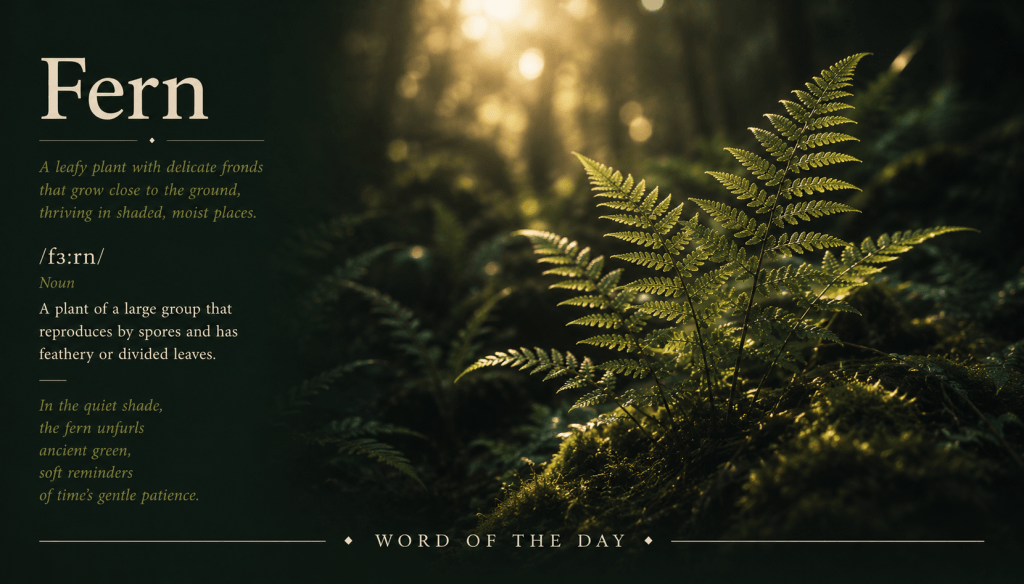
Fern
IPA Pronunciation: /fɝːn/
Part of Speech: Noun
Origin
Fern belongs to the vocabularies of wilderness, shade, quiet growth, and ancient persistence. It refers to a non-flowering plant with delicate divided leaves called fronds, often found in damp forests, shaded paths, and places where light arrives softly.
It suggests life that thrives without display: green persistence in silence, growth without blossom.
A fern is beauty that unfolds without needing to bloom.
Etymology
From Old English: fearn — fern
The word is ancient and elemental, carrying the long continuity of a plant older than many flowering forms of life.
Core Definitions
A Shade-Loving Green Plant
A plant with feathered fronds that reproduces by spores rather than flowers or seeds.
“The path was lined with ferns.”
Symbol of Quiet Natural Growth
In literary use, fern often represents hidden vitality, old forests, and silent endurance.
Explanation & Nuance
Fern differs from flower or tree.
It implies:
Subtlety rather than display
Shade rather than brightness
Persistence rather than dramatic change
Ancient continuity rather than seasonal spectacle
It may be:
Botanical — woodland plants, mossy undergrowth
Emotional — quiet resilience, inward life
Poetic — beauty that exists without performance
Symbolic — memory rooted in hidden places
A fern grows where attention must slow to notice it.
Natural Dimension
Ferns appear in:
Forest floors beneath tall trees
Wet stone walls
Riverbanks and shaded gardens
Rain-soaked paths
Ancient woodland undergrowth
They create:
Softness
Depth
Coolness
Living stillness
Unlike flowers, ferns do not bloom — they unfurl.
Poetic & Literary Use
Fern is deeply poetic because it represents life without spectacle.
A poet may use it literally:
“Ferns leaned over the dark stream.”
Or metaphorically:
“Her grief grew like fern in shadow.”
It often appears in writing about:
Forests
Rain
Memory
Solitude
Ancient places
Childhood
Silence
Recovery
Hidden beauty
Time beyond human scale
Unlike flower, fern suggests secrecy.
It is beauty that does not ask to be seen.
Experiential Dimension
A fern can evoke:
Calm — green quiet beneath noise
Nostalgia — remembered woods and wet paths
Mystery — life thriving in hidden places
Resilience — persistence without announcement
Gentleness — softness shaped by shade
It often feels like something older than speech.
Symbolic Dimensions
Frond — unfolding without flowering
Shade — protection from harshness
Forest Floor — hidden life beneath grandeur
Rain — nourishment through softness
Spore — invisible continuation
Fern symbolizes endurance, inward beauty, and the quiet dignity of unnoticed life.
Synonyms & Near-Relations
Moss — low, soft woodland growth
Frond — the leaf of a fern
Undergrowth — plants beneath larger trees
Vine — climbing hidden growth
Lichen — ancient subtle persistence
Only fern fully combines softness, shade, ancientness, and beauty without bloom.
Conceptual Relations
Shade — the fern’s natural world
Persistence — life continuing quietly
Memory — growth in hidden places
Ancientness — older rhythms of life
Stillness — emotional atmosphere of fern landscapes
Cultural & Intellectual Resonance
Poetry
Fern often symbolizes hidden life, old memory, and quiet resilience.
Botany
Ferns are among the oldest plant groups on Earth.
Art
They evoke woodland intimacy and nostalgic natural beauty.
Philosophy
Fern reflects the idea that value does not require visibility.
Takeaway
Fern names the kind of life that thrives in shadow —
quiet, green, and older than display.
It reminds us that beauty does not always bloom brightly,
that some forms of growth happen in silence,
and that what endures longest
often asks for the least attention.
In poetry, fern is the handwriting of the forest floor —
the soft green memory
beneath the trees,
the patient life
that keeps unfolding
where light arrives
gently enough to stay.
Some forms of beauty do not bloom. They unfurl quietly like fern.

 Word Nook
Leave a comment