

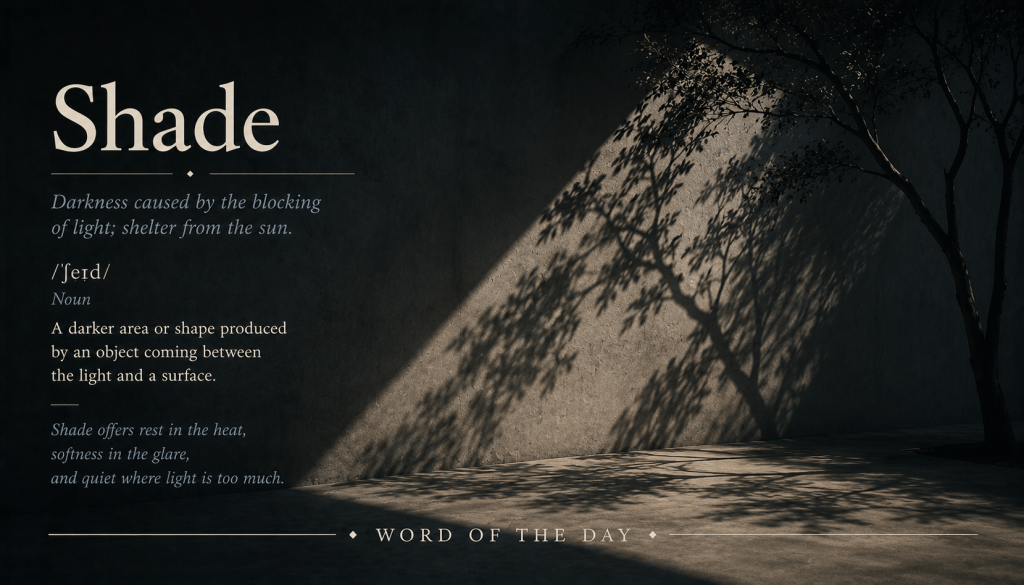
Shade
IPA Pronunciation: /ʃeɪd/
Part of Speech: Noun & Verb
Origin
Shade belongs to the vocabularies of shadow, shelter, subtle variation, and hidden presence. It refers to partial darkness caused by blocked light — and more broadly, to protection from brightness, slight differences in tone, or faint traces of something unseen.
It suggests not total absence of light, but moderated light: a place between illumination and darkness.
Shade is shadow with shape.
Etymology
From Old English: sceadu — shadow, shelter, protection from the sun
The word originally joined darkness and refuge, preserving both concealment and comfort.
Core Definitions
Partial Darkness
An area where direct light is blocked.
“They rested in the shade.”
Subtle Variation
A slight degree of difference, especially in color or meaning.
“A darker shade of blue.”
(Verb) To Cover or Protect from Light
“She shaded the window from the sun.”
Faint Trace or Spirit (Literary)
A ghostlike presence or lingering image of someone.
Explanation & Nuance
Shade differs from darkness.
It implies:
Partial concealment rather than total obscurity
Relief rather than absence
Subtle gradation rather than sharp contrast
It may be:
Physical — trees, clouds, curtains
Emotional — hidden feeling or ambiguity
Visual — tonal variation in color or meaning
Poetic — memory, ghost, or softened presence
Shade belongs to thresholds, not extremes.
Visual Dimension
Shade appears in:
Tree shadows at noon
Clouds passing over fields
Dim corners of a room
The gradual deepening of color
It creates:
Relief
Depth
Contrast
Atmosphere
Without shade, light has no shape.
Poetic & Literary Use
Shade is deeply poetic because it joins concealment with beauty.
A poet may use it literally:
“They walked beneath the cedar shade.”
Or metaphorically:
“The shade of regret followed him.”
It often appears in writing about:
Memory
Summer
Death
Ghosts
Protection
Melancholy
Secrets
Twilight
Ambiguity
Quiet beauty
Unlike shadow, shade often feels gentler.
It is darkness that still allows presence.
Experiential Dimension
Shade can evoke:
Relief — shelter from intensity
Mystery — what is partly hidden
Melancholy — soft dimness of feeling
Safety — retreat from exposure
Distance — softened outlines of memory
It often feels like a place where clarity becomes reflection.
Symbolic Dimensions
Tree — natural shelter
Twilight — border between day and night
Veil — concealment without disappearance
Ghost — presence without full form
Color Gradient — meaning existing by degree
Shade symbolizes moderation, concealment, and the beauty of partial revelation.
Synonyms & Near-Relations
Shadow — darkness cast by obstruction
Shelter — protection from exposure
Hue — variation of color
Tint — slight coloration
Ghost — literary “shade” as spirit
Only shade fully joins shelter, softness, subtle variation, and poetic concealment.
Conceptual Relations
Light — what gives shade form
Protection — relief through covering
Ambiguity — partial visibility
Memory — softened persistence
Threshold — space between clear states
Cultural & Intellectual Resonance
Poetry
Shade often represents memory, mourning, and quiet refuge.
Painting
Shading creates depth, realism, and emotional tone.
Mythology
“Shades” can refer to spirits of the dead.
Philosophy
Shade reflects the idea that truth often exists in gradations, not absolutes.
Takeaway
Shade names the place where light softens —
where brightness is interrupted,
not erased.
It reminds us that clarity is not always comfort,
that concealment can also be protection,
and that beauty often lives
between extremes.
In poetry, shade is the gentle form of shadow —
the coolness beneath memory,
the outline of what remains,
the softened space
where absence
still has shape.
Shade is not the absence of light — it is light softened into reflection.

 Word Nook
Leave a comment