

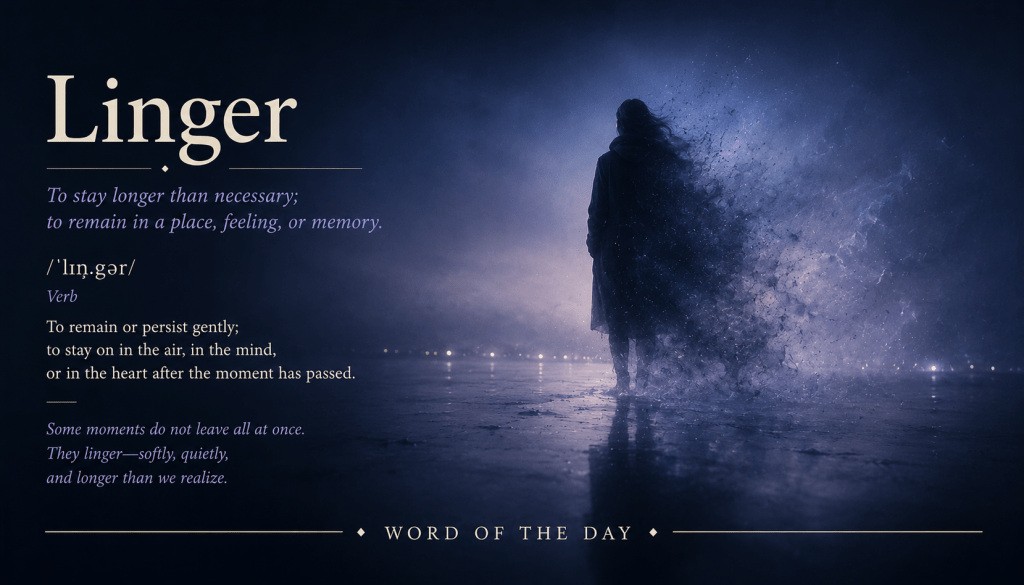
Linger
IPA Pronunciation: /ˈlɪŋ.ɡər/
Part of Speech: Verb
Origin
Linger belongs to the vocabularies of time, presence, delay, and subtle persistence. It describes the act of remaining beyond what is expected — of staying when movement forward seems natural.
It suggests not resistance, but softness: a presence that does not end abruptly, but fades, stretches, or holds.
To linger is to remain without urgency.
Etymology
From Middle English: lengeren — to prolong, to delay
Related to long — suggesting extension in time
The word carries the sense of something extended gently, not forced — duration shaped by hesitation or quiet continuation.
Core Definitions
To Stay Longer Than Expected
To remain in a place or state beyond the usual time.
“She lingered by the doorway.”
To Be Slow to End or Disappear
To continue faintly after the main presence has passed.
“The scent lingered in the room.”
To Delay or Move Slowly
To proceed with hesitation or reduced pace.
“He lingered over his final decision.”
Explanation & Nuance
Linger differs from simply staying.
It implies:
Gentleness rather than force
Continuation rather than interruption
Soft delay rather than resistance
It may be:
Physical — remaining in a place
Temporal — extending a moment
Emotional — holding onto a feeling
Sensory — a sound, scent, or image that persists
To linger is not to stop time —
but to let it stretch.
Temporal Dimension
In time, to linger means:
A moment extends beyond its natural end
Departure is delayed without urgency
Presence softens rather than disappears
It creates:
Suspension
Reflection
Subtle attachment
A conversation lingers.
A goodbye lingers.
A season lingers before it changes.
Time does not break — it loosens.
Sensory Dimension
Linger often describes the persistence of sensation:
A scent that remains in the air
A note that fades slowly
Light that stays after sunset
These are not abrupt endings.
They are gradual dissolves.
The experience continues, even as it weakens.
Poetic & Literary Use
In poetry and narrative, linger carries emotional weight through restraint.
A writer may use it to suggest:
Unfinished feeling
Reluctance to leave
Attachment to a moment
The softness of memory
Examples:
“Her voice lingered in the empty room.”
“He lingered at the edge of the past.”
Unlike remain, linger implies feeling.
It is not just presence — it is presence with hesitation.
Experiential Dimension
To linger can evoke:
Nostalgia — a wish to extend what is passing
Uncertainty — hesitation before moving on
Tenderness — softness in departure
Melancholy — awareness of ending
Attention — choosing to stay a little longer
It often feels like holding on — not tightly, but quietly.
Symbolic Dimensions
Twilight — light that remains after the day ends
Echo — sound that fades slowly
Scent — presence without form
Footsteps — movement slowed before departure
Breath — a pause before release
Linger symbolizes the space between presence and absence.
Synonyms & Near-Relations
Remain — to stay
Delay — to postpone
Hesitate — to pause before acting
Drift — to move slowly without direction
Fade — to gradually disappear
Only linger combines duration with emotional softness and gentle persistence.
Conceptual Relations
Time — extension beyond the expected
Presence — continued existence
Memory — what remains after experience
Emotion — attachment to what is passing
Transition — the space before change
Cultural & Intellectual Resonance
Literature
Lingering moments often carry emotional significance and depth.
Music
Notes and tones may linger to create atmosphere and continuity.
Psychology
Thoughts and emotions can linger, shaping perception and behavior.
Philosophy
It reflects the idea that endings are rarely abrupt — they dissolve.
Takeaway
Linger names the act of remaining —
not by force,
but by softness.
It is the extension of presence
beyond its expected end,
the quiet refusal to disappear all at once.
It reminds us that not everything leaves cleanly,
that some things stay
just a little longer than they should —
and that in that extra moment,
meaning often deepens.
In language, to linger is to exist in between —
between now and then,
between presence and absence,
between what has ended
and what has not yet let go.
Some moments don’t end — they linger.


 Word Nook
Leave a comment