
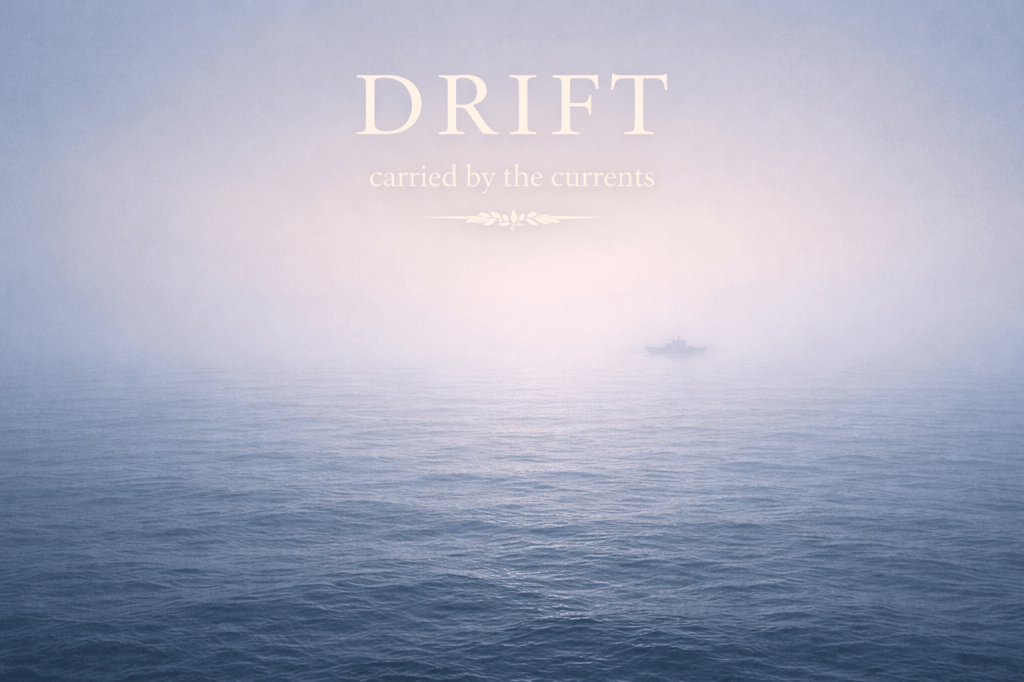
Drift
IPA Pronunciation: /drɪft/
Part of Speech: Noun & Verb
Origin
Drift belongs to the vocabularies of movement, change, and subtle force. It refers to motion carried by external influences rather than deliberate direction — a gradual shifting guided by currents, winds, or unseen pressures.
It suggests movement without insistence, shaped more by environment than intention.
Drift is motion without command.
Etymology
From Old Norse: drífa — to drive, to be driven
The root emphasizes being carried along rather than actively moving.
Core Definitions
Passive Movement
Slow movement caused by external forces.
“The boat began to drift.”
Gradual Change
A subtle shift in position, condition, or meaning.
“The conversation drifted.”
Accumulation or Displacement
Material carried and deposited by natural forces.
“Snow formed a drift.”
Explanation & Nuance
Drift occupies a space between motion and stillness.
It is:
Unhurried
Uncontrolled
Continuous
Often unnoticed
It may be:
Physical — objects moved by wind or water
Mental — thoughts wandering without focus
Social — gradual changes in ideas or behavior
Drift implies absence of firm direction, but not absence of movement.
Physical Context
In nature, drift occurs through:
Wind — carrying sand, snow, or leaves
Water — moving currents and tides
Gravity — slow shifting over time
Examples include:
Snowdrifts
Ocean drift currents
Continental drift (on geological scales)
In each case, motion is persistent but subtle.
Experiential Dimension
In human experience, drift can describe:
Loss of focus
Emotional detachment
Unplanned change
Gentle transition
It may feel:
Peaceful — surrender to flow
Disorienting — lack of control
Inevitable — movement without decision
Symbolic Dimensions
Current — unseen guiding force
Leaf — passive movement
Mist — lack of fixed form
Wave — gentle progression
Distance — slow separation
Drift symbolizes change shaped by forces beyond direct control.
Synonyms & Near-Relations
Float — remain on surface, move lightly
Wander — move without direction (more active)
Glide — smooth motion
Shift — change position
Meander — winding movement
(Only drift strongly emphasizes passive motion under external influence.)
Conceptual Relations
Force — external influence
Motion — continuous movement
Time — gradual change
Control — absence or release of it
Uncertainty — lack of fixed direction
Cultural & Intellectual Resonance
Literature
Drift evokes themes of loss, passage, or quiet change.
Psychology
It describes attention moving away from focus.
Science
Used to describe slow, cumulative processes.
Philosophy
Drift reflects the tension between agency and external forces.
Takeaway
Drift names the movement that happens without command —
a slow unfolding shaped by currents we do not fully control.
It reminds us that not all change is chosen,
that direction can emerge without intention,
and that movement itself
does not always require will.
Drift is the quiet motion of being carried —
through space,
through thought,
through time,
by forces that move us
even when we do not move ourselves.
Drift is what happens when movement chooses you.

 Word Nook
Leave a comment