
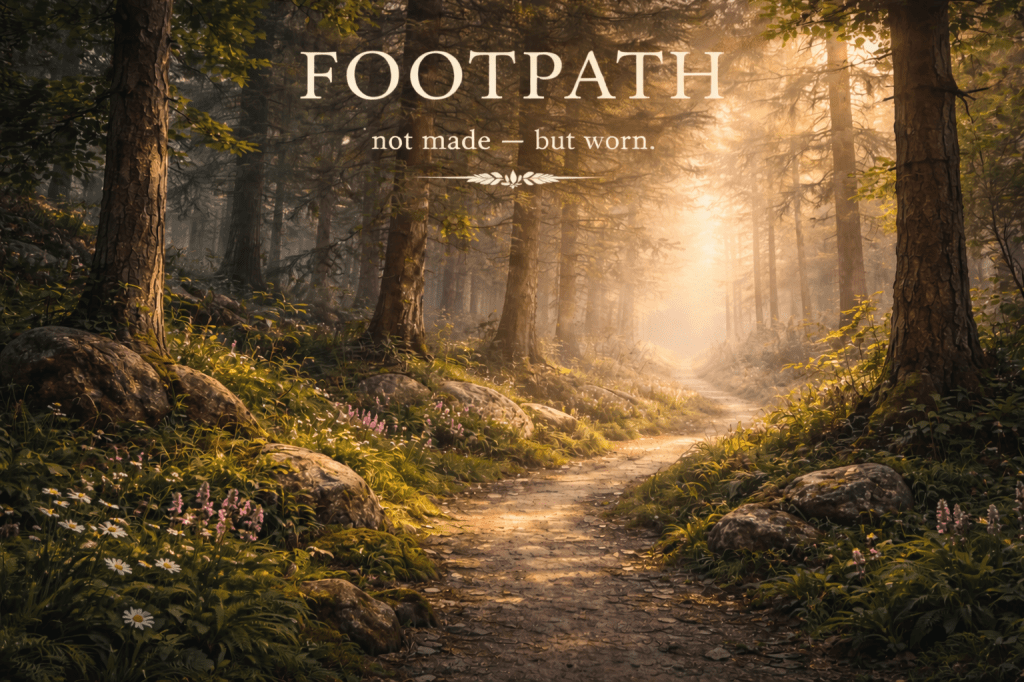
Footpath
IPA Pronunciation: /ˈfʊt.pæθ/
Part of Speech: Noun
Origin
Footpath belongs to the vocabularies of movement, landscape, and everyday passage. It refers to a narrow path intended for walking, formed either by repeated use or deliberate design.
It is a path scaled to the human body — measured in steps rather than distance.
A footpath is a way shaped by footsteps.
Etymology
From Old English: fōt — foot
- pæþ — path
The compound directly expresses its function: a path made for walking.
Core Definitions
Walking Path
A narrow route designed for pedestrians.
“They followed the footpath along the river.”
Informal Trail
A path created by repeated passage rather than formal construction.
Pedestrian Route
A designated walkway separate from roads for vehicles.
Explanation & Nuance
A footpath differs from larger routes in scale and intention.
It is typically:
Narrow
Close to the ground
Intimate in experience
Often winding or irregular
It may be:
Natural — worn into the land by use
Constructed — laid out for access or safety
It prioritizes presence over speed.
Spatial Dimension
Footpaths:
Follow terrain rather than reshape it
Adapt to curves, slopes, and obstacles
Connect places on a human scale
They often pass through:
Fields
Forests
Villages
Edges of roads
A footpath invites engagement with surroundings.
Experiential Dimension
Walking a footpath involves:
Attention to ground and movement
Awareness of immediate environment
Slower pace
Physical connection to place
It encourages:
Observation
Reflection
Exploration
Unlike roads, footpaths are not meant for haste.
Symbolic Dimensions
Footstep — individual movement
Line in Earth — trace of passage
Curve — adaptation to landscape
Dust or Grass — contact with ground
Narrow Way — simplicity and focus
Footpath symbolizes movement grounded in presence.
Synonyms & Near-Relations
Trail — natural walking route
Path — general term
Sidewalk — urban pedestrian path
Track — worn route
Lane — narrow road or path
(Only footpath specifically denotes a path intended for walking, often informal and human-scaled.)
Conceptual Relations
Journey — movement along a route
Scale — human proportion
Landscape — environment traversed
Movement — physical progression
Presence — attention to surroundings
Cultural & Intellectual Resonance
Rural Life
Footpaths connect communities and landscapes.
Literature
They symbolize personal journeys and quiet exploration.
Philosophy
They evoke ideas of simplicity and mindful movement.
Urban Planning
They represent pedestrian access and human-centered design.
Takeaway
Footpath names the narrow way beneath our steps —
a route that follows the land
and is shaped by those who walk it.
It reminds us that movement need not be fast to be meaningful,
that paths can emerge from repetition and presence,
and that even the smallest way
can lead somewhere significant.
A footpath is a quiet line through the world —
drawn not by design alone,
but by the steady rhythm
of human passage.
A footpath isn’t made for speed—it’s made for noticing.

 Word Nook
Leave a comment