
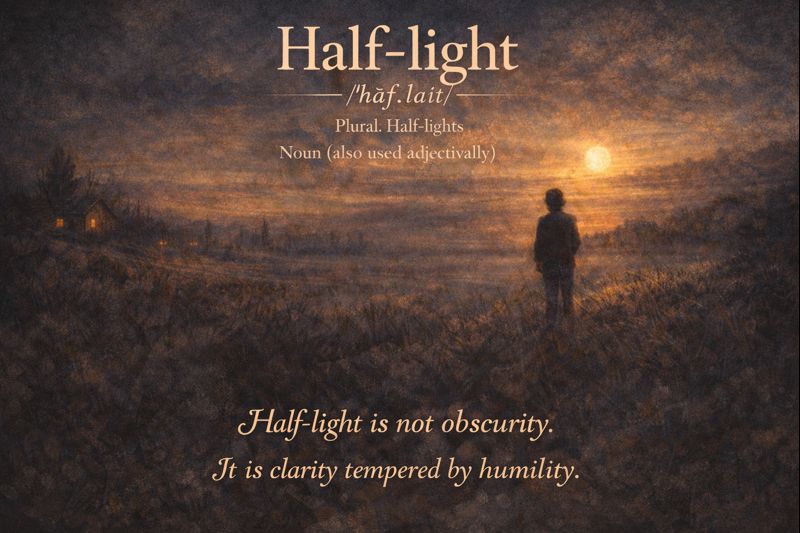
Half-light
IPA Pronunciation: /ˈhɑːf.laɪt/
Plural: Half-lights
Part of Speech: Noun (also used adjectivally)
Origin
Half-light originates as a descriptive term for the transitional illumination of dawn and dusk, when daylight is present but incomplete. It names a condition of partial visibility — enough to discern shape, not enough to impose certainty.
In literary usage, the term evolves beyond optics into a mode of perception: a way of seeing marked by hesitation, tenderness, and restraint. Half-light becomes the atmosphere of memory, ethical reflection, and emotional truth that cannot be fully exposed without loss.
Half-light is not obscurity.
It is clarity tempered by humility.
Etymology
Old English: healf — partial, divided
Old English: lēoht — illumination, understanding
The compound suggests incomplete revelation — illumination that reveals without finalizing.
Core Definitions
Transitional Illumination
The subdued light of twilight or early morning.
“The fields lay in half-light.”
Partial Knowledge or Recognition
Understanding that is suggestive but unresolved.
“The meaning surfaced in half-light.”
Emotional or Psychological Liminality
A state between clarity and obscurity, certainty and doubt.
“Grief persists in half-light.”
Explanation & Nuance
Half-light is defined by threshold experience.
Its essential qualities include:
- Liminality — existing between states
- Gentle Ambiguity — presence without dominance
- Restraint — refusal of total exposure
- Atmosphere over Assertion — tone as meaning
- Ethical Modesty — seeing without mastery
Half-light allows truth to appear without being forced into declaration.
Seamus Heaney & Half-light
Seamus Heaney repeatedly employs half-light — both explicitly and atmospherically — as a poetic condition of memory and moral attention.
In his work, half-light often appears:
- In rural landscapes, especially fields, yards, and thresholds
- In moments of recollection, where the past is felt rather than fully recovered
- As a moral lighting, suited to reflection rather than judgment
For Heaney, half-light becomes the natural illumination of:
- Childhood memory
- Familial intimacy
- Historical inheritance
- Ethical hesitation
It allows him to honor what is remembered without falsifying it through certainty. The half-lit scene preserves dignity, silence, and emotional truth.
In this sense, half-light aligns with Heaney’s broader poetic ethic:
to see clearly, but not cruelly.
Literary & Aesthetic Function
Half-light is frequently used to:
- Delay revelation
- Protect emotional subtlety
- Evoke nostalgia without sentimentality
- Frame moral or historical reflection
- Preserve ambiguity as meaning
It is the favored light of elegy, remembrance, and inward speech.
Examples in Context
Literary:
“The memory returned in half-light.”
Poetic:
“The poem dwells in half-light.”
Psychological:
“Trauma revisits consciousness in half-light.”
Philosophical:
“Human knowledge exists in half-light.”
Visual Arts:
“The composition relies on half-light.”
Symbolic Dimensions
- Twilight — transition and impermanence
- Soft Edges — resistance to finality
- Thresholds — between presence and absence
- Pause — the world held in suspension
- Moral Shade — judgment deferred
Half-light symbolizes truth approached with care.
Synonyms & Near-Relations
- Twilight — temporal emphasis
- Penumbra — technical shading
- Liminal Glow — conceptual framing
- Dimness — purely visual
- Crepuscule — poetic register
(Only half-light carries equal weight of vision, memory, and ethics.)
Conceptual Relations
- Liminality — in-between states
- Elegy — remembrance without closure
- Melancholy — emotion without excess
- Parallax — partial truth through position
- Negative Capability — comfort with uncertainty
Takeaway
Half-light names a way of seeing that refuses violence —
illumination without exposure,
clarity without domination.
In poetry, especially in Heaney’s work, it becomes the light most faithful to memory:
soft enough to preserve truth,
strong enough to keep it visible.
Not all clarity arrives at full brightness.
Curious about what happened today in history? Want to learn a new word every day?
You’ll find it all—first and in one place—at The-English-Nook.com!
If you love languages, this is your space.
Enjoy bilingual short stories, fun readings, useful vocabulary, and so much more in both English and Spanish.
Come explore!
 Word Nook
Leave a comment