

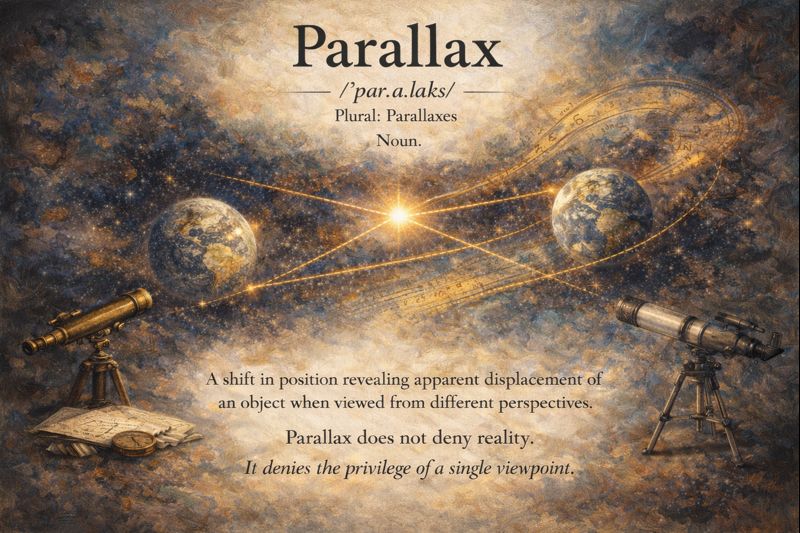
Parallax
IPA Pronunciation: /ˈpær.ə.læks/
Plural: Parallaxes
Part of Speech: Noun
Origin
Parallax originates in astronomy and geometry, where it names the apparent displacement of an object when observed from different positions. Initially a technical measure used to calculate distance between celestial bodies, the concept gradually migrated into philosophy, literature, psychology, and cultural theory.
Outside science, parallax becomes a model for understanding how truth, meaning, and perception shift with position. It asserts that observation is never neutral: the observer’s location—physical, social, ideological—reshapes what is seen.
Parallax does not deny reality.
It denies the privilege of a single viewpoint.
Etymology
Greek: parallaxis — alternation, change
From parallássein — to change, to alternate
Parallax implies movement as revelation.
Core Definitions
Apparent Displacement Due to Perspective
A shift in position caused by change in viewpoint.
“Stellar distance is measured by parallax.”
Perspective-Dependent Difference in Perception
Meaning altered by positional context.
“The debate reveals parallax.”
A Conceptual Gap Between Viewpoints
Incommensurable perspectives that cannot be reconciled.
“The truth emerges through parallax.”
Explanation & Nuance
Parallax is not error.
Its defining qualities include:
- Observer Dependence — perception tied to position
- Relational Truth — meaning emerges between views
- Irreducibility — perspectives cannot be collapsed
- Dynamic Knowledge — understanding requires movement
- Structural Difference — disagreement without deception
Parallax insists that difference may be structural, not resolvable.
Scientific Foundations
Astronomy
Measures stellar distance through Earth’s orbit.
Optics
Depth perception via binocular vision.
Cartography
Mapping distortions from projection.
Scientific parallax demonstrates that distance and depth are inferred through difference, not direct access.
Philosophical & Cultural Extensions
- Philosophy: Truth as position-dependent
- Literature: Narrative unreliability
- Psychoanalysis: Split subjectivity
- Cultural Theory: Ideological perspective
- Politics: Conflicting realities
Parallax becomes a model for epistemic humility.
Examples in Context
Scientific:
“Astronomers rely on parallax.”
Philosophical:
“The argument exposes parallax.”
Literary:
“The novel is structured through parallax.”
Psychological:
“Memory operates via parallax.”
Cultural:
“History is read through parallax.”
Symbolic Dimensions
- Twin Eyes — depth through difference
- Orbit — knowledge gained by motion
- Shifted Image — truth in displacement
- Gap — irreducible difference
- Angle — positional meaning
Parallax symbolizes truth without center.
Synonyms & Near-Relations
- Perspective Shift – explanatory
- Relativity – broader framework
- Viewpoint Difference – descriptive
- Parallactic Gap – theoretical extension
- Anamorphosis – visual cousin
(Only parallax preserves difference without synthesis.)
Parallax vs. Relativism
- Relativism dissolves truth into opinion.
- Parallax preserves reality while multiplying access.
Parallax says truth exists —
but never without position.
Cultural & Intellectual Resonance
Astronomy
Distance through difference.
Phenomenology
Situated perception.
Modern Narrative
Fragmented viewpoints.
Critical Theory
Ideology as position.
Ethics
Understanding without collapse.
Takeaway
Parallax teaches that understanding emerges through movement —
that depth is not given directly,
and that truth often appears only when perspectives fail to align.
It reminds us that disagreement does not always signal error,
that difference can be productive,
and that meaning lives not in a single view,
but in the space between them.
Truth doesn’t disappear—it shifts when you move.
Curious about what happened today in history? Want to learn a new word every day?
You’ll find it all—first and in one place—at The-English-Nook.com!
If you love languages, this is your space.
Enjoy bilingual short stories, fun readings, useful vocabulary, and so much more in both English and Spanish.
Come explore!
 Word Nook
Leave a comment