

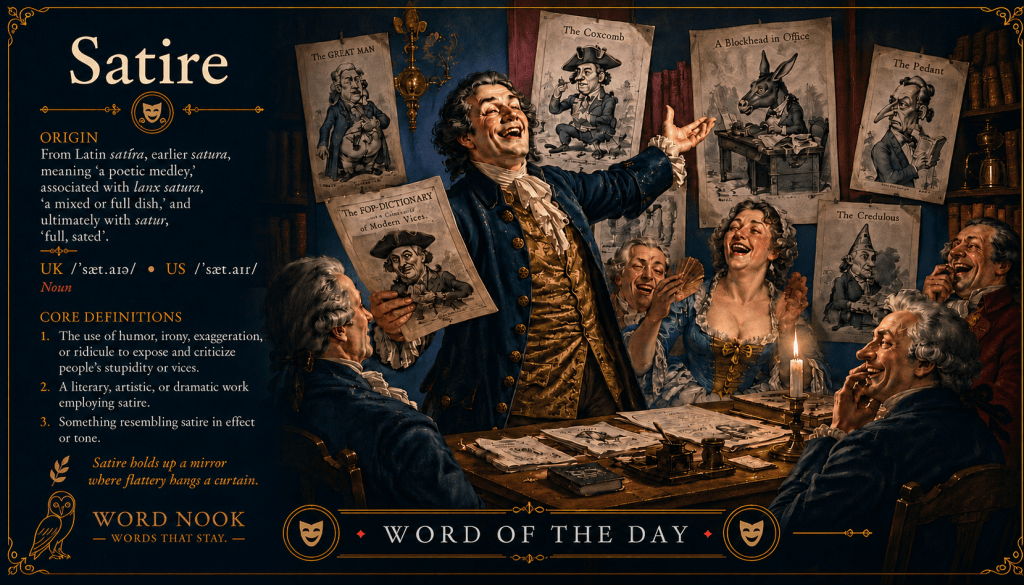
Satire
IPA Pronunciation: /ˈsæt.aɪər/
Part of Speech: Noun
Origin
Satire belongs to the vocabularies of wit, criticism, irony, and social observation. It refers to the use of humour, exaggeration, ridicule, or absurdity to expose foolishness, hypocrisy, vice, or failure.
Satire entertains, but entertainment is rarely its only purpose.
Its laughter usually points somewhere.
A politician’s vanity is enlarged until it becomes grotesque. A social custom is pushed one step beyond normality until its absurdity becomes visible. A familiar argument is repeated so faithfully that its contradictions begin to expose themselves.
Satire does not merely mock.
It reveals by distortion.
Satire holds up a crooked mirror so that the straight face becomes impossible to maintain.
Etymology
From Middle French: satire
From Latin: satira, an altered form of satura — a mixed dish, medley, or miscellaneous composition
The Latin phrase lanx satura referred to a dish filled with various ingredients.
From this developed a literary sense of a mixed or varied composition, eventually becoming associated with writings that attacked folly and vice.
The word was later mistakenly connected with the Greek satyr, the mischievous woodland figure, because satire often seemed coarse, mocking, or unruly.
Despite the resemblance, the two words are not historically related.
Core Definitions
Humorous Criticism
The use of wit, irony, exaggeration, or ridicule to expose foolishness, vice, hypocrisy, or corruption.
“The novel uses satire to expose the absurdities of political life.”
A Satirical Work
A literary, dramatic, visual, or other work built around such criticism.
“The play is a satire on fashionable society.”
A Mode of Expression
A style in which humour becomes a tool for social, political, moral, or cultural criticism.
“Her writing moves easily between comedy and satire.”
Explanation & Nuance
Satire implies:
- Criticism beneath humour
- Exaggeration with purpose
- Recognition of contradiction
- A target
It may be:
- Literary — novels, poems, essays, or plays
- Political — criticism of leaders, institutions, or ideology
- Social — exposure of manners, fashions, and conventions
- Cultural — criticism of habits, media, or collective assumptions
- Visual — cartoons, caricatures, and comic imagery
Unlike comedy, satire usually has something specific to criticise.
Unlike parody, it does not necessarily imitate a particular work or style.
Unlike sarcasm, it is broader than a cutting remark.
Unlike mockery, satire generally aims beyond humiliation toward exposure.
Its laughter contains an argument.
How Satire Works
Satire often makes reality strange enough for us to notice it again.
Its tools include:
- Irony — saying or presenting one thing while another meaning emerges
- Exaggeration — enlarging a flaw until it becomes unmistakable
- Understatement — deliberately reducing something serious
- Parody — imitating a style to expose its habits or weaknesses
- Inversion — reversing normal expectations
- Absurdity — pushing logic until its hidden foolishness appears
The satirist may invent something outrageous precisely because ordinary reality has become too familiar to shock us.
A ridiculous fictional society may expose a real one.
An impossible proposal may reveal the cruelty hidden inside reasonable language.
A fool may speak more truth than everyone around him.
Moral & Social Dimension
Satire is often associated with moral criticism because it depends upon a gap between what is and what should be.
Hypocrisy is fertile ground.
Someone praises humility while demanding admiration.
An institution claims fairness while rewarding privilege.
A society condemns behaviour it quietly encourages.
Satire enters the gap.
Yet satire carries risks of its own.
Ridicule can become cruelty. A joke can strike downward rather than challenge power. A satirical work may expose hypocrisy without offering any alternative.
Good satire therefore depends not only upon sharpness, but upon judgment.
The question is not merely:
Can this be mocked?
It is also:
What does the mockery reveal?
Poetic & Literary Use
Satire has a long literary tradition because language allows criticism to wear many disguises.
A writer may use it openly:
“The novel is a satire of bureaucratic ambition.”
or create a scene whose absurdity performs the criticism without naming it.
It often appears in writing about:
- Politics
- Class
- Fashion
- Hypocrisy
- War
- Vanity
- Greed
- Social convention
- Education
- Human folly
The satirist rarely needs to announce the lesson.
The reader recognises the real world hiding inside the ridiculous one.
That recognition completes the satire.
Satire in Literature
Writers have used satire in very different ways.
Jonathan Swift could make moral horror appear beneath an apparently reasonable argument. Jane Austen exposes vanity, self-deception, and social pretension through precision and wit. George Orwell uses political allegory and absurdity to reveal how language and power can corrupt one another.
Their methods differ, but the underlying movement is similar.
Something familiar is rearranged.
The reader laughs, recoils, or recognises.
Then the target becomes harder to see innocently.
This is satire’s peculiar force.
It can make laughter become evidence.
Experiential Dimension
Satire can evoke:
- Amusement — recognising absurdity
- Discomfort — realising the joke includes us
- Recognition — seeing familiar behaviour exposed
- Anger — confronting hypocrisy or injustice
- Relief — laughing at something otherwise difficult to address
- Reflection — reconsidering what had seemed normal
The sharpest satire often produces two reactions almost at once:
First, laughter.
Then, recognition.
Symbolic Dimensions
- Crooked Mirror — truth revealed through distortion
- Mask — humour concealing criticism
- Needle — small instrument with a sharp point
- Court Jester — laughter permitted to speak dangerous truths
- Caricature — exaggeration exposing character
- Stage — society turned into performance
Satire symbolizes criticism, wit, exposure, and the power of humour to make concealed foolishness visible.
Synonyms & Near-Relations
- Irony — contrast between appearance and meaning
- Parody — imitation for comic or critical effect
- Sarcasm — sharp or cutting verbal mockery
- Lampoon — harsh satirical attack
- Caricature — exaggerated representation
- Burlesque — comic exaggeration or imitation
- Ridicule — making something appear foolish
(Only satire fully combines humour, criticism, exaggeration, and the deliberate exposure of folly, hypocrisy, or vice.)
Conceptual Relations
- Wit — frequent instrument
- Folly — frequent target
- Irony — central technique
- Moral — possible underlying judgment
- Power — common subject
- Hypocrisy — natural prey
Takeaway
Satire names criticism that refuses to arrive solemnly—
the flaw exaggerated,
the hypocrisy performed,
the absurdity pushed
one step farther
than comfort allows.
It reminds us that laughter
can sharpen judgment,
that foolishness often hides
inside familiar habits,
and that sometimes
the clearest way
to expose a lie
is to let it speak
until it becomes ridiculous.
In literature, satire is the laugh that leaves something behind—
the pompous figure enlarged,
the social rule overturned,
the polished argument pushed too far,
and the reader suddenly recognising
that the joke
was never entirely
about someone else.
Satire makes folly laugh loudly enough to betray itself.


 Word Nook
Leave a comment