

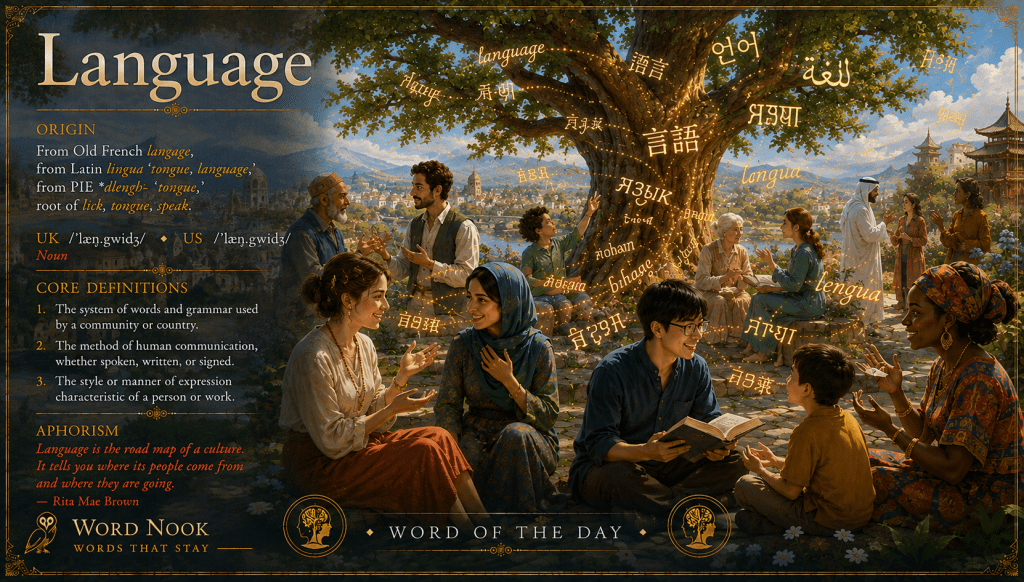
Language
IPA Pronunciation: /ˈlæŋ.ɡwɪdʒ/
Part of Speech: Noun
Origin
Language belongs to the vocabularies of communication, identity, culture, and thought. It refers to a structured system of sounds, signs, or symbols through which people express meaning and understand one another.
Yet language is more than a tool for exchanging information.
It carries memory, humour, authority, affection, insult, ritual, belonging, and history. Through language, people name the world they inherit and describe worlds that do not yet exist.
A language may belong to millions or survive in the voices of only a few.
Each one offers its speakers a particular inheritance of sounds, patterns, expressions, and ways of making experience shareable.
Language is how one mind learns to leave something inside another.
Etymology
From Middle English: language
From Old French: langage
From Latin: lingua — tongue, speech, or language
The word originally connected speaking directly with the physical tongue.
That relationship survives in words such as linguistic, bilingual, and mother tongue.
Over time, language expanded beyond spoken communication to include writing, gesture, symbolic systems, and specialised forms of expression.
Its history begins with the body.
Its reach extends almost everywhere human meaning can travel.
Core Definitions
A System of Human Communication
A structured system of words, sounds, and grammatical patterns used by a community.
“Spanish and English are both widely spoken languages.”
The Use of Words or Expression
A particular style or manner of speaking or writing.
“The language of the poem is deliberately simple.”
A System of Signs or Symbols
Any organised means of communicating meaning.
“Mathematics is often described as a language.”
A Characteristic Mode of Expression
A recognisable way of communicating through gesture, art, movement, or behaviour.
“They understood the silent language of the stage.”
Explanation & Nuance
Language implies:
- Meaning shared through form
- Rules learned through use
- Community and inheritance
- The ability to express what is absent
It may be:
- Spoken — carried through sound
- Written — preserved through visible symbols
- Signed — expressed through gesture and movement
- Literary — shaped deliberately for artistic effect
- Technical — specialised vocabulary within a field
- Symbolic — communication beyond ordinary words
Unlike speech, language can exist without sound.
Unlike communication, it depends upon an organised system rather than any exchange of information.
Unlike vocabulary, it includes grammar, structure, sound, convention, and context.
Language does not merely attach names to things.
It allows relationships between things to become thinkable.
Cultural & Intellectual Dimension
Every language carries traces of the people who have used it.
Within its words may survive:
- Ancient occupations
- Lost technologies
- Religious beliefs
- Historical encounters
- Migration
- Landscape
- Social customs
- Borrowings from neighbouring cultures
Languages constantly change.
Pronunciations shift. Meanings expand or disappear. New words enter. Old forms survive in expressions whose origins speakers may no longer recognise.
This makes language both inheritance and ongoing creation.
No generation receives a language unchanged.
Each one alters it simply by continuing to speak.
Language also shapes belonging. An accent, expression, or familiar phrase can reveal region, generation, profession, family, or community before a speaker explains anything about themselves.
Language & Thought
The relationship between language and thought has fascinated philosophers, linguists, and writers for centuries.
Words give abstract ideas stable forms.
Once something can be named, it can be discussed, questioned, remembered, taught, and challenged.
Yet thought also exceeds language.
People frequently know what they mean before finding the words capable of expressing it. Translation reveals the same difficulty: languages do not divide experience in identical ways, and a perfect equivalent may not always exist.
Language therefore both enables and limits expression.
It gives thought a vessel without becoming identical to thought itself.
Poetic & Literary Use
Language is the raw material of literature.
A painter works with colour.
A composer works with sound.
A writer works with words already used every day by everyone else.
The challenge is to make those familiar materials feel newly alive.
Language in literature may:
- Create rhythm
- Reveal character
- Conceal intention
- Build imaginary worlds
- Preserve unfamiliar voices
- Transform ordinary experience through metaphor
A single word can change the emotional temperature of an entire sentence.
A pause can alter meaning.
A repeated phrase can become memory.
Literature demonstrates that language does not merely carry meaning.
Its shape becomes part of the meaning.
Language in Literature
Few writers considered language more deeply than J. R. R. Tolkien, who was both a novelist and a philologist.
For Tolkien, invented languages were not decorations added after a fictional world had been created. Languages such as Quenya and Sindarin helped generate histories, peoples, myths, migrations, and relationships.
The language came with a world attached.
His work illustrates something fundamental: words carry assumptions about who speaks them, what they remember, and how they understand reality.
To invent a language convincingly is therefore to imagine a culture capable of speaking it.
Experiential Dimension
Language can evoke:
- Belonging — recognising the speech of home
- Curiosity — encountering an unfamiliar way of expression
- Frustration — knowing what one means without finding the words
- Intimacy — sharing expressions understood by only a few
- Power — naming, persuading, commanding, or defining
- Wonder — discovering that another language expresses an idea differently
It often becomes most visible when it fails, changes, or must cross from one person into another.
Symbolic Dimensions
- Tongue — spoken expression
- Alphabet — sound made visible
- Bridge — understanding between minds
- Rooted Tree — language growing through generations
- Open Book — preserved speech
- Untranslated Word — meaning resisting complete transfer
Language symbolizes communication, identity, memory, culture, and the human attempt to make inner experience shareable.
Synonyms & Near-Relations
- Speech — spoken expression
- Tongue — language associated with a people
- Communication — exchange of information
- Vocabulary — words available within a language
- Dialect — regional or social variety of a language
- Idiom — characteristic expression or linguistic form
- Discourse — connected language within a context
(Only language fully combines structure, communication, thought, culture, and the inherited systems through which meaning becomes shareable.)
Conceptual Relations
- Meaning — what language carries
- Thought — what it helps express
- Culture — what it preserves
- Voice — individual expression
- Memory — what it transmits
- Community — what keeps it alive
Takeaway
Language names the bridge built from invisible things—
the sound given meaning,
the thought given shape,
the experience carried
from one mind
into another.
It reminds us that words are inherited
but never merely received,
that every speaker changes
the language they continue,
and that entire cultures
may survive
inside ordinary phrases.
In literature, language is the world before the world appears—
the name before the character,
the rhythm before the journey,
the sentence that opens
and allows a reader
to enter somewhere
that existed first
only in another mind.
Language is how one mind learns to leave something inside another.

 Word Nook
Leave a comment