

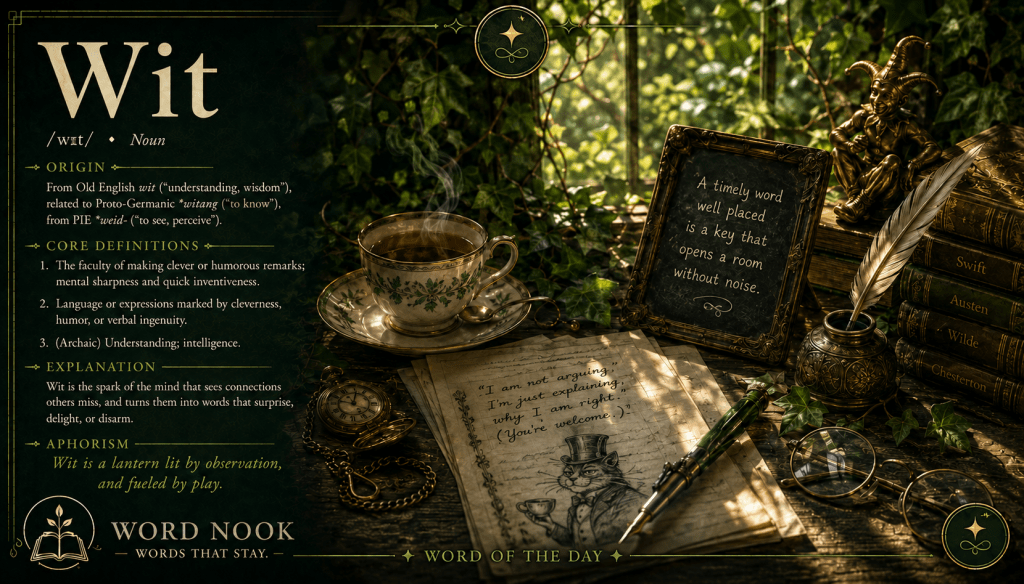
Wit
IPA Pronunciation: /wɪt/
Part of Speech: Noun
Origin
Wit belongs to the vocabularies of intelligence, language, humour, and social perception. It refers to the ability to think quickly, understand sharply, and express ideas with memorable cleverness.
Today, the word is especially associated with humour: a surprising remark, elegant comparison, or perfectly timed response that reveals intelligence through language.
Yet wit is more than the ability to make others laugh.
It depends upon noticing what others overlook, understanding the hidden shape of a situation, and finding the exact words capable of revealing it.
It suggests intelligence moving at conversational speed.
Wit is intelligence quick enough to turn truth into delight.
Etymology
From Old English: witt — understanding, intellect, knowledge, or consciousness
Related to witan — to know
The word belongs to an ancient Germanic family associated with knowing, seeing, and understanding.
Its earlier meanings were broader than modern usage. Wit could refer to the mind itself, intellectual ability, good judgment, or awareness.
Traces of those older senses remain in expressions such as:
- At one’s wits’ end
- To have the wit to act
- To lose one’s wits
- To live by one’s wits
Over time, the word became increasingly associated with quick, inventive intelligence, especially when expressed through language.
Core Definitions
Quick and Inventive Intelligence
The ability to think rapidly and respond with cleverness or insight.
“She relied upon her wit to escape the difficult conversation.”
Clever Humour
The talent for producing amusing remarks through unexpected connections, verbal precision, or intelligent observation.
“His wit made even serious discussions entertaining.”
A Witty Person
A person known for clever and amusing conversation.
“She was regarded as one of the finest wits of the age.”
Mental Faculties
In older expressions, the powers of thought, understanding, or judgment.
“He was frightened nearly out of his wits.”
Explanation & Nuance
Wit implies:
- Mental quickness
- Verbal precision
- Unexpected insight
- Awareness of timing
It may be:
- Playful — creating laughter
- Social — navigating conversation
- Literary — revealing truth elegantly
- Satirical — exposing foolishness
- Defensive — answering pressure without surrendering control
Unlike intelligence, wit must usually become visible in the moment.
Unlike humour, it depends strongly upon cleverness and perception.
Unlike sarcasm, it does not require cruelty or mockery.
Unlike a joke, wit may arise spontaneously from the situation rather than being prepared in advance.
Wit does not merely speak quickly.
It sees quickly.
Literary & Intellectual Dimension
Wit has long been prized in literature because it joins thought with style.
A witty line may:
- Expose hypocrisy
- Reverse an expectation
- Condense an argument
- Deflate vanity
- Reveal social tension
- Turn criticism into entertainment
In the literature of the Renaissance and Restoration, wit was often treated as a major intellectual virtue. It could refer not only to humour, but to imaginative ingenuity, verbal brilliance, and the ability to connect apparently distant ideas.
Writers such as William Shakespeare, Oscar Wilde, and Jane Austen used wit differently.
Shakespeare’s characters employ it in contests of language. Wilde turns social convention into polished paradox. Austen uses it to reveal character, vanity, self-deception, and the quiet absurdities of polite society.
In each case, wit allows truth to enter the room elegantly.
Poetic & Literary Use
Wit is a lively literary word.
A writer may use it directly:
“Her wit was quicker than his anger.”
or figuratively:
“The poem moved with the wit of a blade catching light.”
It often appears in writing about:
- Conversation
- Courtship
- Society
- Intelligence
- Satire
- Reputation
- Pride
- Language
- Rivalry
- Self-possession
Wit is especially powerful in dialogue because timing forms part of its meaning.
The same sentence spoken too early may seem forced.
Spoken too late, it loses its spark.
Wit belongs to the instant in which perception and language meet.
Experiential Dimension
Wit can evoke:
- Delight — recognising an unexpected connection
- Admiration — witnessing mental agility
- Surprise — hearing the perfect response
- Unease — realising one has been precisely understood
- Relief — using humour to loosen tension
It often feels like a window opening suddenly in conversation, allowing everyone to see the situation from a sharper angle.
Symbolic Dimensions
- Spark — sudden understanding
- Rapier — precision without brute force
- Mirror — truth revealed through reflection
- Raised Eyebrow — restrained amusement
- Chess Move — intelligence expressed through timing
- Candle Flame — brightness contained within a small gesture
Wit symbolizes mental agility, verbal elegance, social perception, and the power of language to reveal truth without becoming heavy.
Synonyms & Near-Relations
- Cleverness — quick mental ability
- Humour — capacity to amuse
- Repartee — rapid exchange of witty remarks
- Ingenuity — inventive intelligence
- Sharpness — keenness of perception
- Satire — humour used to expose weakness
- Wordplay — playful use of language
(Only wit fully combines quick perception, verbal invention, timing, humour, and the ability to reveal more than the words appear to say.)
Conceptual Relations
- Intelligence — underlying faculty
- Language — principal instrument
- Timing — essential condition
- Humour — frequent expression
- Perception — hidden source
- Truth — what wit often uncovers
Takeaway
Wit names the intelligence that arrives in time—
the swift perception,
the precise reply,
the truth made light enough
to enter conversation
without losing its edge.
It reminds us that cleverness is not merely speed,
that the finest humour begins
in attention,
and that a single sentence
may expose
what pages of explanation
could not.
In literature, wit is thought with perfect timing—
the raised eyebrow,
the polished answer,
the line that makes the room laugh
and then,
a moment later,
understand
why.
Wit is intelligence quick enough to turn truth into delight.

 Word Nook
Leave a comment