
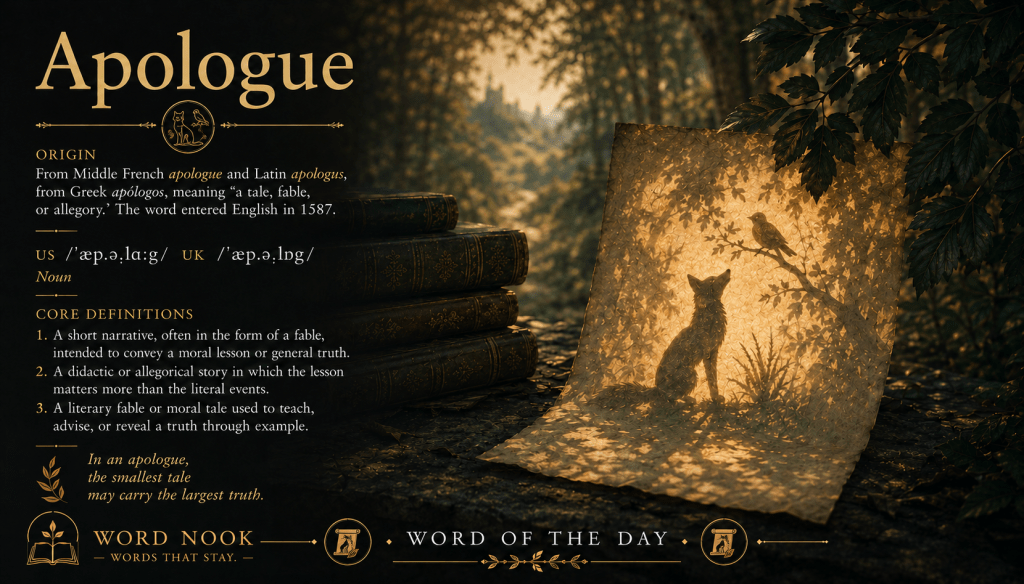
Apologue
IPA Pronunciation: /ˈæp.ə.lɒɡ/ (UK), /ˈæp.ə.lɔːɡ/ (US)
Part of Speech: Noun
Origin
Apologue belongs to the vocabularies of philosophy, rhetoric, literature, and moral storytelling. It refers to a brief allegorical narrative designed to illustrate a moral truth, philosophical insight, or practical lesson.
Unlike a simple anecdote, an apologue is intentionally didactic. Unlike a fable, it is not limited to animals or fantastical characters. It is a story whose chief purpose is to illuminate an idea.
It suggests that wisdom often travels farther through narrative than through argument.
An apologue is an idea wearing the shape of a story.
Etymology
From French: apologue
From Late Latin: apologus
From Greek: apólogos (ἀπόλογος) — story, fable, narrative
The Greek word combines:
- apo- — away, forth
- logos — speech, discourse, account
The term entered English in the 16th century, particularly in discussions of classical rhetoric and moral literature.
Core Definitions
A Moral or Philosophical Story
A short narrative intended to teach a lesson or illustrate an abstract truth.
“The teacher opened the lecture with an apologue.”
An Allegorical Narrative
A story whose characters or events symbolize broader ethical or philosophical principles.
Explanation & Nuance
Apologue differs from related narrative forms.
It implies:
- A deliberate instructional purpose
- Narrative serving philosophy
- Symbolic meaning
- Intellectual reflection
It may be:
- Literary — moral tales
- Philosophical — illustrative narratives
- Religious — ethical instruction
- Political — allegorical critique
Unlike a parable, which often leaves its meaning open to interpretation, an apologue usually has a clearer argumentative or instructional purpose.
Unlike a fable, it need not rely upon talking animals or personified creatures.
An apologue does not merely contain an idea.
The story exists in order to reveal it.
Literary Dimension
Apologues appear throughout world literature.
They include:
- Philosophical anecdotes
- Religious teaching stories
- Political allegories
- Moral narratives
- Instructional tales
Many classical and Enlightenment writers favored the apologue because it allowed difficult ideas to be conveyed through memorable narratives rather than abstract reasoning.
Its strength lies in compression: a brief sequence of characters, choices, and consequences may contain an entire philosophy.
Poetic & Literary Use
Apologue is a distinctly literary and scholarly word.
A writer may use it literally:
“The old monk ended with an apologue.”
or metaphorically:
“The journey itself became an apologue about patience.”
It often appears in writing about:
- Wisdom
- Ethics
- Education
- Religion
- Politics
- Memory
- Storytelling
- Reflection
- Truth
- Human nature
Unlike story, apologue immediately signals that the narrative carries an intellectual purpose.
Its plot is never the whole point.
Apologue in Literature
Although the word itself is relatively uncommon today, the form remains influential.
Works by writers such as Voltaire, Leo Tolstoy, and Jorge Luis Borges often employ apologue-like structures: concise narratives that illuminate philosophical questions through symbolic situations rather than direct exposition.
Modern literature continues to use the form whenever a narrative becomes a vehicle for thought.
An apologue may be fictional, historical, religious, political, or philosophical.
What defines it is not its setting, but the idea toward which the story quietly leads.
Experiential Dimension
An apologue can evoke:
- Reflection — reconsidering familiar ideas
- Insight — sudden understanding
- Curiosity — uncovering hidden meanings
- Humility — recognizing deeper truths
- Admiration — elegance of concise wisdom
It often feels like a conversation that continues long after the final sentence.
Symbolic Dimensions
- Traveler — the seeker of wisdom
- Crossroads — moral choice
- Mirror — self-knowledge
- Lamp — enlightenment
- Bridge — passage from experience to understanding
Apologue symbolizes wisdom, ethical inquiry, philosophical imagination, and the enduring power of narrative to shape thought.
Synonyms & Near-Relations
- Parable — moral or spiritual story
- Fable — moral tale, often featuring animals
- Allegory — sustained symbolic narrative
- Exemplum — illustrative anecdote or moral example
- Anecdote — brief narrative
(Only apologue fully combines philosophical instruction, literary elegance, and concise allegorical storytelling.)
Conceptual Relations
- Story — defining form
- Wisdom — central purpose
- Allegory — principal technique
- Philosophy — intellectual context
- Reflection — intended effect
Cultural & Intellectual Resonance
Literature
The apologue occupies a distinctive place between fiction and philosophy, demonstrating that stories can carry ideas with a force that abstract argument often cannot.
Rhetoric
For centuries, speakers and writers have used apologues to persuade through illustration rather than assertion.
Philosophy
Many philosophical traditions—from ancient Greece to classical China—have relied upon short narratives to communicate complex insights in memorable form.
Poetry
Though uncommon as a poetic subject, the apologue embodies poetry’s broader ambition: to compress profound truths into forms that engage both imagination and intellect.
Takeaway
Apologue names the story that reasons through imagination—
the brief narrative
whose true subject
is not its characters,
but the truth they reveal.
It reminds us that ideas are often remembered
not as propositions,
but as journeys,
encounters,
and choices,
and that wisdom
frequently arrives
wearing the quiet disguise
of a tale.
In poetry and philosophy alike, an apologue is thought made memorable—
a small story
that opens into a larger truth,
inviting the reader
not merely to follow a plot,
but to discover
a different way
of seeing the world.
An apologue is an idea wearing the shape of a story.

 Word Nook
Leave a comment