

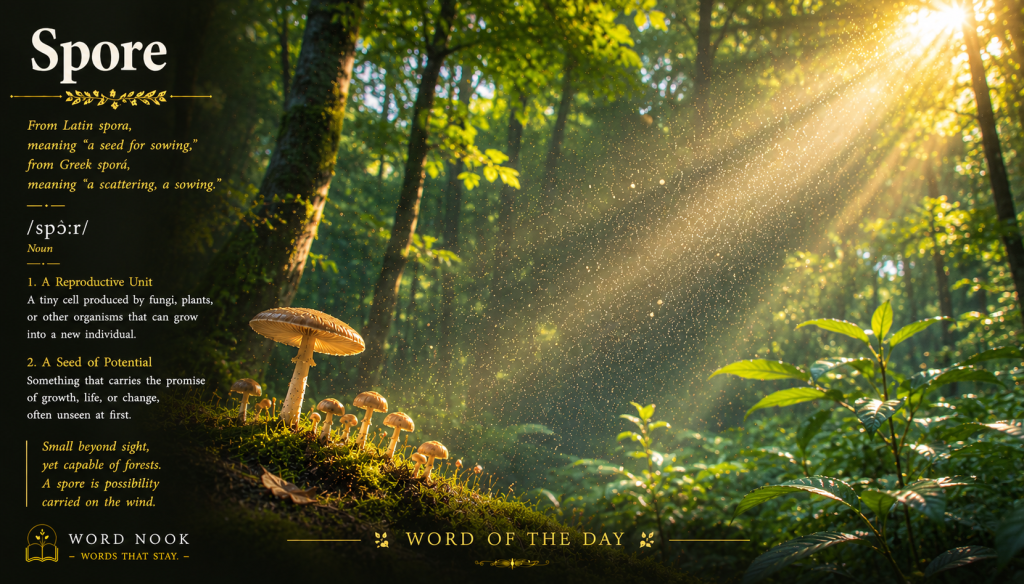
Spore
IPA Pronunciation: /spɔːr/ (UK), /spɔːr/ or /spɔr/ (US)
Part of Speech: Noun
Origin
Spore belongs to the vocabularies of growth, dispersal, potential, and unseen beginnings. It refers to a microscopic reproductive unit produced by fungi, mosses, ferns, algae, and some bacteria, capable of developing into a new organism under suitable conditions.
It suggests possibility condensed to its smallest form: life carried as potential rather than presence.
A spore is a future waiting for conditions.
Etymology
From Greek: spora (σπορά) — sowing, seed, act of scattering seed
Related to the idea of dispersal and propagation.
The word preserves the image of life being cast outward in hopes of finding a place to grow.
Core Definitions
A Reproductive Cell
A microscopic structure capable of developing into a new organism without fertilization.
“Millions of spores drifted from the mushroom.”
A Unit of Dispersed Potential
In metaphorical use, a small source from which larger developments may emerge.
Explanation & Nuance
Spore differs from seed.
It implies:
- Microscopic scale
- Extraordinary numbers
- Dispersal by wind, water, or animals
- Dormancy followed by growth
It may be:
- Biological — fungal, fern, or moss reproduction
- Ecological — colonization of new environments
- Poetic — latent possibilities
- Symbolic — beginnings too small to notice
A spore is often invisible, yet capable of creating entire forests, colonies, or ecosystems.
Natural Dimension
Spores are produced by:
- Fungi
- Mushrooms
- Ferns
- Mosses
- Certain algae and bacteria
They travel through:
- Air currents
- Rainfall
- Animal movement
- Waterways
They create:
- New growth
- Ecological succession
- Colonization of empty spaces
- Continuity across generations
A single spore may travel vast distances before finding suitable conditions.
Poetic & Literary Use
Spore is deeply poetic because it embodies hidden possibility.
A poet may use it literally:
“Golden spores drifted through the forest light.”
or metaphorically:
“A spore of doubt settled in his mind.”
It often appears in writing about:
- Potential
- Transformation
- Beginnings
- Memory
- Ideas
- Influence
- Spread and diffusion
- Chance
- Persistence
- Renewal
Unlike seed, spore feels smaller, lighter, and more elusive.
It belongs to invisibility.
Experiential Dimension
A spore can evoke:
- Wonder — immense potential in tiny forms
- Humility — life’s scale beyond human perception
- Curiosity — hidden processes of growth
- Hope — possibility awaiting its moment
- Mystery — unseen movement through the world
It often feels like the smallest imaginable beginning.
Symbolic Dimensions
- Airborne Spore — possibility carried by chance
- Dormancy — waiting for the right conditions
- Forest Fungus — hidden networks of life
- Microscopic Particle — unseen influence
- New Colony — growth from a tiny origin
Spore symbolizes latent potential, dissemination, resilience, and the power of small beginnings.
Synonyms & Near-Relations
- Seed — larger reproductive structure
- Pollen — plant reproductive particle
- Propagule — reproductive unit capable of growth
- Embryo — early developmental stage
- Germ — initial source of development or growth
(Only spore fully combines microscopic scale, dispersal, dormancy, and transformative potential.)
Conceptual Relations
- Potential — defining symbolic quality
- Dispersal — primary mode of movement
- Growth — eventual outcome
- Dormancy — period of waiting
- Renewal — ecological and metaphorical consequence
Cultural & Intellectual Resonance
Poetry
Spores often symbolize ideas, memories, and possibilities spreading beyond immediate awareness.
Ecology
They are among nature’s most successful strategies for persistence and colonization.
Science
Spores reveal how life can survive extreme conditions and travel extraordinary distances.
Philosophy
The spore reflects the idea that significant change often begins in forms too small to notice.
Takeaway
Spore names life reduced to possibility —
the microscopic traveler
carried by wind,
water,
and chance.
It reminds us that beginnings are not always visible,
that growth often starts long before it is recognized,
and that the smallest things
may contain the largest futures.
In poetry, a spore is a fragment of tomorrow —
the dust-like promise drifting through a shaft of light,
the invisible seed of transformation,
the tiny vessel
through which life
extends itself
into the unknown.
The smallest beginnings often carry the largest futures.


 Word Nook
Leave a comment