

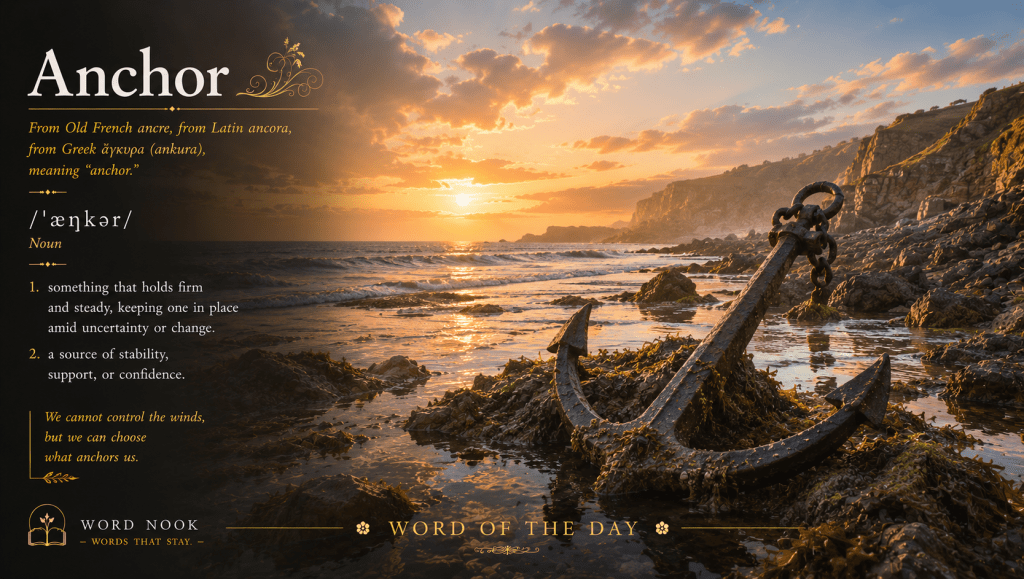
Anchor
IPA Pronunciation: /ˈæŋ.kər/
Part of Speech: Noun & Verb
Origin
Anchor belongs to the vocabularies of ships, stability, grounding, and security. It refers to a heavy device lowered from a vessel to grip the seabed and prevent drifting. By extension, it has become one of English’s most powerful metaphors for steadiness amid uncertainty.
It suggests resistance to unwanted movement: the force that holds when everything else is shifting.
An anchor is stability made tangible.
Etymology
From Old English: ancor
From Latin: ancora
From Greek: ankýra — anchor
The word has traveled through maritime cultures for over two millennia, carrying remarkably consistent associations with holding, securing, and remaining fast.
Core Definitions
Nautical Device
A weighted object attached to a ship by rope or chain, used to prevent drifting.
“The anchor dropped into the harbor.”
Source of Stability
A person, belief, place, habit, or principle that provides steadiness.
“Her family was her anchor.”
(Verb) To Secure or Stabilize
“The boat anchored near the shore.”
“His values anchored him during difficult times.”
Explanation & Nuance
Anchor differs from support or foundation.
It implies:
- Holding against movement
- Security amid uncertainty
- Connection to something deeper
- Resistance to drift
It may be:
- Physical — maritime equipment
- Emotional — relationships and commitments
- Psychological — habits, routines, identity
- Philosophical — principles that provide orientation
- Poetic — anything that keeps one from being swept away
An anchor is not merely support.
It specifically acts against displacement.
Natural Dimension
The anchor belongs to:
- Harbors
- Coastlines
- Ships and boats
- Ocean travel
- Maritime life
It creates:
- Stillness amid currents
- Security amid changing tides
- Temporary permanence
- Connection between vessel and seabed
The image is powerful because it joins surface motion to hidden depth.
Poetic & Literary Use
Anchor is deeply poetic because it transforms a practical object into a symbol of human endurance.
A poet may use it literally:
“The anchor vanished beneath dark water.”
or metaphorically:
“Memory became the anchor that held him.”
It often appears in writing about:
- Belonging
- Home
- Love
- Faith
- Identity
- Commitment
- Resilience
- Navigation through hardship
- The sea
- Loss and recovery
Unlike foundation, anchor emphasizes holding amid movement rather than permanence alone.
Anchor in Poetry
Anchor is one of the most enduring symbols in English poetry.
It frequently represents:
- Hope that endures uncertainty
- Emotional grounding
- Faith during adversity
- Loyalty and commitment
- The tension between freedom and security
A ship without an anchor may drift.
A life without an anchor may do the same.
This image appears from ancient maritime verse through modern poetry.
Experiential Dimension
An anchor can evoke:
- Safety — assurance against drifting
- Trust — confidence in what holds firm
- Relief — stability after turbulence
- Dependence — connection to sustaining forces
- Responsibility — choosing what one remains attached to
It often feels like finding something that remains steady when circumstances do not.
Symbolic Dimensions
- Anchor in Seabed — connection to deeper realities
- Harbor Anchor — rest after a journey
- Chain and Rope — bonds of commitment
- Storm-Anchored Ship — endurance under pressure
- Raised Anchor — departure and change
Anchor symbolizes stability, faithfulness, grounding, and the ability to remain secure amid uncertainty.
Synonyms & Near-Relations
- Foundation — supporting base
- Mooring — means of securing a vessel
- Support — source of assistance
- Root — source of connection and stability
- Tether — attachment preventing drift
(Only anchor fully combines stability, resistance to movement, maritime imagery, and emotional grounding.)
Conceptual Relations
- Harbor — common setting for anchors
- Depth — what gives the anchor its hold
- Drift — condition the anchor prevents
- Commitment — human analogue of anchoring
- Security — desired outcome of anchoring
Cultural & Intellectual Resonance
Poetry
Anchors often symbolize hope, fidelity, and perseverance.
Maritime Tradition
For centuries, anchors have represented safety and survival at sea.
Religion
In many traditions, the anchor symbolizes steadfast faith and enduring hope.
Philosophy
The anchor raises questions about what grounds a person in a changing world.
Takeaway
Anchor names the thing that holds fast —
the weight beneath the water,
the connection to depth,
the force that resists drift.
It reminds us that movement alone is not enough,
that stability has its own value,
and that endurance often depends on what we choose to remain attached to.
In poetry, an anchor is the unseen hold beneath the waves —
the iron resting on the seabed,
the promise that survives the storm,
the quiet certainty
that keeps a vessel,
or a life,
from being carried away.
An anchor is stability made tangible.

 Word Nook
Leave a comment