

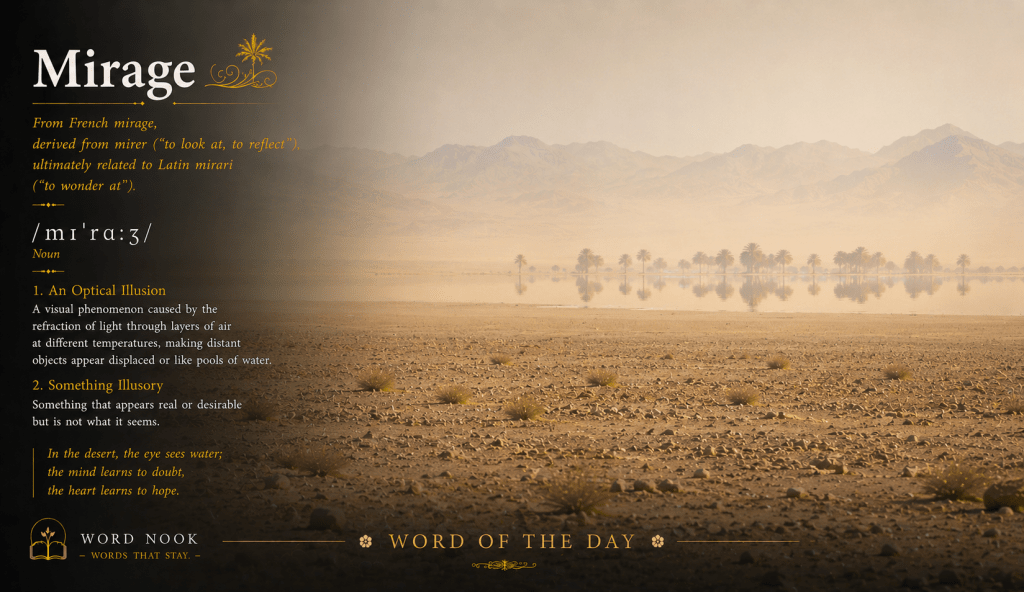
Mirage
IPA Pronunciation: /mɪˈrɑːʒ/
Part of Speech: Noun
Origin
Mirage belongs to the vocabularies of light, illusion, distance, and desire. It refers to an optical phenomenon in which atmospheric conditions bend light, causing distant objects, water, or landscapes to appear where they are not.
It suggests the meeting point of reality and perception: something seen clearly but not truly present.
A mirage is vision deceived by its own certainty.
Etymology
From French: mirage
From mirer — to look at, to reflect
The word emerged in descriptions of desert phenomena, where heat and light create the appearance of water on the horizon.
Its roots are connected to looking, reflection, and visual appearance.
Core Definitions
An Optical Illusion
A visual effect caused by the refraction of light through layers of air at different temperatures.
“A shimmering mirage appeared across the desert.”
Something Illusory or Unattainable
A hope, belief, or goal that seems real but proves unreachable.
“The promise of easy success was a mirage.”
Explanation & Nuance
Mirage differs from hallucination or dream.
It implies:
- A basis in real perception
- Visual plausibility
- Distance and uncertainty
- Mistaken interpretation of reality
It may be:
- Meteorological — apparent water or displaced landscapes
- Psychological — mistaken hopes or expectations
- Philosophical — questions about perception and reality
- Poetic — longing for what cannot be possessed
A mirage is not imagined from nothing.
It is reality rearranged by conditions.
Natural Dimension
Mirages commonly appear in:
- Deserts
- Hot roads
- Salt flats
- Polar regions (in different forms)
- Open horizons
They create:
- Apparent lakes
- Floating objects
- Distorted landscapes
- Shimmering horizons
The phenomenon reveals that seeing and understanding are not the same thing.
Poetic & Literary Use
Mirage is deeply poetic because it transforms desire into landscape.
A poet may use it literally:
“A mirage trembled above the dunes.”
or metaphorically:
“Happiness became a mirage on the horizon of his ambitions.”
It often appears in writing about:
- Longing
- Hope
- Illusion
- Love
- Memory
- Expectation
- Distance
- Disappointment
- Perception
- The nature of reality
Unlike illusion, mirage retains a sense of physical beauty and atmospheric mystery.
Experiential Dimension
A mirage can evoke:
- Wonder — seeing the impossible appear real
- Frustration — pursuing what vanishes upon approach
- Curiosity — questioning perception
- Melancholy — unattainable desires
- Awe — recognition of nature’s visual power
It often feels like certainty dissolving under scrutiny.
Symbolic Dimensions
- Desert Water — hope that cannot be reached
- Shimmering Horizon — uncertain futures
- Distorted Reflection — imperfect perception
- Distant Landscape — unattainable desire
- Heat Waves — conditions that alter understanding
Mirage symbolizes illusion, yearning, misperception, and the human tendency to project wishes onto the world.
Synonyms & Near-Relations
- Illusion — deceptive appearance
- Phantasm — ghostly or unreal vision
- Hallucination — perception without external stimulus
- Vision — sight or imagined image
- Reflection — visual appearance created by light
(Only mirage fully combines atmospheric reality, visual deception, distance, and longing.)
Conceptual Relations
- Perception — faculty through which mirages arise
- Light — physical cause of the phenomenon
- Distance — common setting for mirages
- Desire — emotional parallel to the image
- Reality — what the mirage complicates
Cultural & Intellectual Resonance
Poetry
Mirages often symbolize impossible hopes, romantic longing, and the uncertainty of perception.
Literature
The word frequently appears in stories of journeys, quests, and unattainable goals.
Science
Mirages demonstrate how environmental conditions influence visual experience.
Philosophy
The mirage has long served as a metaphor for the gap between appearance and reality.
Takeaway
Mirage names the thing that appears
because conditions make it seem possible —
the water that is not water,
the destination that retreats as one approaches.
It reminds us that perception is powerful but imperfect,
that desire can shape what we think we see,
and that beauty is not diminished
simply because it proves elusive.
In poetry, a mirage is the shimmer at the edge of certainty —
the lake suspended above desert sand,
the dream visible on the horizon,
the radiant apparition
where hope,
vision,
and illusion
briefly become one.
A mirage is vision deceived by its own certainty.


 Word Nook
Leave a comment