

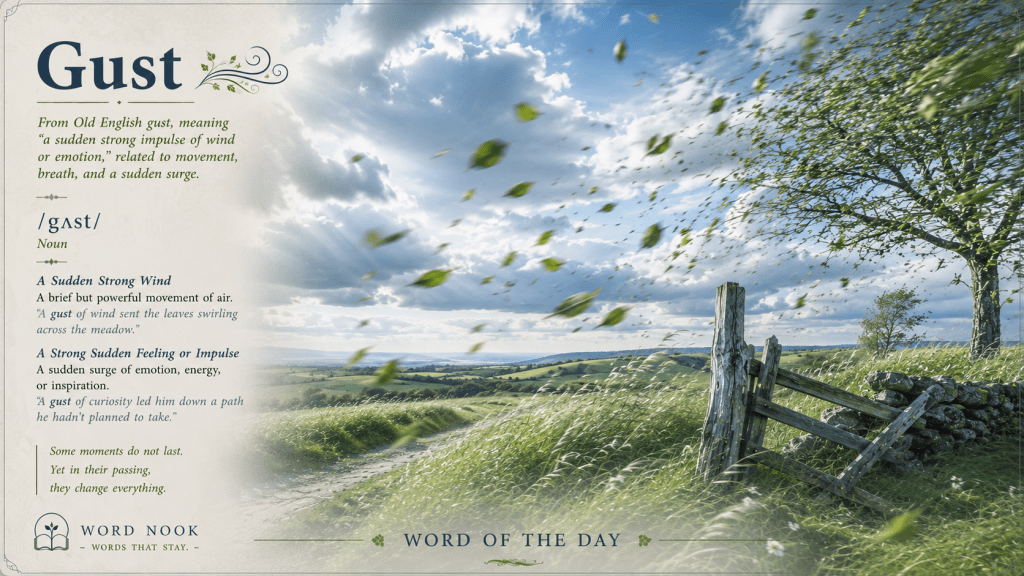
Gust
IPA Pronunciation: /ɡʌst/
Part of Speech: Noun & Verb
Origin
Gust belongs to the vocabularies of wind, suddenness, energy, and interruption. It refers to a brief, strong burst of wind, often arriving unexpectedly and passing just as quickly.
It suggests force concentrated into a moment: movement that appears abruptly, alters its surroundings, and disappears.
A gust is wind in an instant of emphasis.
Etymology
From Old Norse: gustr — a cold blast, gust of wind
The word entered English through Germanic and Scandinavian influences, preserving the sense of a sudden rush of air.
Core Definitions
A Sudden Strong Rush of Wind
A brief increase in wind speed.
“A gust scattered leaves across the road.”
(Verb) To Blow in Bursts
“The wind gusted throughout the afternoon.”
Explanation & Nuance
Gust differs from breeze or gale.
It implies:
- Suddenness rather than duration
- Interruption rather than continuity
- Concentrated force
- Momentary impact
It may be:
- Meteorological — bursts of wind during changing weather
- Physical — movement of air through streets, valleys, or forests
- Emotional — sudden surges of feeling
- Poetic — brief intensifications of life, memory, or change
A gust arrives before one fully notices its approach.
Natural Dimension
Gusts occur in:
- Thunderstorms
- Mountain passes
- Coastal weather systems
- Forest clearings
- Urban streets between buildings
They create:
- Rustling leaves
- Billowing fabric
- Shifting clouds
- Brief turbulence
- Unexpected movement
Unlike a gale, a gust is transient.
Its power lies in its brevity.
Poetic & Literary Use
Gust is deeply poetic because it captures change compressed into an instant.
A poet may use it literally:
“A gust rattled the bare branches.”
or metaphorically:
“A gust of laughter broke the silence.”
It often appears in writing about:
- Weather
- Memory
- Emotion
- Surprise
- Change
- Freedom
- Restlessness
- Autumn
- Movement
- Epiphany
Unlike wind, gust focuses on the sudden arrival of force.
It is the punctuation mark of the atmosphere.
Experiential Dimension
A gust can evoke:
- Surprise — unexpected movement
- Excitement — sudden energy
- Vulnerability — brief loss of stability
- Freedom — contact with untamed air
- Awareness — heightened attention to the present moment
It often feels like the world touching you unexpectedly.
Symbolic Dimensions
- Scattered Leaves — impermanence and change
- Billowing Cloak — sudden motion and adventure
- Opening Door — unexpected opportunity
- Wind Through Grass — fleeting influence
- Sharp Air Current — awakening and disruption
Gust symbolizes spontaneity, interruption, vitality, and the brief forces that alter a moment’s course.
Synonyms & Near-Relations
- Breeze — gentle wind
- Gale — strong sustained wind
- Blast — powerful rush of air
- Squall — sudden increase in wind, often with weather changes
- Draft — localized current of air
(Only gust fully combines brevity, suddenness, and concentrated atmospheric force.)
Conceptual Relations
- Wind — broader phenomenon of which a gust is a momentary form
- Movement — defining characteristic
- Surprise — common experiential quality
- Change — immediate effect
- Ephemerality — short-lived nature
Cultural & Intellectual Resonance
Poetry
Gusts often symbolize sudden thoughts, emotions, inspirations, or disruptions.
Literature
They frequently mark transitions, arrivals, and shifts in mood.
Meteorology
Gusts reveal the dynamic instability within atmospheric systems.
Philosophy
The gust reflects how small, brief forces can alter experience far more than steady conditions.
Takeaway
Gust names the moment when wind gathers itself —
the brief rush
that bends grass,
stirs leaves,
and passes on.
It reminds us that not all power is sustained,
that some changes arrive suddenly,
and that even fleeting forces
can leave visible traces.
In poetry, a gust is the atmosphere’s quick gesture —
the burst of air through autumn trees,
the sudden stirring of a still afternoon,
the passing movement
that reminds us
how quickly
the world can change.
A gust is wind in an instant of emphasis.

 Word Nook
Leave a comment