
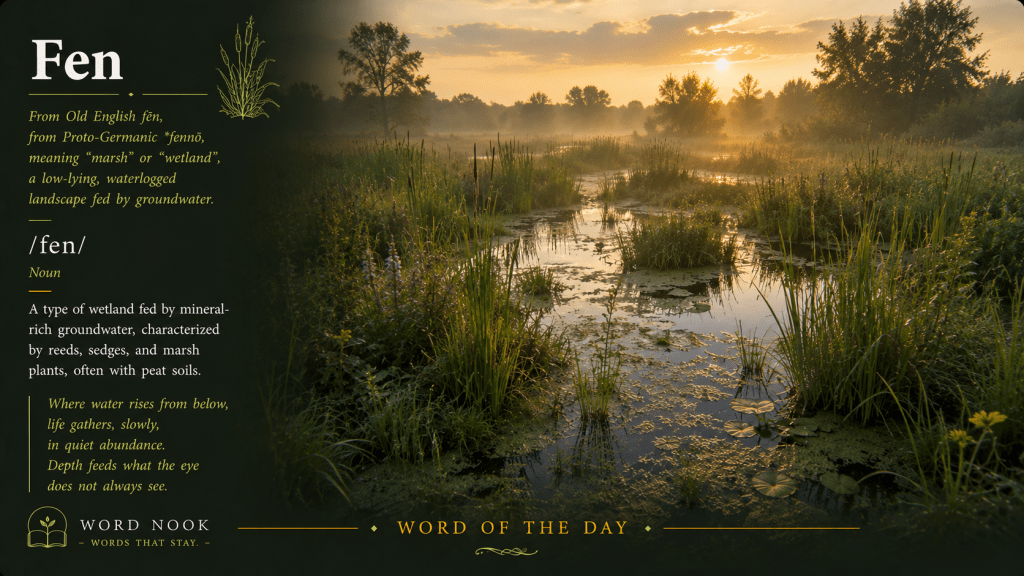
Fen
IPA Pronunciation: /fɛn/
Part of Speech: Noun
Origin
Fen belongs to the vocabularies of wetlands, reeds, mist, and quiet expanses. It refers to a type of low-lying marshy land, often fed by groundwater and characterized by sedges, reeds, grasses, and slow-moving water.
It suggests a landscape neither fully land nor fully water: a place of subtle boundaries, soft horizons, and patient ecological richness.
A fen is a wetland of quiet transitions.
Etymology
From Old English: fenn — marsh, bog, mud, wetland
The word has existed in English since its earliest stages and remains closely tied to the marshlands of eastern England, particularly the region known as the Fens.
Core Definitions
A Marshy Wetland
Low-lying ground saturated with water, often supporting reeds, sedges, and specialized plant communities.
“Mist hung above the fen at sunrise.”
A Landscape of Water and Grass
In literary use, fen often evokes stillness, remoteness, mystery, and ecological abundance.
Explanation & Nuance
Fen differs from bog or swamp.
It implies:
Open wetland rather than forested wetland
Groundwater-fed ecosystems
Subtle movement of water
Broad horizons and low vegetation
It may be:
Ecological — marshes, sedge meadows, reedbeds
Geographical — low-lying wet landscapes
Poetic — places of quiet ambiguity and reflection
Symbolic — thresholds between solidity and fluidity
A fen feels more open than a swamp and more alive than a bog.
Natural Dimension
Fens are characterized by:
Reeds and sedges
Shallow water channels
Peaty soils
Water birds
Mists and low horizons
They create:
Biodiversity
Soft textures
Reflections
Quiet movement
Seasonal transformation
Water is always present in a fen, even when not immediately visible.
Poetic & Literary Use
Fen is deeply poetic because it transforms ambiguity into landscape.
A poet may use it literally:
“Herons rose from the fen at dawn.”
Or metaphorically:
“He wandered through the fen of old memories.”
It often appears in writing about:
Mist
Solitude
Wildness
Thresholds
Silence
Birdlife
Ancient landscapes
Memory
Stillness
Transformation
Unlike marsh, fen feels older, quieter, and more literary.
It carries an atmosphere of patient persistence.
Experiential Dimension
A fen can evoke:
Stillness — water moving almost imperceptibly
Mystery — landscapes softened by mist
Calm — broad open horizons
Isolation — distance from settled places
Wonder — life flourishing in subtle conditions
It often feels like standing inside a landscape that prefers quiet.
Symbolic Dimensions
Reedbed — resilience and flexibility
Mist Over Water — uncertainty and possibility
Hidden Channels — unseen movement beneath stillness
Wet Ground — instability and transformation
Water Birds — life emerging from silence
Fen symbolizes transition, subtle vitality, and the richness that develops in places between categories.
Synonyms & Near-Relations
Marsh — general wetland
Bog — acidic peat-forming wetland
Swamp — forested wetland
Moor — open uncultivated upland, often drier and higher
Wetland — broad ecological category
Only fen fully combines open marshland, groundwater-fed richness, quiet horizons, and literary atmospheric depth.
Conceptual Relations
Water — defining element of the fen
Reeds — iconic vegetation
Mist — common atmospheric companion
Threshold — space between land and water
Stillness — characteristic emotional quality
Cultural & Intellectual Resonance
Poetry
Fens often symbolize mystery, memory, transition, and quiet endurance.
History
The English Fens shaped settlement, agriculture, and regional identity for centuries.
Ecology
Fens are among the most biologically diverse wetland habitats.
Philosophy
The fen reflects how life often thrives in intermediate states rather than fixed categories.
Takeaway
Fen names the landscape where water lingers in the earth —
the reed-filled expanse
between firmness and flow.
It reminds us that boundaries are often gradual,
that richness may arise from subtle conditions,
and that some of the world’s most vibrant places
are those that resist easy definition.
In poetry, fen is the country of reeds and mist —
the quiet wetland beneath a pale sky,
the hidden channels threading through grass,
the living threshold
where land and water
remain gently,
endlessly,
in conversation.
Fen is the landscape between land and water—a place of reeds, mist, quiet richness, and endless transition.

 Word Nook
Leave a comment