

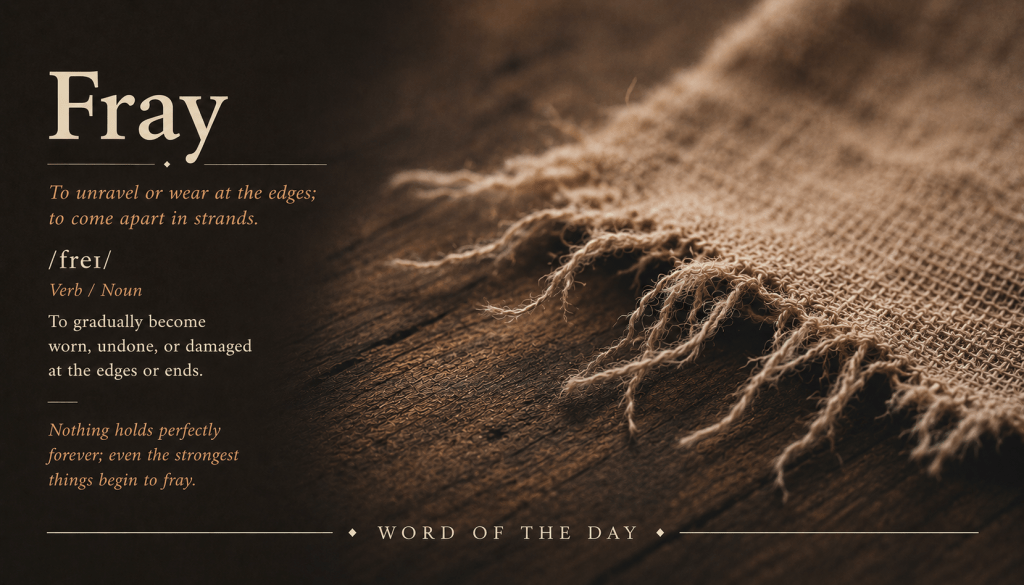
Fray
IPA Pronunciation: /freɪ/
Part of Speech: Verb & Noun
Origin
Fray belongs to the vocabularies of unraveling, tension, wear, and disorder. It refers to the loosening of threads at the edge of cloth — and, more broadly, to anything that begins to wear thin, break apart, or lose coherence under strain.
It suggests damage that happens gradually: not sudden breaking, but slow unraveling.
To fray is to come apart at the edges.
Etymology
From Old French: frayer — to rub, wear away
Related to the idea of abrasion through repeated contact.
The word preserves the sense of deterioration through friction and use.
Core Definitions
To Unravel at the Edge
To become worn so that threads separate.
“The cuffs began to fray.”
To Wear Thin Emotionally or Socially
To weaken through stress or tension.
“Nerves began to fray.”
(Noun) Conflict or Struggle
Less common: a noisy fight or active conflict.
“He entered the fray.”
Explanation & Nuance
Fray differs from break or tear.
It implies:
Gradual damage rather than sudden rupture
Edges rather than total collapse
Stress accumulated over time
It may be:
Physical — cloth, rope, paper
Emotional — patience, nerves, trust
Social — relationships, order, stability
Poetic — the slow unraveling of certainty or self
Fray belongs to what weakens before it fails.
Material Dimension
Fraying appears in:
Fabric worn by repeated use
Rope thinning under tension
Pages softening at the corners
Old banners unraveling in wind
It reflects:
Time
Friction
Exposure
Fragility becoming visible
The object does not disappear at once — it loosens first.
Poetic & Literary Use
Fray is deeply poetic because it makes emotional erosion visible through physical image.
A poet may use it literally:
“The hem frayed in the salt wind.”
Or metaphorically:
“Our silence began to fray.”
It often appears in writing about:
Aging
Love
Memory
War
Exhaustion
Anxiety
Distance
Identity
Decay
Survival
Unlike break, fray feels intimate.
It is damage that happens slowly enough to be witnessed.
Experiential Dimension
Fray can evoke:
Fatigue — strength wearing thin
Anxiety — nerves stretched too far
Loss — gradual weakening of connection
Tenderness — beauty in worn edges
Inevitability — the slow truth of time
It often feels like collapse arriving quietly.
Symbolic Dimensions
Thread — continuity under strain
Hem — vulnerable boundary
Rope — tension and endurance
Paper Edge — fragility through handling
Nerve — invisible structure wearing thin
Fray symbolizes deterioration that begins where things meet the world.
Synonyms & Near-Relations
Unravel — come apart thread by thread
Wear — decline through use
Erode — gradual loss through pressure
Break — sudden separation
Decay — long-term deterioration
Only fray fully carries the sense of edge-wear, gradual unraveling, and intimate strain.
Conceptual Relations
Time — cause of gradual weakening
Tension — force producing wear
Fragility — revealed through use
Persistence — what remains while unraveling
Threshold — the edge where integrity begins to fail
Cultural & Intellectual Resonance
Poetry
Fraying often symbolizes emotional exhaustion, aging, and the fragility of bonds.
Psychology
Stress frays attention, patience, and resilience.
Material Culture
Worn objects gain emotional meaning through visible fraying.
Philosophy
It reflects how endings often begin at the edges, not the center.
Takeaway
Fray names the slow unraveling before the break —
the place where endurance becomes visible.
It reminds us that damage is often gradual,
that strain reveals itself first at the edges,
and that what wears thin
still carries the shape of what it once held.
In poetry, fray is the thread of time made visible —
the cuff,
the nerve,
the promise
beginning to loosen,
not yet broken,
but no longer whole.
Some things do not break at once. They fray at the edges first.

 Word Nook
Leave a comment